City of Tacoma Washington sent this bulletin at 08/07/2025 10:06 AM PDT
Hello District 4,
The City is committed to working towards a safe and livable community, especially as there has been an increase in the number of speeding and reckless driving concerns in the past few years. Drivers are more distracted and GPS navigation has led to detours through residential areas. Neighborhood traffic calming is a frequent concern I've been hearing throughout our district and one that I am taking very seriously.
Like many things, the primary issue we face is long-term sustainable funding for the system transformation needed for our Vision Zero goals. In the face of Proposition 1, the initiative aimed at funding crucial public infrastructure projects, failing on the ballot this spring, we now must take stock of how we move forward in service to community. Our primary concern now is that, without these dedicated funds, we will struggle to keep up with the infrastructure needs of our city and maintain the improvements achieved under the current Streets Initiative, which ends December 2025.
Despite this setback, I remain committed to addressing Tacoma’s infrastructure requirements. The City Council will be actively exploring all available options moving forward, including the possibility of bringing a revised funding measure back to the voters for consideration at an appropriate time in the future.
This enewsletter highlights how the City is leveraging the resources we have now to make an impact in District 4.
Sincerely,
Sandesh Sadalge Tacoma City Council Member, District 4
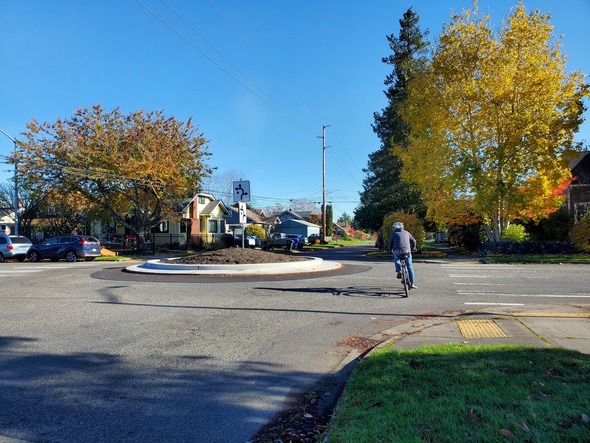
One of the most frequent requests I get as a City Council Member is to install a speed hump or a traffic circle. We all want our neighborhood streets to feel safe and welcoming, which means slower driving.
Neighborhood Traffic Calming can help promote safer transportation conditions on Tacoma’s neighborhood streets. The Neighborhood Traffic Calming Program(NTCP) has been established to receive and respond to residents’ questions and concerns regarding reducing vehicle speeds and/or cut-through volumes on non-arterial neighborhood streets. With limited annual funds and many requests and potential locations within the program’s purview, not all requests will result in mitigative actions. Instead, the program will rely on a transparent process developed to prioritize locations and to focus program-related efforts.
To submit your request for new traffic calming features like speed humps on your street, please call 311 or submit your request online through this link by following these steps:
Choose the location where you have concern. Please submit separate requests when you have concerns at multiple locations.
Select a Request Category: City of Tacoma – Public Works – Transportation – Neighborhood Traffic Calming.
Add a photo or choose “No Photo.”
Enter the details of your request.
Submit the Request.
I will keep championing funding for our traffic calming program so we can get to as many priority streets as possible.
May was bike month in the City of Tacoma. However, at the same time we encouraged community get out and bike, there were 4 car crashes involving bicyclists in Tacoma. As a community, everyone, especially drivers, must commit to making Tacoma a bike-friendly City.
According to the Tacoma-Pierce County Health Department (TPCHD), in Washington, car crashes happen about every five minutes. In 2015, more than 550 people died in car collisions and another 2,100 were seriously injured. All of these were preventable. TPCHD recommends all drivers prioritize safety when you get behind the wheel:
Don’t drive distracted.
Stay alert.
On long trips, stop frequently to move around and get fresh air.
Drive sober. Don’t drive if you are using alcohol, marijuana, drugs, or any medications that might make you sleepy.
Look for pedestrians and cyclists, especially when turning right.
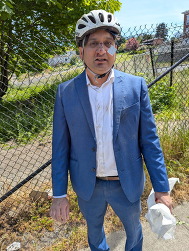
TPCHD also provides safety tips for bicyclists – first and foremost is to wear a helmet! This year I was in a bicycling accident. Wearing the helmet was the difference between scrapes and bruises and serious damage like a concussion.
Pierce County has a website that tells you where you can find a low-cost helmet. It lists public agencies and non-profit organizations that sell properly fitted bike and multi-sport helmets at very affordable prices, with most models priced at less than $12.
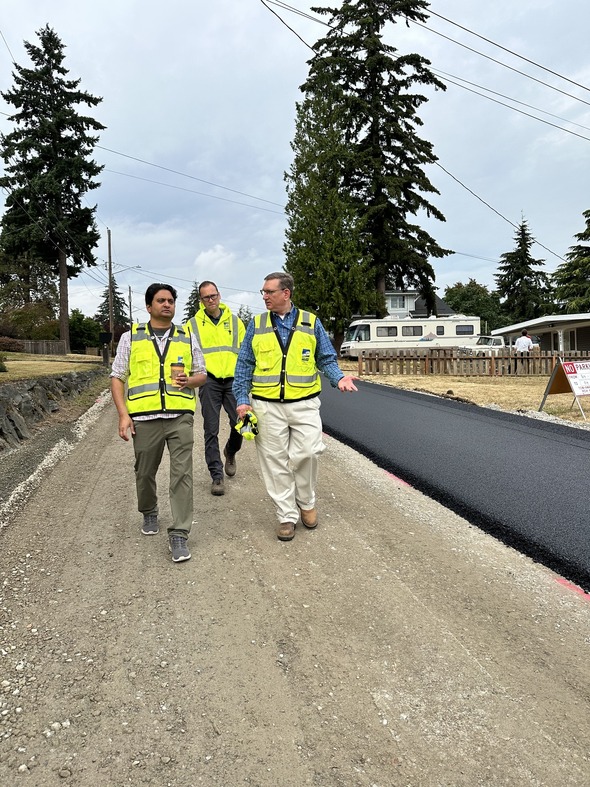
In 2015, Tacoma voters approved Proposition 3 and Proposition A. These measures raised funds through a tax increase set to expire in December 2025 and laid the foundation for the Tacoma Streets Initiative, which has effectively preserved and improved city streets through various capital and maintenance projects. I’ve had the opportunity to visit multiple construction sites and see firsthand how the City is investing in maintaining roads and sidewalks. In District 4, over 1,200 blocks were worked on thanks to funding from Streets Initiative 1. This is about 200 lane miles of streets, and just over half of District 4’s entire street network. While the Streets Initiative has improved conditions and put us in a better place, there is still more work to be done. Twenty percent of streets in our district are still in poor condition, and even the fair and good condition roads need ongoing maintenance to extend their life. Below are just a few of the projects happening now that I know are of high interest to our district. My role is to find sustainable funding sources so we can invest in more critical projects like these.
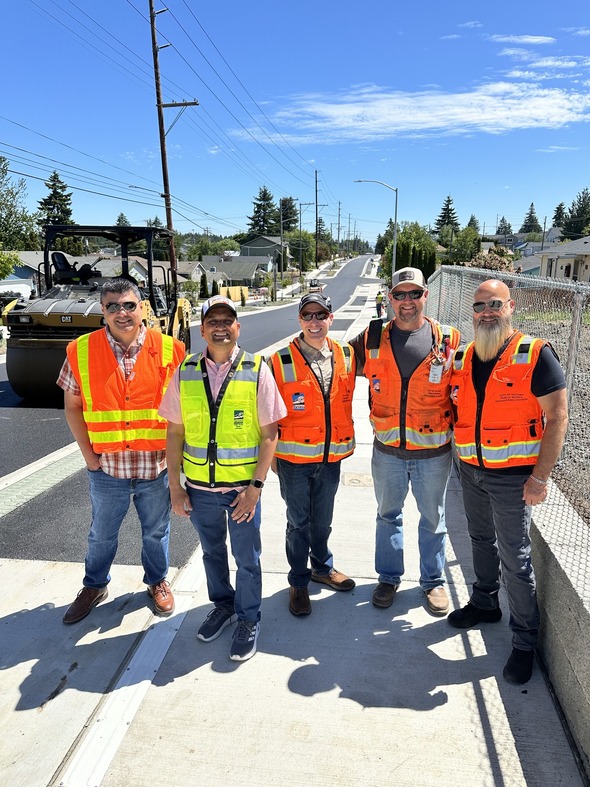
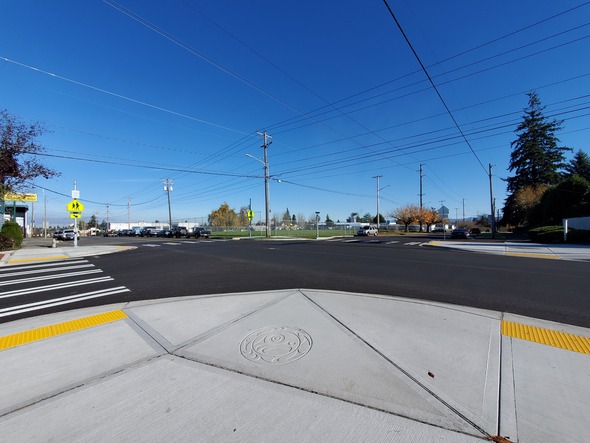
I had the amazing opportunity to join staff from our Public Works Engineering Division to see construction firsthand on the second phase of our East 64th Street project. This is part of a three-phase construction effort to improve multimodal transportation infrastructure along East 64th Street. Phase 1 between McKinley Avenue and Pacific Avenue is complete. Phase 2 will improve East 64th Street from McKinley Avenue East to Portland Avenue. Project improvements include replacing the road, adding bike lanes, replacing sidewalks and curb ramps with ramps meeting ADA standards, and upgrading the stormwater and illumination system. One additional segment is planned (Phase 3) from Portland Avenue to the City limits, and will be completed in future years.
This project will improve the surface of East Portland Avenue by repaving the street and upgrading curb ramps to meet ADA standards. A new pedestrian signal (HAWK beacon) will also be installed at East Portland Avenue and South 60th Street to make it safer for people to cross. Construction is expected to begin November of 2025.
This project will integrate the lights on McKinley Avenue to better move traffic down the McKinley corridor. Upgrades will include accessible pedestrian signals, improved signal detection, fiber optic communications, and a full reconstruction of the McKinley and 56th Street intersection.
This project will improve five intersections along McKinley Avenue:
38th and McKinley
40th and McKinley
48th and McKinley
56th and McKinley
64th and McKinley
One hundred percent of funding for this project is secured. Design began this spring and is projected to be complete in winter of 2025, with construction dates to be set.
This project will improve safety on Portland Avenue from East 27th to East 56th Street by slowing speeds and improving connectivity for people walking, rolling, and bicycling. Tacoma’s Vision Zero Action Plan uses a data-driven approach to set Tacoma’s path towards eliminating crashes that cause serious injuries or deaths by 2035. In addition to actions to improve safety citywide, the Plan identifies roadways that are the highest risk for serious injury & fatal collisions. Portland Avenue is one of these high-risk corridors. When completed, this work will compliment planned light rail and transit improvements and the planned regional Tacoma to Puyallup trail. This project directly connects to the Pipeline Trail and significant community destinations. The City of Tacoma will be working closely with the Puyallup Tribe of Indians, as well as community and transit partners to improve safety and multimodal access along one of Tacoma’s highest crash corridors.
The City of Tacoma’s Safe Routes to School (SRTS) program works to make it safer, more convenient, and fun for K-12 students and families to walk, bike, and actively roll to school through:
A list of recently completed Safe Routes to School Projects can be found on this website. I am happy to share that three projects have received funding through the Safe Routes to School Program or through partnership with other City of Tacoma departments’ efforts and are currently underway:
Boze Elementary School: Construct sidewalk along East L Street between East 64th Street and East 65th Street, connecting the school to the improved East 64th Street Phase 2 improvements. This is estimated to be completed this summer.
Roosevelt Elementary School: Construct new sidewalk and curb ramps along the westside of East Roosevelt Avenue from East 38th Street to East Gregory Street. This is estimated to be completed this winter.
Stewart Middle School: Improvements are in the planning phase with the school students, staff, and families. The start of this work is scheduled for 2027.
Investing in infrastructure for the City’s future includes funding for maintenance and replacement of City fleet services. One of the most pressing needs our City faces is bringing on new fire engines.
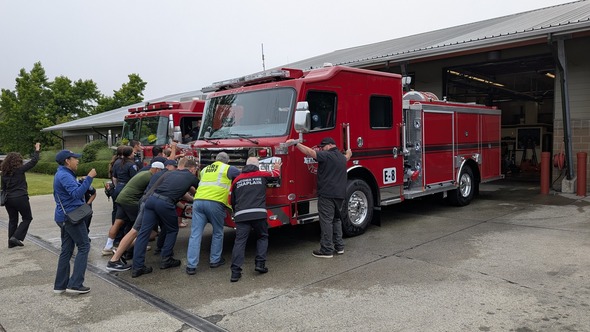
I was honored to join the Tacoma Fire Department in welcoming Fire Engine 8 to the South End and participating in the “Push In” ceremony this July. In the 1800s and early 1900s, firefighters had to push horse-drawn fire engines, ladder wagons, and hose carts back into the station bays after each call. Horses were unable to adequately push the equipment into the station bays in “reverse,” so they were disconnected so crews could push the apparatus inside the bays by hand. This tradition carries forward to today. Check out the video compilation of all three Push-in events this July.
Based on our fleet’s usage, call volume, and operating conditions, Engine replacement is recommended after eight years in frontline service and 13 years in reserve status. With the addition of Fire Engine 8 and the two others that came online in July, the average age of TFD’s engine fleet is now 9.3 years old. The City Council recognized the need to continue to replace engines, and took urgent action this summer when an opportunity presented itself to order two new engines on an expedited timeline. Usually manufacturing engines can take 30 – 48 months, however the City was presented an opportunity to order two engines that would be delivered in approximately 6 months. In June we allocated $2 million in funding to seize this opportunity.
I want to explore what we can do to affect driving behavior holistically. One promising option that has come up is the ability for municipalities to add speed cameras, red light cameras and school zone cameras.
I was initially skeptical and hesitant around this technology but research shows Automated Enforcement technology can have a positive impact and deter dangerous driving by actually modifying behavior. It helps establish and reinforce community norms around safe driving through visibility, predictability, and accountability. In Washington, on average, 88% of drivers who receive a citation from an automated enforcement camera do not reoffend, highlighting strong behavior change after a single violation. Additionally, 70% of speeding camera citations go to people who do not live in that community.
Tacoma’s Automated Enforcement program began in 2008, initially fully managed by the Tacoma Police Department. In 2021, program administration and financial responsibility was transitioned to the Public Works Department. TPD continues to support the program administration through reviewing citations.
Recent changes to the state law give us the opportunity to expand where we have traffic cameras, while meeting these requirements:
Requires an equity analysis for each new location
50% reduced fine for first-time offenders who qualify for state-assistance
Annual report must include how the revenue was used.
Penalty can be no more than $145 and fines can be doubled in a school zone. (Citations do not go on a driver’s record or impact insurance.)
All revenue from traffic safety cameras, after covering operational costs, must be used for traffic safety activities. These include construction, maintenance, complete streets projects, speed-reducing infrastructure, and improvements for active transportation users and individuals with disabilities. Additionally, a proportion of the revenue must be directed to census tracts in the lowest quartile of household incomes and with injury crash rates above the city’s average, in proportion to their share of the population.
This option is still a year or two away (government works slowly), but I am optimistic at getting this implemented within the city.
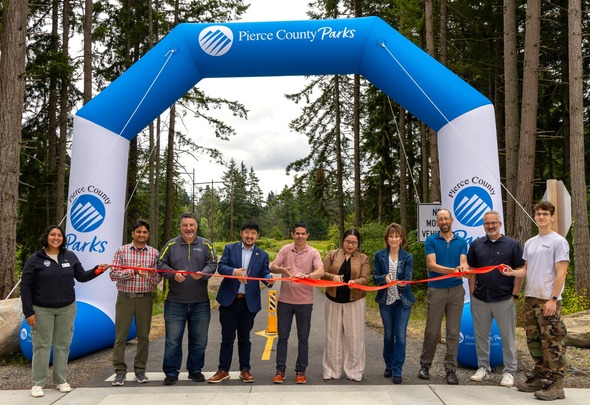
Congrats to Pierce County for their grand opening of the newest addition of the Pipeline Trail, now totaling 5.8 miles from the Tacoma Dome into rural Pierce County at Orangegate Park! The Pipeline Trail is an ADA-accessible, shared-use path connecting the growing trail network throughout Tacoma and beyond. This project would not have been possible without decades of work and partnership between the County, City, Tacoma Water, community advocates, and everyone who dedicated themselves to the vision of a regional trail to connect Tacoma to the broader trail network.
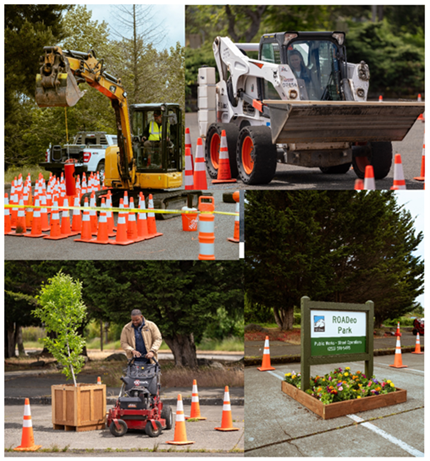
The Public Works Department held their second annual ROADeo competition on Tuesday, May 20. The event was held at the Tacoma Dome’s G parking lot. Participants were able to showcase their great skills and compete in events which included courses utilizing a snowplow, mini excavator, loader, and skid steer. Each event winner has an opportunity to compete at the Washington APWA Conference in October for a chance to go to the national competition.
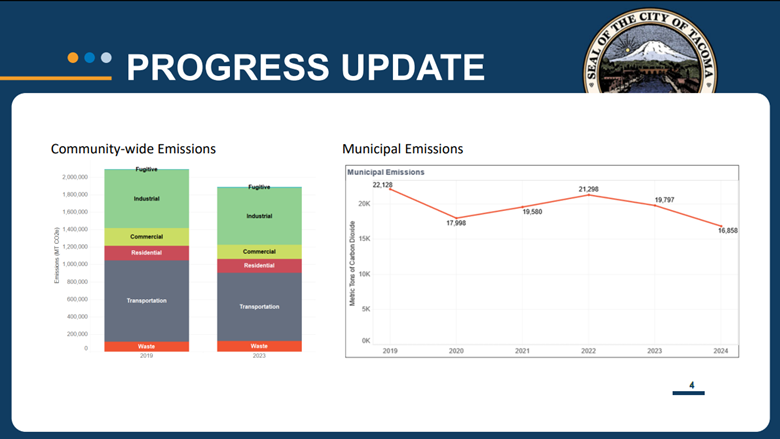
In our recent 2030 Climate Action Plan and 2024 Progress and Implementation Update we heard some exciting news about emission reductions. The chart on the left shows where Tacoma’s emissions come from and where we saw the most reductions since 2019. Most of those reductions are in the gray transportation sector and come from overall reduced vehicle miles travel, with a lesser impact from the purchase of electronic vehicles (EVs) and higher efficiencies in most new vehicles. As for municipal emissions, or the City leading by example, we saw a 24% in transportation emission reductions, mostly due to fleet and facility improvements towards using decarbonized fuels.
We’re seeing meaningful impacts on reducing carbon footprint. Every single trip that becomes a bike or walk or carpool or bus trip instead of a single occupancy vehicle trip helps reduce carbon emissions in Tacoma.
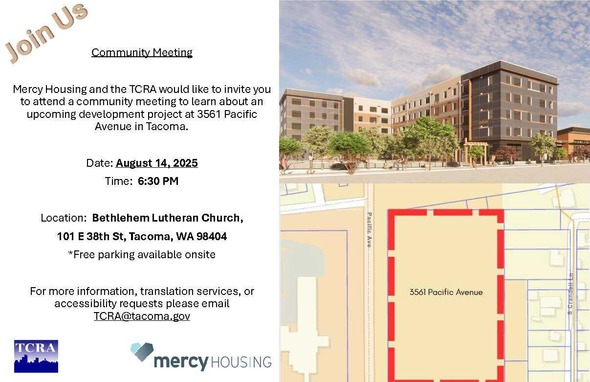
My last enewsletter focused in on what the City is doing to support affordable housing, including highlighting a project at 3561 Pacific Avenue. You are invited to a community meeting to learn more about the development at this location!
What: Community meeting on 3561 Pacific Project Date: August 14, 2025 Time: 6:30 p.m. Location: Bethlehem Lutheran Church (101 East 38th Street, Tacoma)