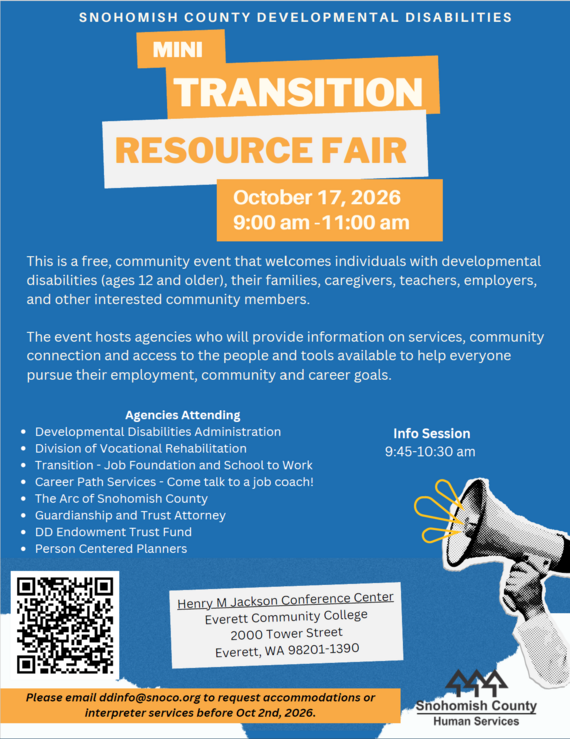
 Come to our Fall Mini Transition Fair on October 17, 2026!
This is a free, community event that welcomes individuals with developmental disabilities (ages 12 and older), their families, caregivers, teachers, employees, and other interested community members.
This event is a smaller version of our large resource fair, featuring community agencies and an information session focused on services, community connections, and access to people and tools that support employment and career goals.
-
When: October 17, 2026
-
Time: 9:00 am to 11:00 am
-
Where: Henry M Jackson Conference Center, Everett Community College (2000 Tower Street, Everett, WA 98201-1390)
Agencies Attending:
- Developmental Disabilities Administration (DDA)
- Division of Vocational Rehabilitation (DVR)
- Snohomish County Transition Services - Job Foundation (JF) and School to Work (S2W)
- Career Path Services - Come talk to a job coach!
- The Arc of Snohomish County
- Guardianship and Trust Attorney
- DD Endowment Trust Fund
- Person Centered Planning (PCP)
- Korean Community Service Center
Info Sessions: 9:45 am to 10:30 am
Please email ddinfo@snoco.org to request accommodation or interpreter services before October 2, 2026. For requests made after October 2, 2026, we will do our best to accommodate them, but we cannot guarantee availability.
Mini Transition Resource Fair Flier (PDF) - Arabic / English / Mandarin / Russian / Spanish / Vietnamese
To learn more, please visit the Mini Resource Fair web page.
October is National Disability Employment Awareness Month
October 2026 marks the nation’s annual celebration of National Disability Employment Awareness Month (NDEAM), a time to recognize the contributions, skills, and expertise people with disabilities bring to workplaces and communities across the country. What began in 1945 as a week dedicated to raising awareness about employment for people with physical disabilities has grown into a month long national observance honoring the broad talents of workers with all types of disabilities.
This year’s theme, “Celebrating Value and Talent,” continues the message of recognizing the strengths individuals with disabilities contribute to meaningful, competitive employment. The theme reflects a longstanding commitment to ensuring that all people, regardless of disability, have the opportunity to participate fully in the workforce.
Here in Snohomish County, we remain dedicated to advancing inclusive employment. Through partnerships with the Developmental Disabilities Administration (DDA), the Division of Vocational Rehabilitation (DVR), and 13 local Career Path Services Providers, more than 800 individuals participate in Individual Employment services. Of those, around 525 are currently employed at 147 different businesses throughout the County. These jobs include roles such as Media Specialist, School Assistant, Parcel Clerk, Peer Advocate, Utility Worker, Pharmacy File Clerk, Hostess, Janitorial Staff, Clerical Aide, Security Personnel, Office Support Staff, Prep Cook, Physical Therapy Technician, Parks Specialist, and Baker, demonstrating the diverse strengths, interests, and contributions of these valued employees. Many participants have also demonstrated exceptional long-term commitment, with more than a dozen individuals having worked in their jobs for 20 to 33 years.
As we honor NDEAM this October, Snohomish County recognizes the workers, employers, families, Providers, and community partners who make inclusive employment possible. We also extend our appreciation to those who partnered with us to gather quotes and stories for this year’s display case, and to the Providers who joined us at the County Council meeting for the passing of the 2026 NDEAM Resolution. We look forward to hearing directly from participants at our upcoming Developmental Disabilities Advisory Board meeting on October 27, 2026, as we continue celebrating the value and talent they bring to our community.
Learn more about National Disability Employment Awareness Month (NDEAM).
Read the 2026 Proclamation from Snohomish County Executive, Dave Somers.
Read the 2026 Resolution from the Snohomish County Council.
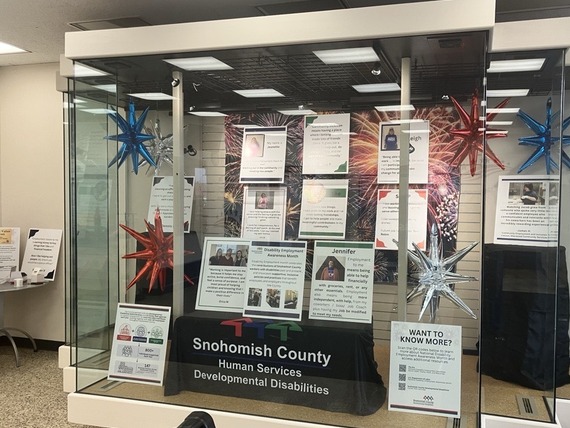
In recognition of NDEAM, the Snohomish County Developmental Disabilities team has created a special display in the first-floor lobby of the West Administration Building at 3000 Rockefeller Ave, Everett, WA. The display will remain up through the end of October, and we invite everyone to stop by, explore the stories and quotes featured, and learn more about NDEAM. Below is a look at this year’s display.
Share Your Voice: Snohomish County Community Needs Assessment
What does it take for individuals, families, and communities to thrive in Snohomish County?
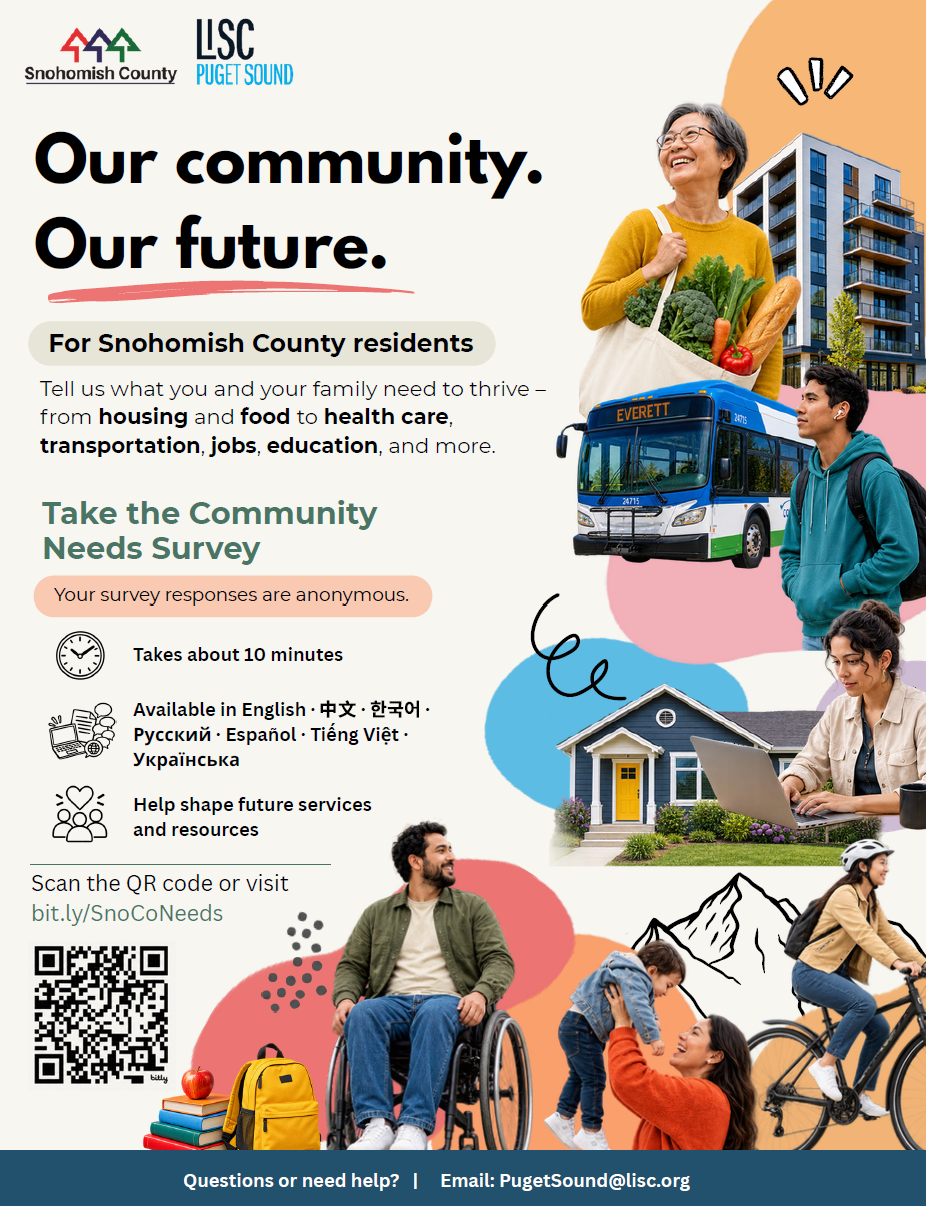
Snohomish County is conducting a countywide Community Needs Assessment to better understand the needs, strengths, and experiences of residents across the county, with a particular focus on people with lower incomes and those working to make ends meet.
The assessment is an opportunity to share what is working well in your community, what challenges you are experiencing, and what resources or changes could make a meaningful difference. Your experience matters and is an important part of understanding the full picture of our communities.
Take the survey to share your perspective and help inform how Snohomish County understands and responds to community needs.
Take the survey here: Community Needs Assessment
Additional Opportunities to Celebrate and Grow in October
ADHD Awareness Month
October 2026 marks ADHD Awareness Month, a national observance dedicated to increasing understanding and support for individuals living with Attention Deficit Hyperactivity Disorder. This year’s theme,“A Community of Support,” emphasizes the importance of connection, shared experiences, and accessible resources. It encourages communities, families, educators, and workplaces to come together to reduce stigma and ensure that people with ADHD feel supported, understood, and empowered.
For more information and resources, visit ADHD Awareness Month.
Disability History and Awareness Month
In 2008, Washington State legislature passed a law declaring October as Disability History Month in public schools and institutions of higher education. 1 out of 5 people in the United States has a disability and learning about the history and contributions of those with disabilities matters. What matters even more is that this is taught through the perspectives of disabled individuals.
There are free resources available to support learning, including the One Out of Five: Disability History and Pride Project. This resource is designed to celebrate the history, identities, and lived experiences within this large and diverse community. One Out of Five was created by the Washington State Governor’s Office of the Education Ombuds (OEO) in partnership with local educators Adina Rosenberg and Sarah Arvey as a guide for schools to recognize and teach Disability History Month. For more information and additional educational materials, visit the One Out of Five: Disability History and Pride Project. visit One Out of Five: Disability History and Pride Project.
Domestic Violence Awareness Month
October is recognized nationwide as Domestic Violence Awareness Month (DVAM), first established by Congress in 1989 to raise awareness about domestic violence and its impact across all communities. Domestic violence affects people of every age, socioeconomic status, gender, and background (National Child Traumatic Stress Network). The 2026 national theme, “With Survivors, Always,” continues last year’s message but deepens the focus on turning awareness into action. This year’s campaign emphasizes standing in solidarity with survivors and addressing the real barriers they face by strengthening safety, support, and accountability systems.
In Snohomish County, organizations and community partners continue to participate in DVAM through awareness efforts, resource outreach, and survivor‑centered activities throughout October.
If you or someone you know is experiencing domestic violence, confidential help is available 24/7 through the DVS hotline at 425‑25‑ABUSE (425‑252‑2873). Together, we continue working toward a safer community and a future free from abuse.
For more information and resources, visit Domestic Violence Awareness Month.
Read the 2026 Resolution from the Snohomish County Council.
Down Syndrome Awareness Month
October is National Down Syndrome Awareness Month, a time dedicated to raising understanding, promoting inclusion, and celebrating the abilities and achievements of individuals with Down syndrome. This month invites communities across the country to recognize the unique talents, strengths, and perspectives of people with Down syndrome, while also acknowledging the barriers many still face.
Led by the National Down Syndrome Society (NDSS), Down Syndrome Awareness Month is a long standing observance focused on increasing public knowledge, challenging misconceptions, and supporting advocacy efforts that help create more inclusive schools, workplaces, and communities. Each October, NDSS highlights stories, educational resources, and national campaigns that encourage people to learn, connect, and celebrate alongside the Down syndrome community.
Through awareness activities, classroom resources, and opportunities to share personal stories, this month reminds us of the importance of ensuring that individuals with Down syndrome are valued, included, and supported in every part of society.
For more information and resources, visit National Down Syndrome Society.
Filipino American History Month (FAHM)
October is Filipino American History Month (FAHM), a time to honor the rich history, culture, and longstanding contributions of Filipino Americans across the United States. The commemoration marks the first recorded arrival of Filipinos in what is now the United States in October 1587, recognizing more than four centuries of Filipino American presence, resilience, and influence. Established by the Filipino American National Historical Society (FANHS) in 1992 and officially recognized by Congress in 2009, FAHM serves as an opportunity to learn, reflect, and uplift stories that have often been left out of mainstream history.
The 2026 national theme, “Beyond the Margins: Centering Intersectional Filipino American Histories,” focuses on the experiences of Filipino Americans whose stories have historically been overlooked or underrepresented. This includes the histories of women, LGBTQ+ Filipino Americans, Indigenous and Moro/Muslim Filipinos, people with disabilities, multiracial Filipino Americans, undocumented migrants, adoptees, and other marginalized communities. The theme invites all of us to deepen our understanding of Filipino American history by acknowledging the complexity and diversity within the community.
For more information and resources, visit Fililino American National Historical Society.
International Dyslexia Awareness Month
October is International Dyslexia Awareness Month, a time dedicated to increasing understanding of dyslexia and celebrating the diverse strengths and accomplishments of individuals with this common learning difference. Dyslexia affects as many as 15–20% of the population, yet with early identification and structured, evidence based support, individuals with dyslexia can thrive in school, work, and daily life.
This month encourages schools, families, and communities to learn more about dyslexia, challenge misconceptions, and promote inclusive practices that help all learners succeed. While the International Dyslexia Association (IDA) continues its global focus on awareness and reducing stigma, many organizations also participate in campaigns such as Go Red for Dyslexia, inviting people to wear red throughout October as a show of solidarity.
Internationally, 2026 programming also highlights the importance of effective instruction. Dyslexia Ireland’s theme for 2026 – “Effective Teaching Changes Lives” – echoes the growing emphasis on evidence informed reading practices and the significant impact that skilled teaching can have on students with dyslexia.
For more information and resources, explore dyslexia resources here.
LGBTQ+ History Month
October is LGBTQ+ History Month, a national observance dedicated to honoring the trailblazers, movements, and milestones that have shaped LGBTQ+ rights and visibility in the United States. First established in 1994 by educator Rodney Wilson, the month was created to recognize and elevate the contributions of LGBTQ+ individuals throughout history.
Each year, LGBTQ+ History Month highlights 31 Icons – one for each day in October – featuring leaders, artists, activists, and historical figures who have impacted LGBTQ+ history and culture. The 2026 Icons include a diverse range of influential individuals whose stories are shared through videos, biographies, and educational resources designed to deepen understanding and spark conversation. This annual spotlight provides an opportunity to learn from the past, celebrate progress, and continue advocating for equity and representation.
Learn more about LGBTQ+ history in Washington State.
Access more resource on LGBTQ+ History Month.
Día de Los Muertos (Day of the Dead)
Beginning the evening of October 31st through November 2nd, Día de Los Muertos a vibrant Mexican holiday that honors and celebrates deceased loved ones. It combines indigenous traditions with colorful altars, marigold flowers, sugar skulls, and offerings to welcome the spirits back for a joyful reunion. Read more about Día de Los Muertos.
Local Día de Los Muertos (Day of the Dead) events to attend:
- Sugar Skulls (Calaveritas de Azucar)
- Saturday, October 17, 2026 from 11:00 am to 12:30 pm
- Sultan Library, 319 Main St Suite 100, Sultan, WA 98294-0580.
- Learn about Dia de Muertos, a tradition celebrated in Mexico and other regions globally, by decorating pre-molded sugar skulls using colorful paint, sequins, tissue paper flowers, mini paper banners and Papel picado.
- Free community event - this program is open to all adults and children age 6 and older.
- Learn more about the event details
- Spooky Month Crafts: Feathered Skull with The Fatbrush Art Workshop
- Friday, October 30, 2026 from 2:30 pm to 4:30 pm
- Monroe Library, 1070 Village Way, Monroe, WA 98272-2035
- Join Maria Casey of The Fatbrush Art Workshop to create stunning chicken skull niches adorned with vibrant flowers and traditional motifs. Using cardboard and acrylic paint, young artists will bring their imaginative designs to life, celebrating Mexican culture and honoring the spirit of Día de los Muertos.
- All supplies will be provided, but are limited. The project in this workshop is intended for kids and teens, ages 8 and older.
- Learn more about the event details.
- Día de los Muertos Celebration
- Friday, October 30, 2026 from 6:30 pm to 7:30 pm.
- Mariner Library Meeting Room, 520 128th St SW Suites A9 A10, Everett, WA 98204
- In preparation for Día de los Muertos, make a Catrina headband, paper cempasuchil (marigold) flowers, learn to write calaveritas (small humorous poems), and/or add to our community altar. The little ones will be able to participate as well and decorate their own paper skulls and, together, we will enjoy a pan de muerto (sweet bread) and hot chocolate, while supplies last.
- Learn more about the event details.
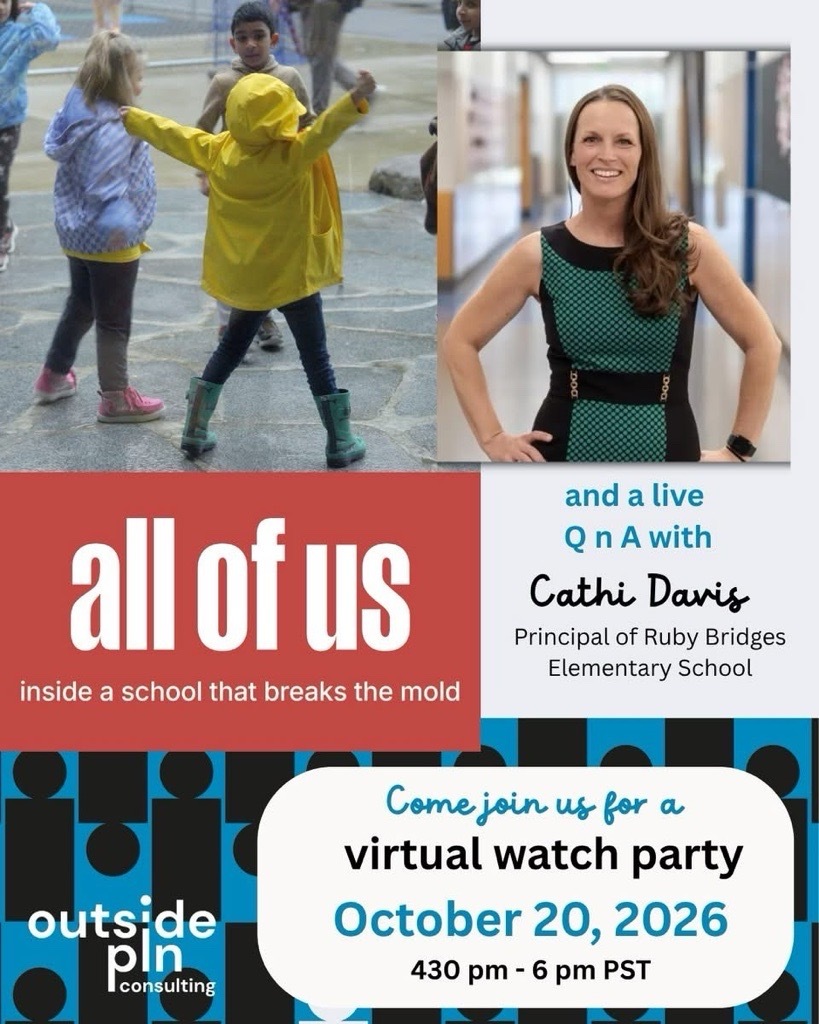
All of Us – Inside a School that Breaks the Mold
Ruby Bridges Elementary is a fully inclusive Kindergarten-5th Grade school community in Snohomish County. Since the inception of this school community in 2020, they have designed all learning and instruction with an emphasis on universal design, collaboration, and flexible delivery of support and services for all students in their general education learning community. As principal Cathi Davis puts it: “Special education is not a place; it is a service. At Ruby Bridges, all students are general education students first.”
Lay Guardian Toolkit
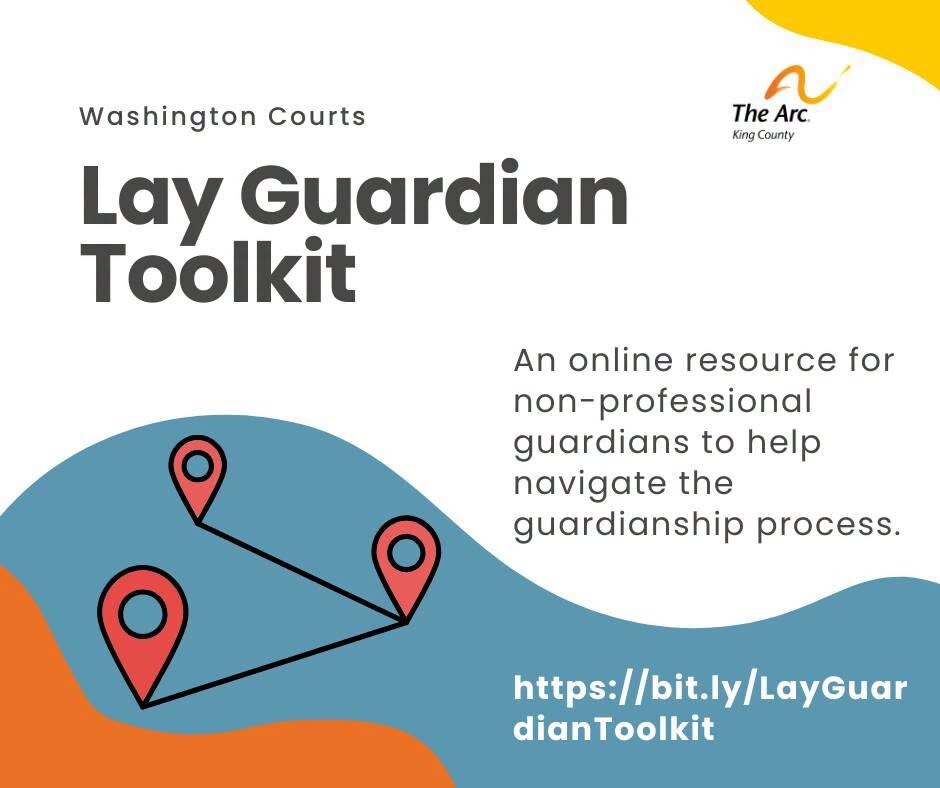
The Lay Guardian Toolkit is a resource for non-professional guardians to help navigate the guardianship process in Washington State.
Learn more about the Lay Guardian Toolkit.
Hidden Voices: Americans with Disabilities in United States History
The Hidden Voices project highlights the experiences and contributions of individuals whose stories have often been left out of traditional narratives. Hidden Voices: Americans with Disabilities in United States History brings forward the perspectives of Americans with disabilities and the important role they have played and continue to play in shaping our country.
This resource offers educators a collection of profiles, historical context, and instructional guides designed to help students explore the social, political, cultural, and economic impact of people with disabilities throughout U.S. history. Each section encourages learning from multiple perspectives, recognizing the complexity of identity, and understanding how disability has intersected with major events and movements in American history.
Aligned with the Passport to Social Studies curriculum, Hidden Voices supports inclusive education by ensuring that the stories of underrepresented individuals and groups are part of classroom learning. It also emphasizes developing empathy, respect for differences, and a deeper understanding of the many ways people with disabilities have shaped our shared history.
To explore the full resource, visit Hidden Voices: Americans with Disabilities in United States History.
Museum of Disability History: Learning Through Hidden Narratives
The Museum of Disability History offers an important opportunity to explore the often untold stories of people with disabilities and their impact on the social, political, cultural, and economic development of the United States. Through curated exhibits and educational resources, the museum highlights the perspectives and experiences of individuals who have historically been left out of mainstream narratives, helping us better understand the depth and diversity within disability history.
The museum’s learning materials are designed to support educators in bringing these histories into the classroom. Resources include biographical profiles, historical context, primary and secondary source documents, and guiding questions that encourage learners to consider multiple perspectives. By examining how people with disabilities shaped, and were shaped by, major events in U.S. history, students gain a fuller picture of our shared past and develop a deeper appreciation for disability as a vital part of the American story.
Aligned with inclusive education practices, the Museum of Disability History emphasizes empathy, respect for differences, and representation across instructional materials. This approach helps ensure that the contributions of people with disabilities are acknowledged, understood, and valued in both historical study and today’s communities.
To explore more about disability history and access educational materials, visit the Museum of Disability History online.
|