|
Photo of the Month
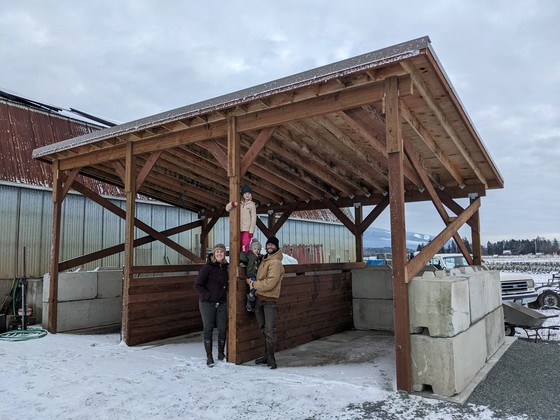 Tara and Brennan Van Loo stand with their two children in front of their brand-new manure storage bin. The bin will help keep manure out of waterways so it can be used as rich fertilizer.
Check out this brand-new manure storage bin on the Van Loo property! With three sections for composting and a roof to stop rain from leaching nutrients, this bin will soon be full of rich fertilizer.
The best part? The Van Loos only had to cover 25% of the cost! Thanks to funding from the EPA's National Estuary Program, Skagit County was able to shoulder the majority of costs for this project. Why? Because work like this is so, SO important in protecting water quality.
The Van Loo property, like many other farms, is near the Samish River. Manure piles that sit uncovered in fields can create runoff full of all kinds of bacteria and excess nutrients. That polluted runoff flows right into the river and other waterways. Keeping manure covered and contained ensures all that material stays out of the water and on the farm, where it can be used as fertilizer.
Are you looking for a way to improve your farm and water quality? You might be eligible to receive funding for a project like this. We and our partners can often help with projects such as:
- Building manure storage bins
- Installing gutters and downspouts on farm buildings
- Creating heavy use areas for livestock
- Bank stabilization
- Fencing for livestock exclusion
- Riparian restoration
Take a look at our Natural Resource Stewardship Program or contact Karen DuBose at kdubose@co.skagit.wa.us or 360-416-1460 to discuss possible project funding. You can also check out Skagit Conservation District's Cost-Share Program.
|
|
|
Overall, December 2022 came in a little bit colder and wetter than normal. The average daily temperature at the Sakuma AgWeatherNet station was 35.4°F, and total precipitation was 4.07”. Of course, focusing on averages does not tell you much about extreme events. Anyone in the area is sure to remember the snowfall and bitter cold just before the holidays, followed by a quick warm-up and heavy rains.
Water quality results showed typical patterns for this time of year, and some response to specific weather events. Cold weather slows down bacterial activity. Thanks to the cold snap, we saw low bacterial counts in our sampling for the first three weeks of December. Our last sampling of the month occurred as rivers were rising with rain and snowmelt. Those samples contained higher numbers of bacteria, likely because of runoff washing contaminants off the surroundings.
The rainstorms after the holidays were enough to trigger two shellfish closures in Samish Bay. The first closure was immediately lifted after sampling results confirmed the water remained clean. Those samples were collected by the volunteer Storm Team. Thanks, Storm Team! Initial sample results confirmed the second closure, but the bay reopened after a clean sample was obtained the following day.
As always, you can check out all our sampling results on the Water Quality Results Map.
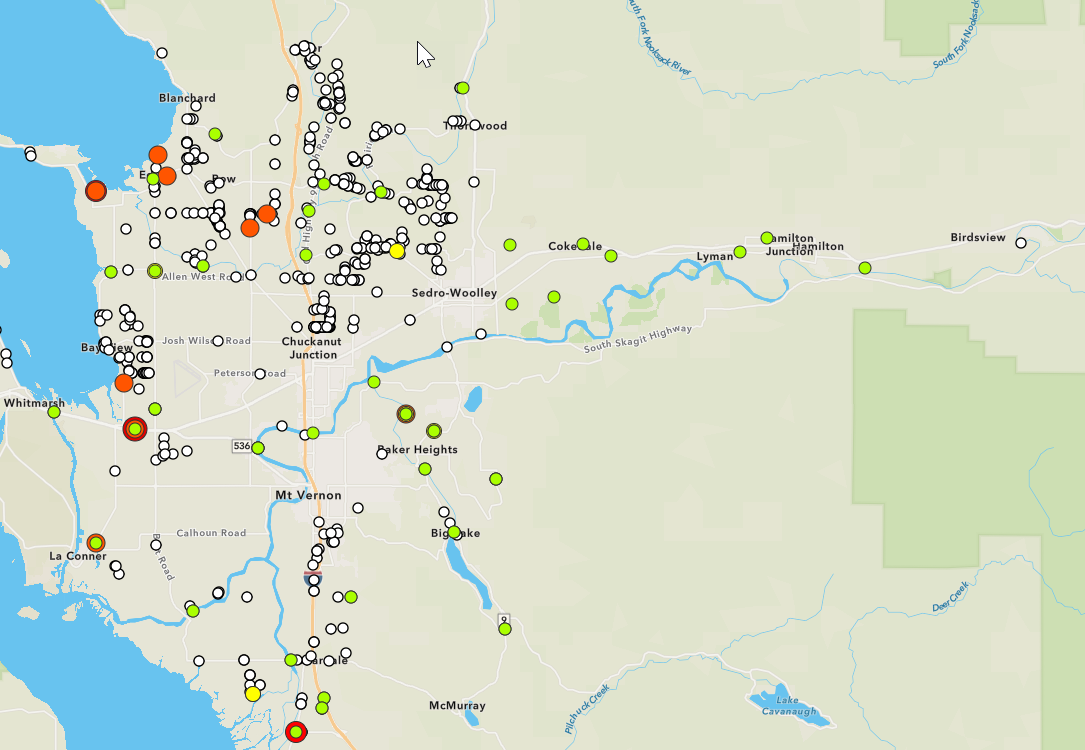 December's water quality results. Red dots represent sites with high levels of fecal bacteria, yellow represents sites with moderate levels of fecal bacteira, and green dots represent sites with low fecal bacteria levels. Click on the map to go to the online water quality map, where you can explore sites in Skagit, Whatcom, and Snohomish Counties.
|
|
Tip of the Month to Protect Life and Home
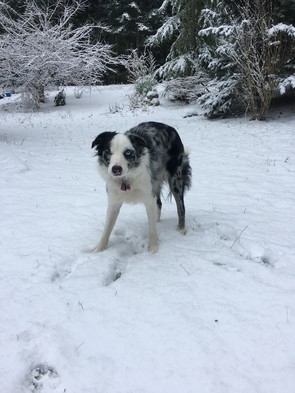
Do these cold, dark days have you missing summer? If you're dreaming about lounging in the summer sun and playing in our local waters, you're not alone. Luckily, you can start preparing for summer fun right now... kind of!
What we do (and don't do) in the winter can affect our fun all year round. The "do" we're talking about? Dog doo!
We know it's no fun to scoop in the winter, but that dog poop build-up in your yard will only get harder and harder to deal with the longer you leave it. A little work now could save you a lot of back pain later! Plus, you might save your shoes from encountering an unpleasant surprise in the dark or under the snow.
Dog poop in the yard isn't just a risk for your shoes, though. Bacteria and parasites in the poop could make your dog sick— yes, even if it's your dog's own poop! Time spent on scooping could be money saved on vet bills.
Unfortunately, dog poop doesn't actually disappear when it rains. Rain and melting snow will wash the poop in your yard into our local waterways, polluting them with bacteria like fecal coliform and E. coli. In 2020 and 2021, we found DNA evidence of dog poop in 13 of the 18 sites we sampled. These sites were located in rural areas away from parks and walking areas, meaning the majority of this poop came from yards that were not regularly scooped. So, even when that poop gets washed out of your yard, you might still end up coming into contact with it in local waters. Yikes!
Make sure our water is as ready for summer fun as we are. Help keep our streams, rivers, lakes, and seawater clean. Scoop often and early this winter!
|
|
|

Farm Tip of the Month
Remember all of that fertilizer talk last month? Well, we have some more! Talk about laying it on thick!
If you have questions about when to apply fertilizer, something called T-Sum can help! T-Sum is a measurement based on adding up average daily temperatures. It is used to help decide when to add nitrogen to your field. The best time to fertilize is usually when T-Sum reaches between 200 and 300. This is when grasses are growing and will actively take in the nutrients you apply.
T-Sum can't tell you everything, though. You'll need to consider the weather and the condition of your fields before you fertilize. If it's too rainy or your fields are wet, all that fertilizer will run right off into nearby waterways. What a waste! And don't even get us started on the water quality issues... Anyway... If your pastures are dry, a T-Sum of 200 or more might mean it's time to apply!
Keep an eye on the Skagit County Clean Water and Skagit Conservation District Facebook pages to learn when T-Sum reaches 200. You can also find T-Sum, as well as monthly farm tips, on the Skagit Conservation District's Farming Resources page!
When the time to fertilize does come, remember to fertilize responsibly. Learn about how to test your soil for what it actually needs in our December newsletter and check out our video on preventing fertilizer pollution here. You can also refer to Whatcom Conservation District's Application Risk Management Worksheet, a great resource for deciding when, how and how much to fertilize.
Love math and want to figure out T-Sum for yourself? Here's how:
T-Sum is calculated by adding daily average temperatures (in °C) every day starting on January 1. For example, the average temperatures from the Sakuma AgWeatherNet station on January 1st, 2nd and 3rd were 4.9 °C, 4.3 °C and 4.3 °C. Added up, that's a T-Sum of 13.5. We're still a long way from fertilizing time!
|
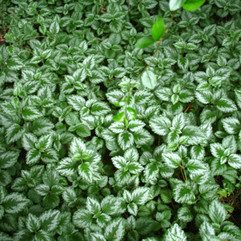
Yellow-archangel (Lamiastrum galeobdolon)
Yellow-archangel, also known as Herman's pride, dummy nettle or golden dead-nettle, spreads so quickly that it is on Washington's quarantine list. Nobody needs extra quarantine in their lives these days! It is illegal to buy, sell and transport yellow-archangel or its seeds in the state. Here are the facts:
Description: Yellow-archangel is a semi-evergreen plant that grows close to the ground. It often grows in dense, trailing mats over other plants. Its leaves are hairy, oval shaped and toothed, and grow opposite each other on the stem. The leaves are green and often have silver or gray markings. The plant has yellow flowers with an upper petal that looks like a hood and a lower petal with orange markings.
Toxicity: Yellow-archangel is not known to be toxic.
Control: You can pull vines by hand, but make sure not to leave any roots, or they will resprout. Cutting the stems will cause the plant to grow back more densely than before. Dispose of all parts of the plant by placing them in thick plastic bags and taking them to a sanitary landfill.
Learn more about yellow-archangel from the Washington State Noxious Weed Control Board.
|
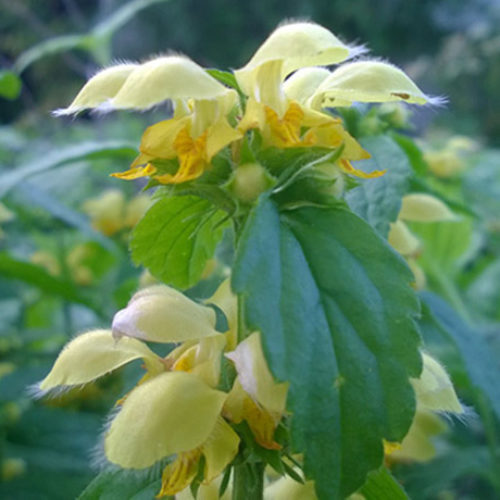 Yellow-archangel flowers grow close to the stem and have a large upper petal that looks like a hood over the rest of the flower. Yellow-archangel photos courtesy of Washington State Noxious Weed Control Board.
|
|
 |
|
Program News
This month, Skagit County Natural Resources is excited to welcome... me! I'm Anna Thomas, our new Education and Outreach Specialist. I'll be writing most of what's in our newsletters and posting on our Facebook, Nextdoor and YouTube pages. You'll also see me at events we attend, like the upcoming Country Living Expo and Cattlemen's Winterschool!
|
Classes and Events
Put in your preorder for Skagit Conservation District's Native Plant Sale!: You can now place your order for native plants to enhance and beautify your yard or garden. Choose between a variety of species, each with its own benefits to our local ecosystems. Learn more here!
Swanrise at Barney Lake, January 15, 7:00 AM to 9:30 AM: Grab your binoculars and join Skagit Land Trust to watch hundreds of majestic trumpeter swans take flight. Check out Swanrise page for more information, as well as additional Swanrise and "Goodnight Swan" events.
Come say hello at WSU's Country Living Expo and Cattlemen's Winterschool, January 21, starting at 8:00 AM: This annual expo and winterschool is the place to be if you're interested in just about anything related to farming or homesteading! The event includes classes on subjects ranging from animal husbandry, farm planning and soil health to bread baking, cheese making and wool spinning. Learn more online and reserve your spot today!
Bask in the glow of Illuminight Skagit, January 28, 5:30 PM - 8:00 PM: Stroll Riverwalk Plaza in Mount Vernon for music, lantern displays and lantern making. Keep an eye out for our friends at Skagit Conservation District! Learn more here.
Join the Salish Sea Stewards Volunteer Training Program at Padilla Bay! February 7 - April 25, 2023, Tuesdays 1:00 PM - 5:00 PM: Learn from local experts about the Salish Sea, the threats it's facing and what you can do to help! Classes include lectures as well as hands-on field training. Learn more and register here.
SoilCon 2023, virtual, February 14 & 15, 8:00 AM to 12 PM: Get the dirt on soil health at Washington Soil Health Initiative's annual SoilCon. The conference topics are sure to intrigue anyone interested in soil health. Learn more about the conference here and register (for free!) here.
Volunteer Opportunities
Be a part of MLK Jr. Day of Service, January 16, 10:00 AM to 2:00 PM: Join Skagit Land Trust for a day of serving our community and our land by removing invasive plants around Cumberland Creek. Learn more here.
Get your hands dirty at Mud Lake, February 4, 9:00 AM to 12:00 PM: Help Skagit Land Trust pull and pile invasive blackberry and ivy at Mud Lake Conservation Area. Learn more here.
Tear down fences along the Samish River, February 10, 9:00 AM to 1:00 PM: Join Skagit Land Trust as they remove an old fence line in Tope Ryan Conservation Area. You may even get to remove some invasive plants, too! Learn more here.
|
|
Contact Us
For questions or more details, please contact Karen DuBose at kdubose@co.skagit.wa.us or 360-416-1460.
This project has been funded wholly or in part by the United States Environmental Protection Agency under assistance agreement PC01J18001-0 to the Washington Department of Health. The contents of this document do not necessarily reflect the views and policies of the Environmental Protection Agency, nor does mention of trade names or commercial products constitute endorsement or recommendation for use.
|
|
|
|
|