|
Photo of the Month
 The Skagit Regional Source Control Inspection Program will start inspecting businesses and helping them apply pollution solutions in January.
Hey, Skagit businesses! We want to let you know about the new Skagit Regional Source Control Inspection Program. Skagit County formed this program in partnership with Mount Vernon, Burlington and Sedro-Woolley. Its purpose: helping businesses reduce their pollution of stormwater.
In January our source control inspector will start visiting businesses. They will check for potential sources of stormwater pollution. Stormwater is rain runoff from roads, roofs, parking lots, and other developed surfaces. The water picks up everything it flows over, including chemicals, oils, and dog poop. It then flows into nearby waterways. Things like open dumpsters, leaky vehicles and chemical spills all pollute stormwater.
If the inspector identifies possible sources of pollution at your business, we will work with you to apply solutions. These solutions are often easy, everyday practices.
It is the responsibility of every business to manage and dispose of waste properly. We are here to help you do so.
State and federal law requires cities and counties to inspect businesses for possible sources of pollution. State and federal law also requires businesses to manage and dispose of waste properly. Our program is here to help you do so by using pollution reduction techniques.
Learn more about the Source Control Inspection Program online. Please contact Jason Quigley at 360-416-1459 or jasonq@co.skagit.wa.us with questions. We look forward to working with you!
|
|
By the numbers, the weather in November was about average. The average daily temperature at the Sakuma AgWeatherNet station was 38.1°F, just shy of the long-term average of 39°F. Total rainfall came in at 5.27”, just over the average of 5.07”. The rain was concentrated with almost two-thirds of the total coming in the first week of the month. It felt like another dry streak was upon us for a couple weeks mid-month, but rainfall was back around the Thanksgiving holiday. We closed out November with a bit of snowfall, to the delight of some and the chagrin of others.
Heavy rains early in the month led to a first-flush in waterways and a brief closure of shellfish harvests. First-flushes happen when rains return after dry periods. The rains wash pollutants that have accumulated on the landscape into rivers and waterways. This month's first-flush caused the Samish River flow to increase by over 400 cubic feet per second (CFS) in under 24 hours, triggering a conditional closure of shellfish harvest. A high count of bacteria in the river confirmed the closure. Harvest was allowed to resume after samples showed that river water had cleaned up.
We sampled our northern route after the first-flush and saw high bacterial levels at many sites throughout the county. Counts were mostly back down to normal levels when we returned two weeks later. We did not have heavy rains before either of our southern route sampling events. Sites along the southern route were generally in good shape in November.
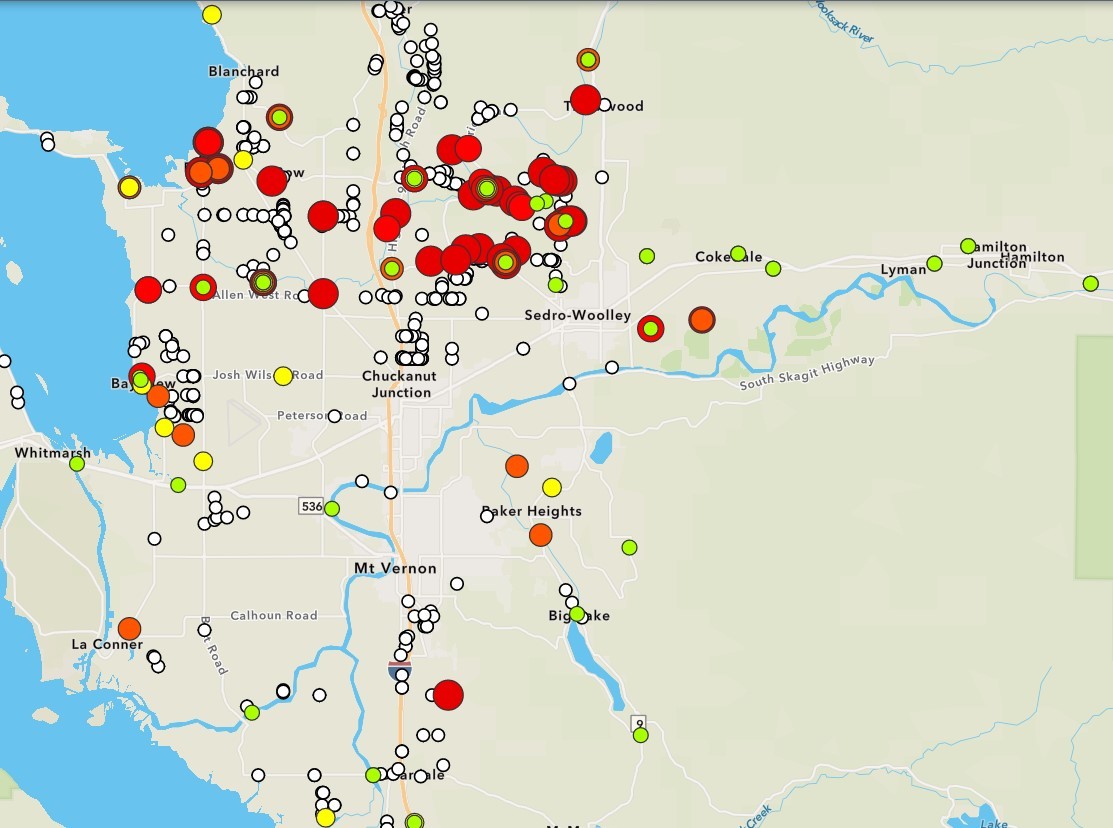 November's water quality results. Red dots represent sites with high levels of fecal bacteria, yellow represents sites with moderate levels of fecal bacteira, and green dots represent sites with low fecal bacteria levels. Click on the map to go to the online water quality map, where you can explore sites in Skagit, Whatcom, and Snohomish Counties.
|
|
Tip of the Month to Protect Life and Home
Got flooding? Rural Stormwater Solutions has ideas to help!
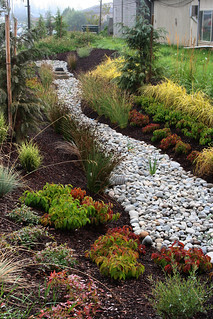
Many rural areas lack storm drains but certainly don't lack storms. If you live somewhere like this, you may have noticed puddles— or even ponds— in your driveway, yard and roads. Standing water may start out as a nuisance but stormwater issues can lead to flooding, erosion and water quality problems. That new lake in your yard could end up in your basement or even wash out your road.
Not sure what to do about all that water? Rural Stormwater Solutions is here to help! This website is full of techniques for detaining, conveying and dispersing those pesky puddles. A big thanks to Washington State University Extension and The Washington Stormwater Center for creating such a great resource!
The site offers details on the benefits and logistics of rain gardens, permeable pavements, drainage ditches and more. It also has instructions for creating site maps to understand the water on your land. Find out where the water is coming from, where it should go and where future projects might send it.
|
|
|
Farm Tip of the Month
Fertilizing? Ready... Set... WAIT!
Did you check to see what nutrients your soil is missing? What about the nutrients it already has?
Fertilizing soil that is already oversaturated with certain nutrients is like hosing down a plant that's sitting in a foot of water. It creates waste and it sends all those excess nutrients spilling out into the environment. This leads to algal blooms in our local waters, harming wildlife AND our ability to swim in the summer.
Here are four tips to keep your soil and our streams healthy:
Soil Tests: Soil can't talk. How can you find out exactly what it needs? Try a soil test! Soil testing is easy. You can do it yourself using a soil test kit. When you get your results back, you can get fertilizer that has everything your soil is missing— and nothing extra. Here's a list of soil testing labs that can help you learn more about your soil:
Strip Tests: Want to see for yourself what works? Do a strip test! Section off a portion of your field and add the nutrients, alone or in combinations, that your soil is missing. You can tell by their growth which added nutrients your plants are benefiting from and which they already have enough of.
Manure Tests: Using your own homemade fertilizer? Get it tested! Just like soil, you can send in your manure to be tested for nutrients. Find out how much you need to apply. Excess manure on your fields ends up polluting the water. Here are some labs where you can get your manure tested:
Cover Crops: One of the key nutrients that Skagit soil often lacks is nitrogen. Planting cover crops is a good way to supplement nitrogen while using less fertilizer. Legumes fix nitrogen, and root plants like beets and radish can store nitrogen, as well as other nutrients, in the soil. By spring you'll have richer soil and plenty of sprouts for grazing!
Saving fertilizer is saving money! Remember to read the instructions on your fertilizer to make sure you aren't using more than necessary. When applying in spring and fall, you'll also want to consider the weather and the layout of your pasture. Too much rain will wash all that fertilizer away before it can work. If you don't have a buffer between your pasture and nearby waterways, your fertilizer will end up right in the water.
Phew. . . We've talked a lot about fertilizer this month. Tired of reading? Check out our video on fertilizing the right way to prevent pollution here.
|

Noxious weeds are plants that have been legally designated as non-native and invasive. These plants threaten our agricultural lands, ecosystem functions and fish and wildlife habitat. They even affect water quality by reducing bank stability and pushing out beneficial native plants.
We decided to bring you monthly tips on handling noxious weeds— how to identify them, control them and help us eliminate them!
Now... our first Noxious Weed of the Month!
Spurge Laurel
Spurge laurel, AKA Daphne or wood laurel, is a noxious weed that you'll notice all year long. It's evergreen, which means it doesn't drop its leaves in fall and winter. Here are the facts:
Description: Spurge laurel is a shrub (0.5 to 1.5 meters tall) with glossy, dark green leaves. Its leaves are oval shaped with smooth edges and pointed tips. They are duller and lighter in color on the bottom. Its flowers are small, bright green, and grow at the base of the leaves. Its fruit starts out green, then becomes black as it matures, and looks like a black olive.
Toxicity: Every part of the plant is highly toxic to humans and livestock. Its sap can cause irritation to the skin.
Control: Spurge laurel can be pulled by hand when small or cut below the soil line when larger. Make sure to wear gloves when working with it!
Learn more about spurge laurel from the Washington State Noxious Weed Control Board.
|
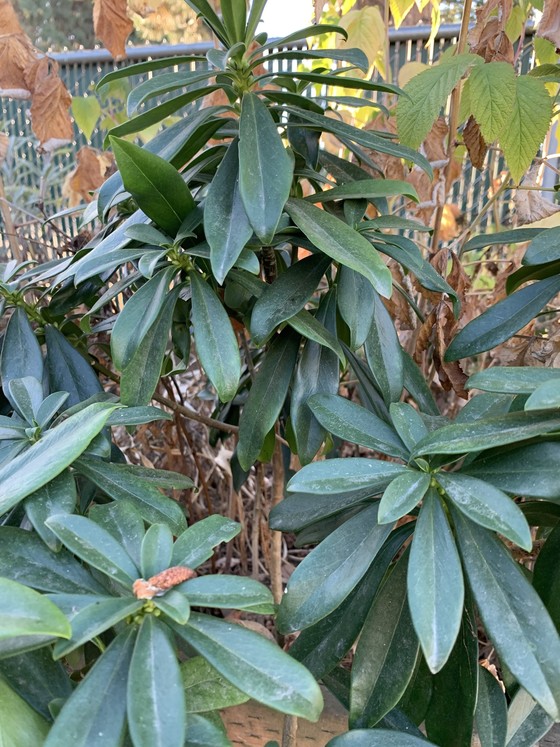 Spurge laurel is an evergreen shrub, so its leaves will stay green through winter.
|
|
 |
|
Program News
Welcoming new staff: We are excited to welcome Madelyn Loy to our team as our new Noxious Weed Coordinator— and informant for the new "Noxious Weeds" section of our newsletter! Originally from Mount Vernon, Madelyn is excited to join the efforts of the Skagit County Noxious Weed Control Board.
|
Volunteer and Educational Opportunities
Participate in a winter trail cleanup at Barr Creek, December 9, 10:00 AM to 2:00 PM: Help Skagit Land Trust clean up the trail at Barr Creek Conservation Area. Not only will you help keep the trail in shape, you'll get to enjoy beautiful views of Bar Creek's pools and waterfalls as you work. Learn more about this work party and others on the Skagit Land Trust Events page.
Remove invasives at Samish Miles Conservation Area, December 16, 9:00 AM to 12 PM: Join Skagit Land Trust in turning what was once a house site into a new nature preserve! Samish Miles Conservation Area is closed to public access, so this is your chance to see it and experience its transformation. Learn more about this work party and others on the Skagit Land Trust Events page.
Learn how to care for (and profit from) your forested land: Washington State University is offering their Online Forest Stewardship Coached Planning Course to teach landowners how to get the most out of their forested land. Classes are Wednesdays 6:00 PM to 8:30 PM, January 21 - March 22. The $150 fee includes a consultation site visit to your property. Learn more about the course here.
Events
Swanrise at Barney Lake, December 10, 7:15 AM to 9:00 AM: Grab your binoculars and join Skagit Land Trust to watch hundreds of majestic trumpeter swans take flight. Check out Swanrise page for more information, as well as additional Swanrise and "Goodnight Swan" events.
SoilCon 2023, virtual, February 14 & 15, 8:00 AM to 12 PM: Get the dirt on soil health at Washington Soil Health Initiative's annual SoilCon. The conference topics are sure to interest anyone interested in soil health. Learn more about the conference here and register (for free!) here.
|
|
Contact Us
For questions or more details, please contact Karen DuBose at kdubose@co.skagit.wa.us or 360-416-1460.
This project has been funded wholly or in part by the United States Environmental Protection Agency under assistance agreement PC01J18001-0 to the Washington Department of Health. The contents of this document do not necessarily reflect the views and policies of the Environmental Protection Agency, nor does mention of trade names or commercial products constitute endorsement or recommendation for use.
|
|
|
|
|