Asotin County VSP Site Visit
May 12, 2026
Asotin County Demonstrates a Whole-Watershed Approach to Conservation
The Voluntary Stewardship Program (VSP) Technical Panel continued its spring site visits with a stop in Asotin County, where innovative forest management, stream restoration, and long-term monitoring are being combined into a true watershed-scale conservation strategy. The visit highlighted how voluntary stewardship can address challenges from the ridge tops to the valley bottoms while supporting both natural resource conservation and working lands.
One of the first stops featured a forest thinning project near Anatone, where forestry mulching is being used to selectively remove underbrush, damaged trees, and small-diameter timber to reduce wildfire risk while improving forest health and wildlife habitat. Unlike traditional thinning methods, forestry mulching minimizes soil disturbance, helping preserve the natural structure of the landscape and reducing erosion potential. These projects also provide an opportunity to educate landowners about proactive forest management and build long-term relationships that strengthen community resilience.
Perhaps the most innovative aspect of Asotin County's approach is how these upland projects directly support downstream restoration. Rather than treating forest management and stream restoration as separate efforts, woody material generated during thinning projects is repurposed to construct Post-Assisted Log Structures (PALS) in streams such as Couse Creek. These structures help slow water, capture sediment, reconnect floodplain channels, and create more diverse aquatic and riparian habitat. Additional woody debris placed throughout the floodplain further enhances habitat complexity for wildlife. This integrated strategy demonstrates how conservation actions in one part of the watershed can provide benefits throughout the entire system.
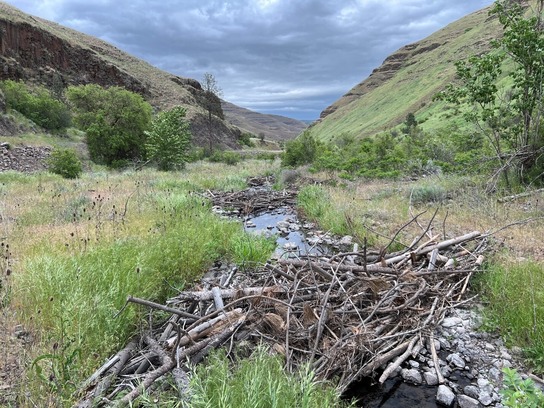
Photo: Post Assisted Log Structures in Asotin County, WA.
Photo Description: Sediment accumulation from a post assisted log structure.
By: Sean Williams, WDFW. (May, 2026).
|
The Technical Panel also learned about Asotin County's strong commitment to monitoring and adaptive management. Dedicated monitoring staff use field assessments, spatial datasets, and other innovative tools to evaluate changes in wetlands, upland habitats, agricultural intensity, and restoration effectiveness over time. Combined with strong technical assistance and close collaboration with landowners, this monitoring program provides valuable information to guide future conservation decisions.
Like many eastern Washington communities, Asotin County continues to face significant challenges. Increasing wildfire risk, the high cost of forest thinning projects, evolving forest management regulations, and the need for long-term monitoring all require sustained investment and collaboration. Despite these challenges, the county's Conservation District has built strong partnerships with landowners that continue to expand opportunities for voluntary conservation.
The Asotin County site visit showcased how VSP can support conservation across an entire watershed by connecting forest management, stream restoration, monitoring, and landowner engagement into one coordinated strategy. It serves as an excellent example of how voluntary stewardship can improve watershed resilience while maintaining the productivity and sustainability of Washington's working landscapes.
Whitman & Garfield County VSP Site Visit
May 13, 2026
Stewardship Through Collaboration
This spring, the Voluntary Stewardship Program (VSP) Technical Panel had the opportunity to visit project sites in Garfield and Whitman counties, where strong partnerships between local Conservation Districts, producers, and agency staff are translating conservation planning into measurable on-the-ground results. The visit highlighted not only a diverse portfolio of restoration and agricultural stewardship projects, but also the long-term relationships that make voluntary conservation successful.
Garfield County showcased several projects demonstrating how working lands and healthy riparian ecosystems can coexist. Along Alpowa Creek, the Technical Panel toured a livestock operation implementing prescribed grazing, riparian fencing, streambank stabilization, off-channel watering facilities, and riparian plantings. A particularly valuable discussion focused on the role of flash grazing within previously enrolled Conservation Reserve Enhancement Program (CREP) areas. Site managers shared how carefully managed grazing can help control invasive weeds, stimulate desirable vegetation, and improve long-term maintenance of riparian restoration projects while continuing to support agricultural operations.
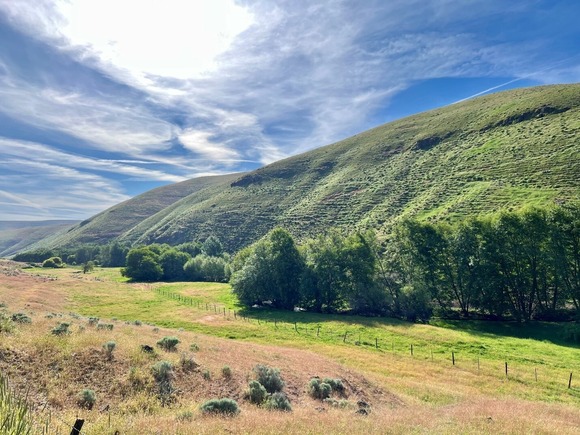 Photo: Alpowa Creek in Garfield County, WA.
Description: Livestock management in a riparian area.
Photo By: Sean Williams, WDFW. (May, 2026).
The group also visited a hedgerow planting project near Stember Creek, where strategically planted vegetation serves multiple purposes such as, reducing chemical and snow drift, buffering nearby residences, and creating habitat for wildlife while helping reduce runoff entering the creek. These projects illustrate how relatively small conservation practices can provide multiple ecological benefits while remaining compatible with productive farming.
In Whitman County, the Technical Panel visited restoration efforts along Rose Creek, where riparian forest buffer plantings were paired with Post-Assisted Log Structures (PALS) to improve stream function within an incised channel. The structures are designed to slow water, retain sediment, reconnect portions of the floodplain, and improve habitat complexity while newly established riparian vegetation provides future stream shading and wildlife habitat. What made these projects especially noteworthy was the commitment to monitoring. Wildlife use is being evaluated with acoustic bird monitoring, while water monitoring equipment is helping assess how the restoration influences stream conditions over time.
Beyond the individual projects, the site visit underscored several strengths shared by both counties. Robust monitoring programs, strong producer engagement, active participation from multiple Conservation Districts, and close collaboration among local, state, and federal partners continue to strengthen VSP implementation. At the same time, discussions acknowledged ongoing challenges, including sustaining long-term monitoring programs, maintaining restoration sites, and ensuring conservation practices remain flexible enough to support both ecological function and agricultural viability.
The Whitman and Garfield County tour demonstrated that successful voluntary stewardship extends beyond implementing conservation practices. It also depends on long-term partnerships, adaptive management, and continued collaboration between producers and conservation professionals. Together, these efforts are helping protect critical areas while supporting resilient agricultural landscapes across southeastern Washington.
|