|
We thought the pace last week was maddening... hoo boy! It has only gotten busier as bills that squeaked out of their policy committee by the cutoff (last Wednesday) now race through the next steps of the process.
Bills with a fiscal impact of over $50,000 are required to go through a fiscal committee (for our interests: Appropriations or Capital in the House, Ways and Means in the Senate). Those bills must now jump through the next hoop and pass their fiscal committees before the looming Monday deadline.
Those without high fiscal impacts will head straight to the floor to await a vote of the full chamber.
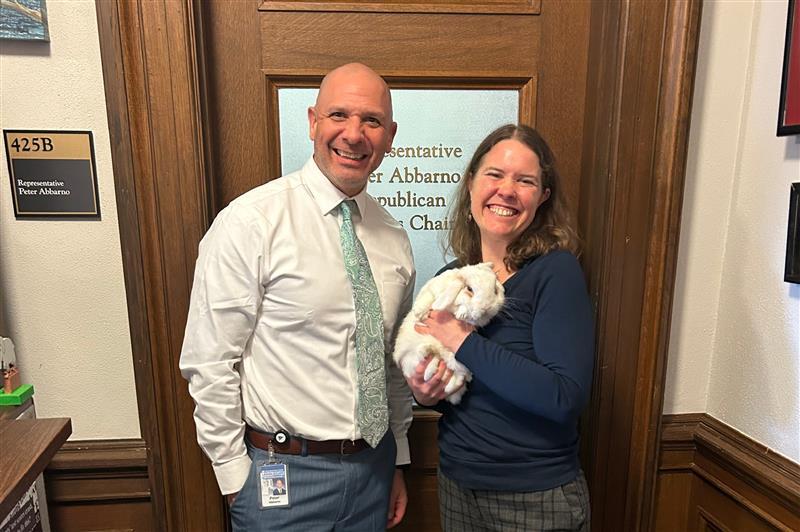 I make sure to visit Representative Abbarno when he’s in Olympia. Not only is he an ally for conservation districts, but I also get to see Veto the bunny, who turns three on March 22!
Conservation District Elections: SHB 2499 Moves Forward
This past Tuesday, the House State Government and Tribal Relations Committee passed SHB 2499 out of committee on a split vote. What’s the “S” for, you ask? That means that the bill has been substituted from the original. Much of the content remains the same. Here’s what is new:
- Candidates are no longer required to file personal finance disclosure reports (it is still required for all elected and appointed supervisors).
-
Annual elections are no longer required. Instead, elections are required when a supervisor’s term ends (an election cycle of three years on, one year off).
- Language has been added to clarify that the election laws that typically govern conservation districts do not apply to those who switch to the general election.
Some of these changes reflect technical corrections that were flagged by the State Conservation Commission (SCC). Unfortunately, they don’t get us where we need to be. While we had submitted proposed amendments, none of them were ultimately considered by the committee. SCC will continue to express concerns in alignment with the recommendations from the Joint Committee on Elections.
This bill has a fiscal note higher than $50,000 due to implementation costs for SCC, including rulemaking, policy updates, and other administrative costs. The Department of Commerce, which develops fiscal notes for local governments, identified indeterminant impacts to conservation districts associated with supervisor turnover. Indeterminant simply means that, while they can’t quantify the total, it’s not without cost.
The next step for this bill is a hearing with the Appropriations Committee. That will take place sometime today. It may have occurred by the time this newsletter goes out. It may still be in the queue.
After that, for the bill to continue advancing, the Appropriations Committee will need to schedule an executive session by the end of the day on Monday to pass it out of committee. SCC will continue to seek amendments to this legislation.
Policy Cutoff
So – what didn’t make it through policy cutoff? A few bills we have been tracking won’t move forward this year.
HB 2154 is the bill that would have prevented conservation districts from acquiring agricultural land that is 20-acres or more. This bill received a hearing but was never scheduled for a vote. This is good news for conservation districts, many of whom opposed this bill, along with SCC.
SB 6104, simply titled “Protecting agriculture,” also did not receive a vote this year. A similar bill, SB 5117, made it a bit further last year, but stalled in the Senate Ways and Means Committee.
This bill requires certain regulatory agencies to assess the impacts of their actions on agricultural viability. It also includes changes to local land-use policy recommended by the Food Policy Forum in its report on land-use policies to prevent the loss of agricultural land.
SCC has been tracking this bill because we were identified as a consulting agency, along with the Washington State Department of Agriculture (WSDA), to provide guidance in the development of methods and procedures for assessing impacts to agricultural viability. Some conservation districts also took an interest in this bill because of the challenges they see agriculture facing in their communities.
While that bill won’t make it this year, there are a couple still in play that address agricultural viability. HB 2238 directs WSDA to develop a statewide food security strategy, including opportunities to address state policy and regulatory barriers to food production and supply chain coordination. HB 2619 will create a joint legislative task force to recommend ways to streamline, eliminate, or modify regulations that impact agriculture.
Resources
|