Unpacking Tribal Sovereignty
Sovereignty is not just history. Sovereignty is not just heritage. Sovereignty is a living government-to-government relationship.
What is Tribal Sovereignty?
Sovereignty is About Government
- Tribal identity is cultural.
- Tribal citizenship is also political.
- Tribal Nations are governments.
- Recognizing Native cultures in the contemporary context is important.
- Recognizing Tribal sovereignty requires something more: understanding and respecting the governmental status, authority, rights, and responsibilities of Tribal Nations.
What Does Sovereignty Have to Do with Education?
- A great deal.
- Tribal Nations are not simply stakeholders in education. They are governments and education partners.
- Education is a treaty right for some tribes.
Sovereignty is Reflected in Areas Such As:
- Tribal consultation
- Native student education
- Tribal languages
- Curriculum and Native history
- Government-to-government relationships
- Tribal data sovereignty
- State-Tribal Education Compact Schools
What Does Sovereignty Ask of Me?
LEARN:
- Learn whose traditional lands you live and work on.
- Learn about the sovereign Tribal Nations of Washington.
- Learn the difference between Tribal governments, Native organizations, and Native individuals.
RECOGNIZE:
- Recognize Tribal Nations as governments, not simply stakeholder groups or cultural communities.
RELATE:
- Government-to-government work begins with relationships.
- Learn which Tribal Nations your work may affect and how your agency maintains those relationships.
CONSULT:
- Consultation is more than notification or outreach.
- Understand your agency's Tribal consultation responsibilities and involve the appropriate Tribal governments early.
APPLY:
-
Ask yourself: Could this policy, program, grant, data decision, communication, or initiative affect Tribal Nations or Native students?
-
Then: If yes, sovereignty belongs in the conversation.
|

Explore These Resources for Uplifting Native Voices and Tribal Sovereignty in Education
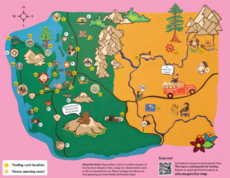
Discover Washington’s Tribal museums and cultural sites through the Tribal Cultural Roadmap, created by the Tribal Cultural Affairs program, artist Shana Yellow Calf, and Tribal partners. Be sure to pick up trading cards at starred locations to learn more about each Tribe and commemorate your visit.
American Indian Community Center provides social and economic development services while preserving the culture and traditions of Native people in the Spokane area.
Chief Seattle Club is a Native-led agency providing housing and human services, guided by Native values to end homelessness and nurture the spirit of urban Native people.
Course: Indian Country 101 is an online tribal engagement training series designed with Natural resource practitioners in mind and is built from the premise that you can’t work with tribes in the United States without first outlining the long and complicated history of tribes and governments.
Həłmxiłp Indigenous Birth Justice is an indigenous-led movement empowering community members through culturally rooted care across life stages—from pregnancy to menopause—while addressing systemic inequalities in health.
Mother Nation is a non-profit organization that delivers social and cultural healing services for Native women that nurture, create stability, and inspire growth through sisterhood.
Na'ah Illahee Fund is an Indigenous-led intermediary advancing climate justice, food sovereignty, and self-determination by moving resources to grassroots leaders and strengthening Indigenous communities across the Pacific Northwest.
Native Action Network is a nonprofit advancing Native women’s leadership and representation across all levels of government while affirming Native identities and fostering community-driven justice.
Outdoor Learning School & Store is a nonprofit rooted in Indigenous knowledge, building authentic relationships with diverse Indigenous communities to elevate their voices through outdoor education.
Pacific Northwest Native Lacrosse empowers Native youth through culturally rooted lacrosse programs that honor the Creator’s Game, foster leadership, and strengthen tribal community connections.
Setting Sun Circle is a nonprofit that shares stories rooted in Indigenous heritage to foster gratitude, honor ancestral responsibilities, and inspire a more connected and hopeful future.
The NATIVE Project provides services that promote wellness and balance of mind, body, and spirit for individuals, staff, families, and communities.
Unkitawa uses traditional art, culture, and ceremony to assist and support Indigenous communities in South King County, Washington State, and beyond to protect and heal the Earth for the benefit of all.
United Indians of All Tribes Foundation provides educational, cultural and social services that reconnect Indigenous people in the Puget Sound region to their heritage by strengthening their sense of belonging and significance as Native people.
Urban Native Education Alliance (UNEA) was founded in 2008 to engage generations of Native youth through education, culture, and tradition.
Washington Tribal Authors and Illustrators is a collection of books created by Washington State Tribal authors and artists which is featured in the OSPI Native Literacy Guidance published earlier this year on ONE's website.
|
Office updates, announcements, policy changes, funding opportunities, and important deadlines.
New Resource: Supporting Native Students Experiencing Foster Care
Five Guiding Practices for Schools
Native students experiencing foster care may navigate multiple systems, relationships, and responsibilities involving schools, families, caregivers, Tribal Nations, and community partners. Supporting students requires more than understanding policies and procedures. It also requires knowing who students are, honoring their identities and connections, and working together to ensure they receive the support, rights, and protections they deserve. Read more about Supporting Native Students Experiencing Foster Care.

Learning Standards Updates
Science Initial Adoption
The Initial Adoption of the Washington State K–12 Learning Standards for Science were released on October 15, 2026 in Bulletin 035-26.
The science learning standards: continue to use the Next Generation Science Standards (NGSS), include new Environment and Sustainability standards, update the numbering/coding, include multiple formats for displaying the standards, and highlight science experiences for students. The initial adoption learning standards for Science are available in a word, PDF, and excel spreadsheet format.
Educators are encouraged to review the initial adoption set of standards, then provide feedback via a survey. This feedback will be reviewed to determine updates for final adoption and the resources and support needed for implementation. The science standards documents and survey can be found here: Washington State Learning Standards Review.
For the most current information, check the Learning Standards and Instructional Materials website. Updates will also be provided in future newsletter editions.
|
Make Your Voice Heard: Join the WSNAEAC
Nominations Accepted Through November 30
The Office of Superintendent of Public Instruction (OSPI) is seeking nominations for membership on the Washington State Native American Education Advisory Committee (WSNAEAC). This committee provides Native American perspectives and guidance to the State Superintendent of Public Instruction, helping strengthen relationships among public schools, tribal compact schools, Tribal leadership, and Native communities throughout Washington.
We are currently recruiting for two vacancies:
Elementary/Secondary (East) Representative
Pre-K/Early Learning Representative
Print or download the WSNAEAC nomination form
Submit Nominations by November 30, 2026
We encourage Tribal Leaders and education partners to nominate individuals who are committed to advancing Native education and supporting Native student success. Your participation helps ensure Native voices are represented in educational decision-making across the state.
For more information, please read the WSNAEAC recruitment memo, visit the WSNAEAC website, or contact the Office of Native Education.

ESSA Tribal Consultation Office Hours
To support districts in meeting the ESSA Tribal Consultation requirement, the Office of Native Education is hosting weekly Office Hours.
The sessions provide a dedicated opportunity for participants to ask questions, share insights, and receive updates related to Tribal Consultation processes, including Strengthening Tribal Consultation and Administrator Government to Government Relationships Training initiatives.
Fridays, now through November 27
11am–12pm | Join on Teams
The discussions are open to Tribal Education Departments, Local Education Agencies (LEAs), school directors, school administrators, and other interested partners. Sessions are held in a group setting and may include multiple participants to encourage collaboration, shared learning, and collective problem-solving.
Whether you are new to ESSA Tribal Consultation or looking for support with this year's requirements, we encourage you to participate.
|
Highlights from Tribal visits, school districts, conferences, community partnerships, and staff engagement across Washington.
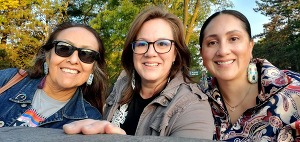
Members of the ONE Team Share Experiences from the NIEA Conference
The Office of Native Education (ONE) attended the National Indian Education Association (NIEA) Conference in Buffalo, New York, where this year's theme, “Strength in Community: Building the Future Together,” highlighted our shared commitment to supporting Native students and advancing education systems that honor tribal sovereignty, language, and identity.
Attending the conference helped the staff at ONE strengthen partnerships with Tribal leaders, Native education advocates, and state and national organizations dedicated to Native student success while learning from promising practices across the country. The conference also helped to support ONE’s ongoing efforts to strengthen tribal consultation and collaboration among OSPI, tribal governments, school districts, tribal schools, Native communities, and Tribal Education Compact schools to better serve Native students and families.
Pictured from left to right: Maxine Alex, Tribal Consultation Program Supervisor | Kathrine Lawrence, Administrative Program Specialist | Bawaajigekwe Boulley, Native Student Success Program Supervisor
|
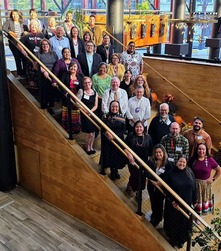
IESLN Annual Meeting & 10-Year Celebration at NIEA
During the National Indian Education Association (NIEA) Convention, the Office of Native Education (ONE) joined fellow members of the Indigenous Education State Leaders Network (IESLN) for its annual meeting and a celebration of ten years of collaboration, leadership, and advocacy for Indigenous education.
Founded in 2016, IESLN is a community of practice that brings together state education agency leaders and partners from across the country to improve outcomes for Native students through relationship-building, policy advancement, and the sharing of promising practices. ONE would also like to acknowledge Dr. Elese Washines and Dr. Kenneth Olden, members of the IESLN research arm, for their valuable contributions. We extend our apologies if any contributors were inadvertently omitted.
As IESLN celebrates its tenth year, we also honor the conclusion of a decade-long grant that supported Native education initiatives across the nation. Through research, advocacy, cross-state collaboration, and the advancement of promising practices such as accurate identification of Title VI Indian Education Students, supporting Max AI/AN Identification, research promising practices in Tribal Consultation, IESLN helped strengthen systems and opportunities for Native students. Join us as we celebrate the impact of this work, recognize the other State leaders across the nation who made it possible, and reflect on the enduring legacy of this important work.
Learn more about IESLN and its work:
IESLN Home Page
IESLN Membership and History
IESLN Resources
Together, we celebrate ten years of strengthening Indigenous education systems and reaffirm our commitment to Native student success for generations to come. ONE would like to acknowledge IESLN’s fiscal support to attend this meeting and travel to NIEA.
|
A featured story showcasing promising practices, educator innovation, Tribal partnerships, and/or student success.
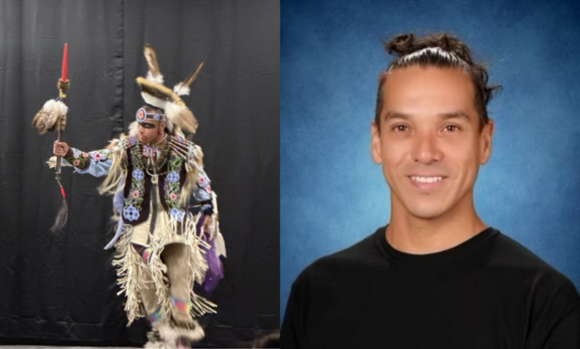 Chibron Tomeo | Leading Through Culture, Connection, and Care
Physical Education Teacher and Track & Field Coach | Spokane International Academy
Member of the Spokane Tribe
Nominated by Morgen Flowers-Washington, Head of School, Spokane International Academy
In celebration of Native American Heritage Month, we are honored to recognize Chibron Tomeo, an educator whose leadership demonstrates the power of cultural identity, meaningful relationships, and advocacy in supporting Native student success.
For six years, Chibron has served students from kindergarten through high school at Spokane International Academy, creating an environment where young people feel seen, heard, and safe. As a member of the Spokane Tribe, he brings his cultural knowledge and community connections into the school. During Native American Heritage Month, Chibron and his family have shared traditional cultural dances with students, creating meaningful opportunities for cultural learning, visibility, and appreciation.
Chibron's leadership extends well beyond the gymnasium. As a member of the Head of School Advisory Committee, he advocates for students and colleagues, helping shape school practices that prioritize safety and belonging. His recent advocacy contributed to improvements in the school's master schedule, supporting safer and smoother transitions for students throughout the day.
A former college athlete, Chibron also brings his experience to coaching track and field. During the 2025–26 school year, he coached two students to the state meet. Beyond athletic accomplishments, he mentors students through injuries, celebrates their personal growth, and works alongside families to help young people succeed.
Chibron's story reminds us that Native student success is strengthened when students have educators who honor their identities, build trusting relationships, and advocate for their well-being. His contributions reflect the importance of Native representation in education and the many ways Indigenous educators enrich our schools and communities.
Congratulations, Chibron, and miigwech for the care, leadership, and cultural knowledge you share with students, families, and colleagues.
With appreciation to Morgen Flowers-Washington and Spokane International Academy for sharing Chibron's story and helping us celebrate Indigenous excellence in education.
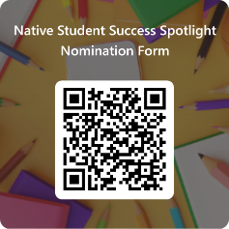
Help Us Find Our Next Native Student Success Spotlight
Do you know a student, educator, program, or community member doing meaningful work to support Native student success? We want to celebrate them!
We have made nominations easier with a new Native Student Success Spotlight Nomination Form. Share who you would like to recognize, tell us a little about what they are doing and why it matters, and we will take it from there.
Scan the QR code to submit a nomination
Photos, links, and student-created work are welcome, but not required. The nomination form also includes information about photo permissions for nominees under 18.
|
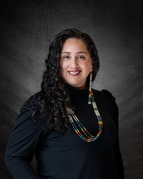
Native Student Success Office Hours: Let’s Connect
Dear Readers,
I hold virtual office hours every Friday at 10:00 am. If you are a student, family member, educator, or community partner and want to connect, share feedback, or process together, I invite you to email me for the virtual link.
We are doing this work together, and I would love to hear from you.
Sincerely,
Bawaajigekwe Boulley
bawaajigekwe.boulley@k12.wa.us
|
Upcoming trainings, conferences, webinars, registration links, and learning resources.

Administrators Government-to-Government (G2G) Relationships Training
House Bill 1426 (2022) mandates in renewing an administrator certificate on or after July 1, 2023, continuing administrators must attend a 5-hour Government-to-Government Relationships Training to focus on:
- Introduction to Tribal Sovereignty in Washington State
- Boarding Schools and Historical Trauma
- Identifying Native Students in Public Schools
- Agents of Change: School Leadership Behaviors and Dispositions
- Creation of Government-to-Government Systems
Next G2G Training:
Note: Last live training before January 1, 2027 recertification deadline.
December 11 | WSU Vancouver Campus | Vancouver, WA
Visit the Tribal Consultation website for more information about G2G training.
|
Upcoming events, grant deadlines, observances, and opportunities to engage with the Office of Native Education.
November invites us to celebrate Native American Heritage Month, a time to honor the past, recognize the present, and look toward a future shaped by respect, understanding, and strong partnerships with Tribal Nations and Native communities. We acknowledge the important contributions Native peoples continue to make in education, leadership, culture, and community life.
Throughout this month and beyond, our office remains dedicated to supporting Native students, families, educators, communities, and Tribes across Washington. We are committed to providing resources, fostering collaboration, and creating opportunities that promote student success, educational equity, and a strong sense of belonging for every learner.
If you have questions or need support, please feel free to email us at NativeEducation@k12.wa.us.
We value our partnership with you and look forward to continuing to work together in support of Native students and communities across Washington.
Sincerely,
Bawaajigekwe Boulley
Maxine Alex
Kathrine Lawrence
Kari Tally
The Office of Native Education shares resources, learning opportunities, and information to support educators, families, and communities. Inclusion in this newsletter does not constitute endorsement by the Washington Office of Superintendent of Public Instruction (OSPI). Some resources may be intended for educators, families, or community members and may not be designed for classroom use. We encourage recipients to review all materials for alignment with district policies, local needs, and applicable state and federal requirements before implementation. The views and opinions expressed in linked articles, events, and external resources do not necessarily reflect those of OSPI or the Office of Native Education.
Explore past newsletters through the Native Education Newsletter Archives.
|