|
The Washington State Board of Education approved a legislative proposal to comprehensively update Washington’s high school graduation requirements at its meeting on September 10. The Board’s proposal will be presented to the Legislature for consideration during the 2027 legislative session.
On September 16, Board staff held a press conference to provide an overview of the proposal and answer questions from members of the media. You can watch a recording of that presentation here.
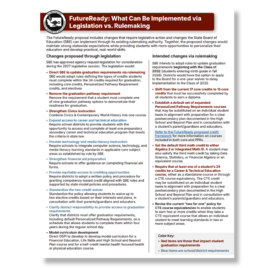
Some elements of the FutureReady proposal would require legislative action, while others fall within the Board’s existing rulemaking authority.
During the Board’s October 14-15 meeting, members will hold a work session on FutureReady to review a draft of proposed rules that can be implemented through the Board’s rulemaking authority. Members will provide feedback to staff on adjustments in advance of voting on proposed rules at their December 2026 meeting. If rules are approved in December, the Board would open a public comment period, which would stay open throughout the 2027 Legislative Session. The Board will provide additional information about the rulemaking process and opportunities for public comment as that work progresses.
What Would the Proposal Do?
The proposal combines strong academic expectations with meaningful, personalized learning to ensure every student graduates ready to succeed in a rapidly changing world.
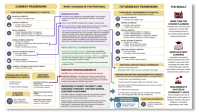
- Remove the current requirement that students complete one of nine graduation pathway options and instead demonstrate readiness through successful completion of strengthened credit and subject-area requirements and a meaningful High School and Beyond Plan (HSBP).
- Update requirements within the existing 24-credit framework to strengthen learning in financial education, technology and media literacy, mathematics, civics, and mental health.
- Better balance core and flexible credits to give students more opportunities to pursue coursework aligned with their postsecondary goals.
Changes would only take effect if the Legislature provides needed funding, as determined by the Office of the Superintendent of Public Instruction.
More opportunities for meaningful learning connected to student goals and supported by personalized guidance
The proposal expands Personalized Pathway Requirements (PPRs) from three to five credits. At the same time, it would create a set of default courses in PPRs designed to keep most postsecondary options open. To make a course substitution, a student must work with their parents/guardians and counselors to decide what courses would better prepare them for the postsecondary goal in their HSBP. This ensures flexibility is used thoughtfully.
The proposal would integrate instructional time into the framework for students to explore their postsecondary goals through the HSBP by including a one-credit course in PPRs dedicated to Financial Education, Life Skills, and High School and Beyond Plan instruction. This, paired with the expanded PPRs, would give students more opportunities to use the HSBP to align their course taking to their postsecondary goals.
Finally, the proposal would remove the current requirement that students complete one of nine graduation pathway options and instead allow students to demonstrate readiness through successful completion of strengthened credit and subject-area requirements and a meaningful High School and Beyond Plan.
More student preparation in skills they need to be ready for success after graduation
The proposal adds or strengthens instruction in subjects that students, educators, and employers say are needed for the future and have been long requested by communities.
- Create a one-credit PPR course focused on financial education, life skills, and High School and Beyond Plan instruction.
-
Expand Career and Technical Education (CTE) opportunities and access by requiring all schools to offer at least one CTE course sequence. CTE would remain part of the credit framework as a flexible requirement that students are expected to take but could be substituted based on their High School and Beyond Plan, in consultation with parents/guardians and educators.
- Strengthen math expectations by setting the default third math credit to either Algebra 2 or Integrated Math III (or substitute with Data Science, Statistics, or Financial Algebra based on a student's HSBP goal). Additionally, the proposal adds a senior year quantitative reasoning course as one of the default PPRs.
- Require schools to integrate computer science, technology, and media literacy learning standards in applicable core subject areas as established by rule by SBE.
- Give students more opportunities to receive mental health education by requiring schools to offer a 0.5-credit health or physical education course focused on mental health and wellness.
-
Strengthen civics education by requiring a year-long Civics course that incorporates contemporary issues through a civic lens. This would combine the current 0.5-credit Civics course and 0.5-credit Contemporary World History, Geography, and Problems course into a single one-credit Civics course. Rather than separating government, current events, and civic participation into separate courses, students would examine real-world issues while developing a deeper understanding of democratic institutions, civic responsibility, and public policy.
Establish clearer statewide expectations while giving students and districts flexibility in how those expectations are met.
The proposal would establish consistent statewide policies for how students can earn competency-based credit, PE excusals tied to athletic participation, and language credits as a multilingual learner. Creating statewide policies ensures that a student’s location is no longer the determining factor in whether they can benefit from these policies.
The proposal also encourages districts to utilize existing flexibility in CTE course equivalencies by allowing students to earn two credits when a CTE course provides students with the opportunity to demonstrate competency in both the CTE standards and academic course standards.
To support districts in implementation, the proposal tasks relevant agencies with creating model curriculum for new courses, ensures that graduation requirement changes identified as having a fiscal impact would not take effect until funded by the Legislature, and preserves local control in setting additional graduation requirements.

Frequently Asked Questions Page
The Board has collected the most frequent questions we’ve received and created an FAQ page. This page includes information about the recommendation development process, credit and subject-area requirements, implementation, funding, and more.
Click here to visit our FAQ page.
|
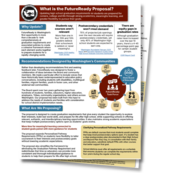
"What is the FutureReady Proposal?" Informational Handout
This handout provides a brief overview of the Board’s proposal. It explains why the Board is proposing changes, how the proposal was shaped through community engagement, and what would change for students.
Click here to view the handout.
|
|