|
Board Approves Resolution to Advance Graduation Requirements Proposal |
|
|
The Washington State Board of Education took an important step forward in its FutureReady work during its August 12–13 meeting by approving a resolution that sets the direction for proposed updates to Washington’s high school graduation requirements. During their September 10 meeting, Board members will consider approval of agency request legislation and proposed rules based on the adopted resolution.
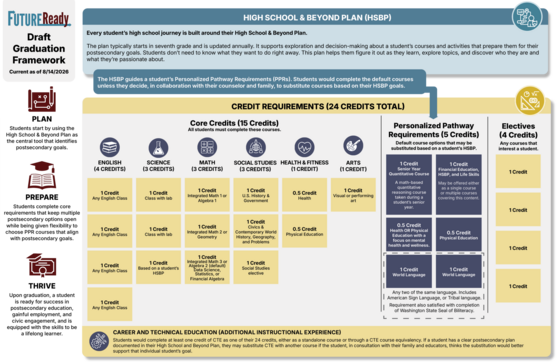 The State Board of Education's proposed graduation requirement framework. Click the graphic to view a PDF version.
The resolution does introduce a few notable changes to the proposal that we want to highlight:
Implementation Timeline: The resolution establishes the Board’s intent to request legislation that would enact the following timeline for implementation:
- The Graduation Pathway Requirement would be removed as a requirement to earn a diploma upon passage of this legislation.
-
All other changes requiring legislative action would, at the earliest, be implemented as a requirement for the Class of 2032 (students entering ninth grade in fall 2028).
-
For changes that can be implemented through the Board’s rulemaking authority, and that have no state fiscal impact, as determined by the Office of Superintendent of Public Instruction, most changes would go into effect for the Class of 2032 (students entering ninth grade in fall 2028). Some system changes that do not impact credit requirements for students might be implemented earlier based on guidance from stakeholders.
Expand CTE Opportunities and Flexibility: The resolution clarifies that, at a minimum, one of a student's 24 credits is expected to be a CTE course, either as a standalone course or through a CTE course equivalency. Students could substitute the CTE credit on an individual basis when aligned with a clear postsecondary plan documented in their High School and Beyond Plan and developed in consultation with their families and educators. Additionally, the proposal would require school districts to offer at least one CTE course sequence that meets the state's criteria for preparatory CTE programs as noted in RCW 28A.700.030. Refer to our FAQ section on CTE for more information.
Technology and Media Literacy: The resolution adds a requirement that instruction in technology and media literacy be provided at all grade levels through an interdisciplinary approach, including English language arts, science, social studies, and other appropriate content areas.
Health & Fitness PPR: The resolution modifies the previously proposed 0.5-credit Health requirement within the Personalized Pathway Requirements. Students could now meet this requirement through a Health or a Physical Education course focused on mental health and wellness. Refer to our FAQ section on health and fitness for more information.
The resolution represents an important milestone, but this work is not finished.
With the resolution approved, Board staff will continue working with stakeholders to develop draft legislation and rules that reflect the Board's direction. The Board is expected to consider a draft legislative proposal at its September 10 meeting for potential introduction during the 2027 legislative session.
The Board is expected to release draft rules in fall 2026 for recommendations that can be implemented by the Board’s rulemaking process. The Board will share more information about the rulemaking timeline, including opportunities for public comment, as information is available. Final rules will not be adopted until after the 2027 legislative session.

Frequently Asked Questions Page
The Board has collected the most frequent questions we’ve received and created an FAQ page. This page includes information about the recommendation development process, credit and subject-area requirements, implementation, funding, and more.
Click here to visit our FAQ page.
|
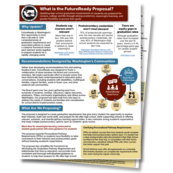
"What is the FutureReady Proposal?" Informational Handout
A brief overview of the Board’s proposal. It explains why the Board is proposing changes, how the proposal was shaped through community engagement, and what would change for students.
Click here to view the handout.
|
|
|
|
|