|
You can find more information on the MBLC website or check out our Google Calendar of Events.
We have completed our professional development and networking events for the 2025-26 school year, and we look forward to seeing you all again next year as we continue this work.
May 5th Spring Gathering
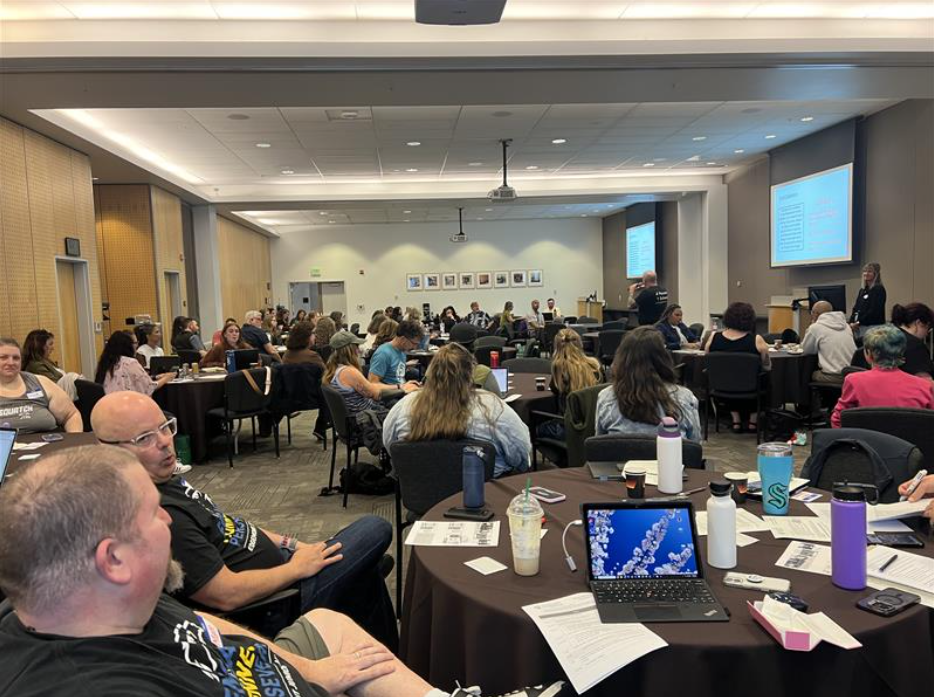
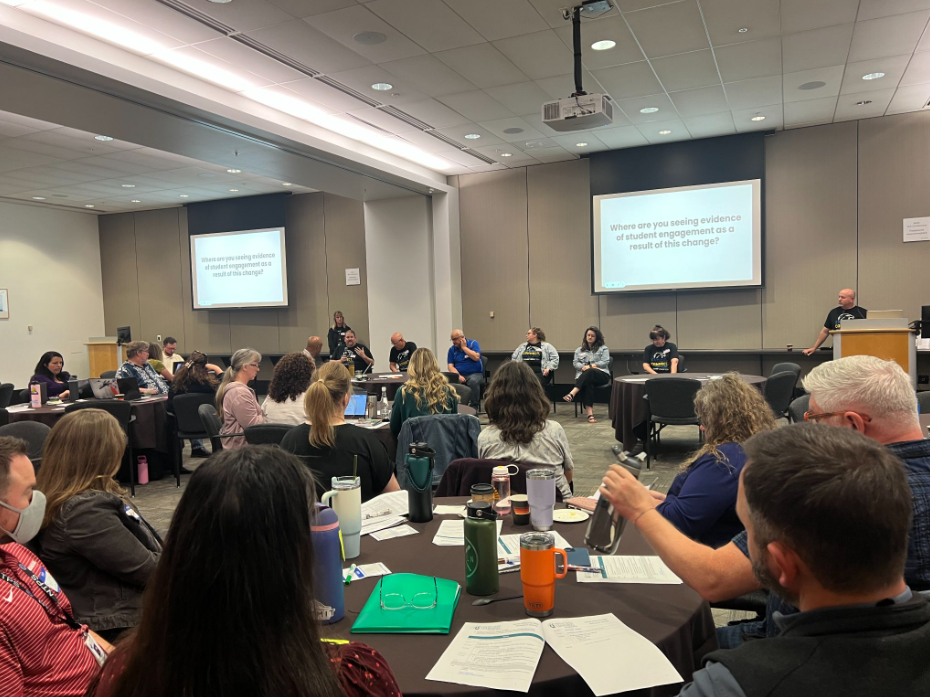
Our full community gathered at The Conference Center at Seattle-Tacoma International Airport. This was a full-day event run by our exemplar MBLC schools (Living Lab Schools) and our lead MBLC educators working to coach others on MBL practices (our Impact Fellows). It was a fantastic day of learning and sharing!
A huge thank you to our entire MBLC community for engaging throughout the day and for sharing your insights, wisdom, authenticity, and humor. Check out these photos from the day!
MBLC school teams listen to a Living Lab school presentation during the MBLC 2026 Spring Gathering.
Educators from Living Lab Schools discuss important elements of implementation progress during a presentation at the MBLC 2026 Spring Gathering.
OTHER ANNOUNCEMENTS AND OPPORTUNITIES
June 16–18; Napa Valley, California
PBL World is the flagship event for Project-Based Learning (PBL) hosted by PBLWorks. This event is ideal for educators and school leaders looking to deepen their PBL practices through hands-on workshops.
July 20–23; Memphis, Tennessee
Big Bang brings together students, educators, and community leaders for a powerful exploration of student-centered learning and school transformation.
FullScale Symposium
October 8-10, 2026, Indianapolis, IN
The Symposium is the premiere event for learning about next generation learning models, anytime, anywhere learning, the latest policy developments to enable the future, research and best practices around innovations, and trends around future-focused education transformation.
Here are some MBLC highlights from our coaches. Enjoy, and let us know your wish list for next time!
It’s Never Too Late to Learn, Part 2: Revisions and Retakes
By Elis Kanner
In the MBLC March Newsletter, “It’s Never Too Late to Learn,” Great Schools Partnership Senior Associate Kate Gardoqui describes the grading policies and school structures that make meeting grade-level expectations a reality for nearly every student at Del Lago Academy, a competency-based high school in California. In this newsletter, we deepen our exploration of what it takes to translate the belief “It’s Never Too Late to Learn” into reality by focusing on how to embed frequent opportunities for retakes and revisions into all aspects of schooling—from lessons to schedules.
First, let’s review what we mean by revisions and retakes. At the classroom level, an effective revision process includes the following steps:
- Analyzing student work (based on clear criteria for success aligned to the standard or performance indicator) to identify gaps in understanding
- Providing instruction to address gaps
- Identifying or creating a task to reassess the target area (often a different task than the original one)
- Assessing the revision
- Repeating this process until the learner reaches proficiency
- Updating the grade for that target standard, performance indicator, or competency
- Celebrating growth
When revisions and retakes include all of these steps, they offer students the opportunity to confront misconceptions, gain new insights, and deepen existing understandings. They also allow students to reflect on the quality of their work, practice metacognition, and ultimately develop a confident scholar identity—the kind of self-efficacy that comes from having evidence that they truly can learn and achieve at high levels.
Next, let’s consider why opportunities for retakes and revisions are an essential component of competency-based education (synonymous with mastery-based learning). In a traditional school, if a student does not demonstrate mastery of every standard, they often still move on to the next level because scores are averaged or because you can pass with a D. However, in a competency-based system, students do not advance to the next level without demonstrating proficiency. Therefore, without frequent, consistent, and structured opportunities for retakes and revisions, students (and teachers) would be set up to “fail” whenever a first attempt does not meet rigorous expectations. Humans learn through repeated cycles of trial, error, and feedback; we rarely get things “right” the first time—especially when engaging in cognitively demanding tasks. Therefore, in a school where we expect all students to reach mastery, revision is not a “nice-to-have” strategy—it is essential to the learning process.
Like all things in education, there are reasonable concerns about giving students frequent opportunities to revise their work. Let’s consider five common critiques and misconceptions.
Misconception #1: Students try less the first time if they know they will get another attempt.
Correction: Students engage more when they know they are being held to high expectations and supported to get there. This is a valid concern, and the system you build must take it into account. When students know that they will need to meet high expectations in order to pass, they have an incentive to try their best from the start. In systems with demanding criteria for passing, most learners soon figure out that consistent engagement is the best way to stay on track.
Misconception #2: Revisions and retakes always occur after the deadline.
Correction: Opportunities for revision are built into the learning process. Because multiple factors impact learner variability (e.g., prior knowledge and skills, interest, attendance, learning profile, language proficiency), competency-based learning is most effective when opportunities for revision are built into the learning process. In all subject areas—not just ELA—educators can build in opportunities to receive feedback and retake formative assessments until proficiency is demonstrated and students are ready for a summative (i.e., unit, midterm, or final) exam.
Misconception #3: Students only take advantage of opportunities to revise because they miss deadlines.
Correction: Students need opportunities to revise because meeting high expectations is challenging. In most cases, the diversity and complexity of the learning and teaching process—not lackluster work habits—explain why students need repeated attempts to reach mastery. However, there are certainly instances when missing a deadline is the reason a student has not yet demonstrated mastery.
Misconception #4: Allowing retakes and revisions means abandoning accountability.
Correction: We can separate content learning from feedback on work habits. Schools can create policies that maximize opportunities for learning while still maintaining sensible deadlines. To avoid chaos and confusion—especially at the end of marking periods—schools should establish clear retake policies, including timelines, how extenuating circumstances will be handled, and consequences for missing deadlines. Students need and deserve feedback on how their work habits support or undermine their learning, but this feedback must be distinct from feedback on content understanding. Many schools separate work habits (such as time management) from content mastery by assessing them as distinct competencies. (This also makes it clear that the school needs to actively teach time management and how to manage deadlines, and actively help students develop those skills, rather than sit in judgement of whether the student has come to them with those skills.)
Misconception #5: Allowing revisions does not prepare students for college or the real world.
Correction: The real world rarely expects mastery on the first attempt - learning to use the revision process well is a life skill. In most real-world contexts, revision is expected—especially during the learning stage. For example, if you do not pass your drivers test on your first try, you keep trying until you succeed. The same is true for professional exams in fields such as electrical work, plumbing, and medicine—many people take these exams multiple times. However, it is also good for students to learn the skill of preparing to do well on their first attempt, because second tries can be expensive. To mirror this reality, students should take increasing responsibility for managing the process of retakes as they get older. For example, high school students should take greater responsibility for seeking feedback, requesting support, and managing timelines. Educators can set up office hours to mirror how students are expected to receive support in college. And, especially as students get older, retaking major assessments, like in the real world, comes at the cost of time that could be spent engaged in other activities.
Summary
Once you accept that retakes and revisions are a necessary part of the learning process, nearly everything about school begins to change. Instead of revision being the exception, it becomes the norm. For maximum impact on student learning, this shift requires rethinking everything from classroom routines to school schedules and grading policies. The goal of a retake system is to avoid situations in which both students and teachers give up on learning because something was not mastered the first time. However, allowing retakes and revisions does not mean abandoning deadlines and accountability. Three school-level conditions are essential for a retake system to effectively support student progress:
- A grading system that communicates high expectations and defines passing as true proficiency
- Work habits assessed separately from academic performance
- Clearly communicated limits on when and how students can access opportunities to revise or retake assessments
We have developed a Revisions and Retakes Resource to support you in building effective routines and structures at the classroom, grade, and whole-school level. Please reach out to your coach for support in designing your system; we are excited to partner with you in this important work.
For a deeper investigation of grading practices aligned with competency-based learning, including many practical examples, see Equitable Grading Unlocked: Practical Strategies from the Classroom (2026).
READ THIS, WATCH THAT!
Transformation Journey: Lake City Area Schools
Listen to or read the transcript of Getting Smart’s podcast about a courageous school district in Michigan that chose to commit to transforming their system to a fully competency-based model in order to nurture a more equitable, student-centered, and fair model of teaching and learning for their students.
Shifting Your Grading Practices: 8 Examples from the Field
Learn from examples across the country about how to effectively implement student-centered grading practices in competency-based teaching and learning environments.
A Bridge to the future of state assessment
Read Transcend’s report on the future of state assessment and how they address the following question: what vision for assessment should guide us in a world where we aim to transform the student experience while also preserving the core goals—rigor, transparency, and fairness—of our current assessment systems?
|