|
The State Board of Education and the FutureReady Task Force are close to completing a first draft of conceptual recommendations for updating Washington’s high school graduation requirements.
On March 20, the FutureReady Task Force met to build consensus on credit and subject area requirements and began synthesizing ideas into a comprehensive set of conceptual recommendations. During the meeting, members reviewed feedback gathered through community engagement efforts, along with recommendations developed by FutureReady’s three subject-area subcommittees. Task Force members made meaningful progress toward agreement, informed by the many perspectives contributing to this process. Read the meeting summary to learn more about the discussion. The Task Force will continue this work at its next meeting on May 21, and the Board will also discuss emerging concepts at its April meeting.
Running in tandem with recommendation development, the Board's engagement team has been working with organizations across Washington to host listening sessions designed to gather input from communities whose voices are essential to this work. To date, we have received input from hundreds of students, school staff, families, and community members through both community-led listening sessions and Board-organized activities.
This input reflects a range of perspectives, including those of tribal communities, Black communities and other racialized communities who have historically been underserved by the education system, rural students, college students, and military-connected families. We have also intentionally gathered feedback from a variety of learning environments, including traditional public schools, alternative schools, skill centers, and online schools.
This feedback continues to directly inform Task Force and Board discussions and helps ensure that voices not traditionally included in education policy conversations are represented.
Following the Task Force’s May 21 meeting, we anticipate completing a first draft of conceptual recommendations. These early-stage recommendations will be shared with education stakeholders across the state for additional feedback and refinement. Community input at this stage will help shape the next phase of work: developing technical recommendations.
Technical recommendations will translate the conceptual ideas into a more detailed framework. This includes outlining how updated requirements could function in practice and identifying potential implementation supports for school districts, administrators, and educators. We anticipate completing technical recommendations in mid-summer 2026. These technical recommendations will be used to prepare a legislative proposal for consideration during the 2027 Legislative Session.
Throughout this work, the Board and Task Force will continue to seek input from a wide range of partners, including students and families, educators, school and district leaders, employers, tribal education partners, higher education representatives, and community-based organizations. Ongoing engagement will remain a core part of refining recommendations before they are finalized.
Click the image to view a full-sized version.
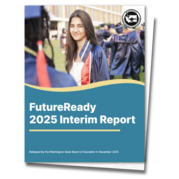
Read the FutureReady 2025 Interim Report
This report summarizes the work the Board and FutureReady Task Force have accomplished during their first year of work. It talks about why we’re updating requirements, our process for determining gaps in current graduation requirements, and what the next steps are as the FutureReady initiative prepares to develop recommendations.
📝 Read the Report Here
|
|
 |
-
Download our FutureReady Phase II handout for an overview of the initiative, its timeline, and what kind of topics we're exploring.
-
Our FutureReady FAQ section answers many of the questions we've received about the initiative.
-
Listen to our December 2025 webinar with League of Education Voters where staff talked about what we’ve learned over the past year of discussion and community engagement. We shared information about FutureReady's process for identifying the academic knowledge and real-world skills students need to succeed in today’s world and where Washington’s current graduation framework falls short in meeting students’ needs.
|