|
You can find more information on the MBLC website or check out our Google Calendar of Events.
MBLC School Intervisitation at Innovation Heights Academy (Registration Closed)
Tuesday, March 24th, 2026
9:30 a.m. - 2:00 p.m. PST
Innovation Heights Academy, Highline School District
(11427 3rd Ave S, Seattle, WA 98168)
During the visit, attendees will be observing classroom instruction, hearing from teachers and school leaders, and hearing from a student panel. The focus areas for the visit will be Co-teaching, Use of Competencies, and Project-based Learning.
MBLC Spring Gathering
Tuesday, May 5th, 2026
10:00 a.m. - 3:00 p.m. PST
The Conference Center at Seattle-Tacoma International Airport
(17801 International Blvd, SeaTac, WA 98158)
This is a full-day event run by our exemplar MBLC schools (Living Lab Schools) and our lead MBLC educators working to coach others on MBL practices (our Impact Fellows).
There will be highly interactive small-group protocols run by our Impact Fellows in the afternoon. Participation in these sessions will require some knowledge of MBL frameworks and practices. We ask that non-MBLC participants come with some knowledge or awareness of MBL practices.
Light morning refreshments, coffee, and lunch will be provided.
Registration Information
Please complete the official registration form by Friday, March 27th, 2026.
Priority registration will be reserved for MBLC school teams.
Please note that each attendee must complete a unique form. Clock hours will be available for this event, provided by SBE. Please indicate whether you intend to request clock hours in your registration form.
This event only has a few spots left. Please register soon!
OTHER ANNOUNCEMENTS AND OPPORTUNITIES
Help Spread the Word: State Board Accepting Applications for New Student Board Member
Do you know a high school sophomore interested in representing their fellow students? The Washington State Board of Education is accepting applications for its next Student Board Member, until Tuesday, March 31.
Educators, counselors, and community leaders: please consider sharing this opportunity with students in your network. Student board members help represent the perspectives of more than one million students and participate directly in statewide education policy discussions.
Learn more and access the application on the Board’s website.
Eligibility
Applicants must be current sophomores (rising juniors) who will attend a public or private school in Washington during the 2026–2028 term and demonstrate a positive academic and/or extracurricular record. No prior experience in education policy or formal student leadership is required.
Getting Smart's List of 2026 Education Conferences
Check out Getting Smart’s list of can’t miss education conferences in 2026! Some conferences to note from this list:
Deeper Learning Conference
March 30–April 1; San Diego, California
High Tech High continues its tradition of fostering equity-focused education by immersing attendees in innovative practices and student-centered learning.
April 29–May 1; Los Angeles, California
EdLoc’s National Convening gathers leaders of color in education to break down silos and share strategies for dismantling systemic barriers to success for students of color.
June 16–18; Napa Valley, California
PBL World is the flagship event for Project-Based Learning (PBL) hosted by PBLWorks. This event is ideal for educators and school leaders looking to deepen their PBL practices through hands-on workshops.
July 20–23; Memphis, Tennessee
Big Bang brings together students, educators, and community leaders for a powerful exploration of student-centered learning and school transformation.
FullScale Symposium
October 2026; Indianapolis, Indiana
Details coming soon.
Here are some MBLC highlights from our coaches. Enjoy, and let us know your wish list for next time!
It’s Never Too Late to Learn: How One Competency-based School Holds Students to Higher Standards
By Kate Gardoqui
At the MBLC Meeting on March 17, 2026, we were lucky to be joined by a guest speaker from Del Lago Academy in Escondido, California. Alyssa Wallace, a Teacher on Special Assignment for Instructional Interventions and Instructional Coach, talked about how her school has built a wide variety of interconnected structures to help all students gain a high level of academic achievement.
Del Lago serves approximately 800 students. According to the 2024-2025 School Accountability Report Card, over 70% of Del Lago students are economically disadvantaged and 10% are English Language Learners. Approximately 95% of Del Lago students pass all of their courses every year - not because teachers lower the bar to let them through, but because they refuse to give up on their students and have high expectations for each student. This remarkable outcome is the result of a carefully designed system built on three pillars: intentional inclusion, competency-based grading, and flexible structures that give every student the time and support they need to succeed.
It might be easy to assume, based on Del Lago’s impressive passing rate, that the school is selective. However, intentional inclusion is one of the central tenets of Del Lago, and admission is granted solely on the basis of a lottery. The school recruits a cross-section of the Escondido community, meaning that its demographics mirror those of any other public school in the city. A responsive culture designed to foster restorative practice and caring relationships helps all of these diverse students feel a sense of belonging. This culture is the foundation on which Del Lago educators have built their intervention and student support structures. Although the various intervention systems are impressive, it’s important to remember that this responsive culture is essential as well.
Among the artifacts that Alyssa shared with the MBLC educators was the Del Lago grading scale. This grading scale illustrates the high bar that is set for students: students must demonstrate minimum competency (a level that corresponds to a “C” in a traditional grading scale) in EVERY competency within a class in order to pass. If a student earns grades between C and A for all but one competency, and does not get to the level of a C in the last competency, they need to work with their teachers until they have demonstrated sufficient strength in that last competency before passing the class and moving on.
This grade scale may seem harsh at first - it represents a higher bar than can be found in many traditional schools, where students can skate by with D’s. However, the increased rigor works because it comes along with so many structures designed to show students that they CAN meet higher expectations. Students who have not shown competency in every category at the end of a grading term receive a “No Mark,” rather than a D or an F, and then have 16 weeks to try to make up whatever competencies were missing.
One key to Del Lago’s ability to hold students to high standards is that when a student receives a “No Mark,” this does not indicate a final failure; rather, it is an expected part of the learning journey and an invitation to keep going. Students who are working to make up competencies have many structures they can access to do so. Twice a week, all students have a 45-minute flex period called “X-Block,” which teachers use for targeted re-teaching and re-assessment. (Online scheduling software is used to organize students into these blocks). After school and lunch tutorials are funded through Title 1 dollars, and teachers offer recorded online lessons, peer tutoring, and extended evening tutorials as other interventions.
What this means is that Del Lago educators have used tremendous creativity to add many, many more units of time into the school year when students can go back and deepen their learning or strengthen their skills. This provision of extra time is what not giving up on students looks like in practice.
One drawback to providing extra time for students to demonstrate competency can be that students abuse the privilege and put off their work until the last minute. To prevent this, Del Lago teachers have built an 8-week interim deadline. Students who have not cleared their No Marks by that point are required to attend a mandatory “lock-in,” - a four hour after-school session with the teacher and tutors. Some students dread this and it serves as a useful deterrent to waiting too long; other students, however, attend by choice, appreciating 4 uninterrupted hours to get work done with the support of tutors.
Other structures that help students meet the high bar of the grading scale are the systems that make space for teachers to meet together regularly to discuss students’ needs. Teachers work in grade level “villages” sharing the same 100 students, which allows them to pool instructional time, grouping students strategically for interventions. Most teachers have only one or two classes to prepare for, which enables them to spend more planning time thinking about interventions. And for the school’s highest-need students, a Comprehensive Students Assistance Team meets every two weeks to review a live data dashboard tracking academics and social-emotional indicators and build individualized plans.
The systems and structures at Del Lago are the result of more than a decade of work; as Alyssa said, “we are constantly, constantly evaluating and revising and tweaking and refining.” The results speak for themselves: the 95% passing rate, along with science and ELA scores significantly above the state and district, reflect what becomes possible when a school treats mastery not as a sorting mechanism but as an expectation for everyone. The school’s approach asks more of students, not less. But it also gives them all the time, support and encouragement they need to get there.
Del Lago Grading Scale
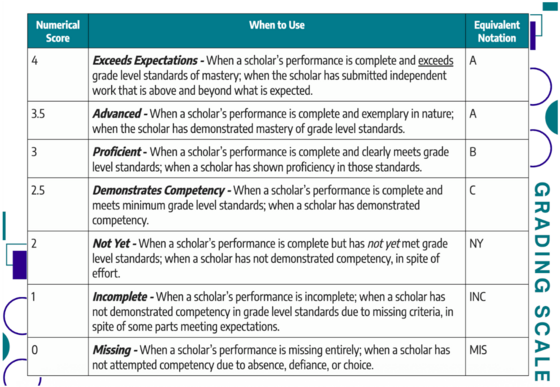 Del Lago Handbook Excerpts Shared by Alyssa Wallace: Del Lago Academy handbook materials
READ THIS, WATCH THAT!
A study by the Brookings Institution finds that the potential risks to students of generative artificial intelligence (AI) use outweigh the benefits. This report discusses these risks and offers a framework for action.
KnowledgeWorks reminds us about the key differences between traditional grading systems and competency-based grading systems, emphasizing that competency-based grading increases equity, fairness, and student ownership by tying grades to transparent, clearly defined learning expectations.
Research shows that in math classrooms, use of “math” vocabulary is tied to stronger academic achievement when coupled with expert teaching practices. This article shows several strategies for building math language into daily lessons so students can begin using them to think and communicate mathematically.
|