Attendance improvement starts with strong Tier 1 strategies. Use your school's attendance data to identify universal patterns and build a culture of belonging. Lean into your already formed teams to dedicate attendance lead prevention efforts, plan early interventions, and monitor progress.
Explore OSPI's Teaming Routines Checklist, Team Meeting Agenda Template, and Tier 1 Attendance & Engagement Data tool. Let's work together to ensure every student is present, engaged, and supported!
|
Increase Taking Attendance

Taking daily attendance is vital for multiple reasons:
- Support student safety: inform parents if their child's where they are expected to be
- Help schools to identify patterns that can lead to attendance improvement
- Connect families and students to resources
Lincoln Nugent, a teacher at Selah High school, created a humorous video for staff that addresses the challenges and misconceptions surrounding the reliability of Tier 1 Attendance Data.
|
Attendance Conferences - Conversations with Parents

The Parent Conversations for Attendance Conferences is a guide that offers step-by-step prompts for warm, supportive conversations about their child's attendance. This tool supports school staff in fostering effective family-school collaboration.
Looking for more Tier 1: Building a Culture of Attendance for All Students, visit:
|
Connection to a Caring Adult
Personalized belongingness: 2x10

Do you know a student who is struggling with coming to school regularly? Research indicates that having a connection to one caring adult increases consistent school attendance. Try engaging with the student for 2 minutes daily for 10 days, discussing topics of their choice.
Topics to get the conversation started:
- Hobbies
- Pets
- Favorite candy
Check out the 2x10 Tracker to support staff in their interactions.
|
Strive for Less than 5 Days Absent.
 |
|
Attendance Works shares celebrations, tools, and resources for increased attendance. In their September newsletter, they highlighted that Suncoast Campaign for Grade-Level Reading is celebrating with a music video. |
When is your child too sick for school? - Health Infographic
Now available in 7 additional languages!
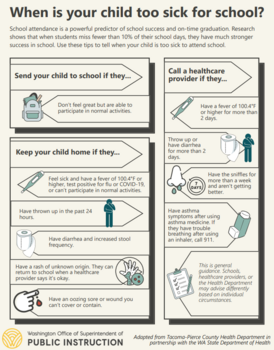
Our health infographic, originally released in English, is now available in seven additional languages.
OSPI, in collaboration with the Washington State Department of Health, has released a new health infographic adapted from the Tacoma-Pierce County Health Department.
This easy-to-use tool helps guide decisions about when students should stay home due to symptoms and when it's safe for them to attend school.
Schools are encouraged to use this resource to reinforce consistent messaging around student wellness and attendance.
You can find all translations of the health infographic on the Best Practices for Improving Attendance webpage; just scroll down to the expandable menu and look for the Tier 1: Building a Culture of Attendance (All Students) section.
Access all available versions here:
Arabic, Chinese, Dari, English, Russian, Spanish, Ukrainian, Vietnamese
|
School Attendance & Community Well-Being: A Public Health Approach to Chronic Absenteeism
National Center for Adolescent & Young Adult Health & Well-Being, from the American Academy of Pediatrics is hosting a collaborative roundtable with ASTHO, NASN, and Y-USA. They will explore chronic absenteeism as a public health issue and its impact on school and community well-being. The session will provide an overview of the challenge and spotlight resources to strengthen school-community partnerships. The roundtable will take place in a three-part format:
- Learn- Understand why chronic absenteeism matters.
- Practice- Explore strategies through breakout discussions.
- Do- Identify actionable next steps to address the issue.
The roundtable will be held at 11:00 AM PST on November 7, 2025, with a follow-up office hour on November 20, 2025.
22nd Annual Becca Conference 2025
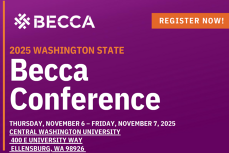
Registration Closes November 1, 2025.
The Becca Conference brings together experts representing education, justice, and community from across the region to provide new information, training, and development to professional and community members who support young people in their pursuit of successful post-secondary pathways, careers, and civic engagement.
-
When: Thursday, November 6th and Friday, November 7th, 2025
-
Where: Central Washington University, Ellensburg, Washington
|
What are District Requirements for Medical Documentation Regarding Excused/Unexcused Absences?
Under state statute (RCW 28A.225.020(2)), school districts have the flexibility to establish board policies that address excessive excused absences. This can include requiring medical documentation.
As highlighted in OSPI's Mental Health Related Absence Guidance (pg. 13), it is critical to consider the implications of requiring medical documentation. Securing and producing a doctor's note may not be equitable. Access to a doctor can be highly variable due to family circumstances and the lack of availability of local mental health care resources. Because requiring medical documentation before excusing absence for medical reasons would negatively and disproportionately impact families with lower-income and less flexible jobs, OSPI does not recommend instituting such a requirement.
Additionally, every individual requires a different frequency of care and healing time. OSPI strongly recommends that schools develop regular communication with students and families as part of their process before requiring medical documentation.
For more guidance regarding responding to excessive excused absences, please review the question: What can districts do about excessive excused absences?
|