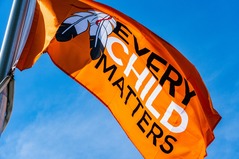
September 30th is a National Day of Remembrance
American Indian Boarding Schools & Orange Shirt Day
Orange Shirt Day, now recognized as the National Day for Truth and Reconciliation in Canada, is a statutory holiday that honors the survivors and acknowledges the lasting impact of the Indian residential school system. The observance has since been embraced in the United States as the National Day of Remembrance for those affected by the American Indian boarding school era, honoring the more than 150,000 Native American children who attended Indian boarding schools.
The U.S. Department of the Interior's Federal Indian Boarding School Initiative has documented 417 institutions across 37 states or territories, confirming that at least 973 American Indian, Alaska Native, and Native Hawaiian children died while attending boarding schools. These institutions operated with the explicit goal of cultural assimilation, using the philosophy of "kill the Indian, save the man."
Washington State's Boarding School History & Truth and Reconciliation Efforts
Washington State has established a Truth and Reconciliation Tribal Advisory Committee (TAC) to "conduct research and guide agency staff" in investigating the state's history of Indian boarding schools and developing "recommendations regarding how our state can address the harms caused by Indian boarding schools and other cultural and linguistic termination practices." As the committee states: "Truth and Reconciliation is a process that provides space and time to investigate, name, honor and address generations of harm caused by state and federal wrongdoings that benefited and empowered the white dominant culture through unjust means."
The TAC includes five appointed members: Rebecca Black (Quinault Indian Nation), Diana Bob (Lummi Nation), Abriel Johnny (Tlingit/Cowichan First Nations), Tamika LaMere (Anishinaabe/Little Shell Chippewa), and Edward Washines (Yakama Nation).
We particularly recognize Tamika LaMere, who serves as Director of Native Education for Spokane Public Schools and is a member of both the Truth and Reconciliation Tribal Advisory Committee and OSPI's Washington State Native American Education Advisory Committee. As a citizen of the Little Shell Tribe with a background in Social Work and Educational Leadership, she continues "to strive towards creating opportunities that respect and honor our Indigenous youth that nurture all aspects of their being, so they are able to thrive educationally."
Indian Boarding Schools in Washington State (as identified by the state's Truth and Reconciliation Committee):
-
Puyallup Indian School (1857-1869) - Squaxin Island
-
Tulalip Mission School/St. Anne's Catholic Mission (1857-1902) - Priest's Point
-
Fort Simcoe Indian Boarding School (1860-1922) - White Swan (among the first in the US)
-
S'Kokomish Boarding & Day School (1866-1918) - Olympia
-
Cushman Indian School (1869-1920) - Tacoma (where Emerald Queen Casino now stands)
-
Quinault Boarding & Day School (1870-1920) - Taholah
-
Sacred Heart Academy/Goodwin Mission (1873-1921) - Kettle Falls
-
St. Francis Regis Mission School (1873-1921) - Ward
-
St. Mary's Mission School (Pascal Sherman Indian School) (1886-Open) - Omak
-
Colville Mission School (c1887-unknown) - Kettle Falls
-
St. George Indian Residential School (1888-1936) - Federal Way
-
St. Joseph's Boarding School (1888-1889) - Federal Way
-
Neah Bay Boarding & Day School (1890-1933) - Neah Bay
-
Chehalis Boarding & Day School (1890-1920) - Oakville
-
Tonasket Boarding School (1891-1897) - Tonasket
-
Fort Spokane Boarding School (1900-1914) - Davenport
-
Tulalip Indian Industrial School (1905-1932) - Tulalip Bay
Moving Forward Together
Washington State has established a Truth and Healing Commission Advisory Committee to investigate the state's history of Native boarding schools, with a report expected to provide recommendations for addressing ongoing impacts. Educators play a crucial role in ensuring this history is understood and that Indigenous students feel valued and supported in today's classrooms.
Orange Shirt Day represents more than remembrance; it's a commitment to creating educational environments where every child's cultural identity is respected and celebrated. By participating thoughtfully and authentically, Washington State educators can contribute to healing and help ensure that the phrase "Every Child Matters" becomes a lived reality in our schools.
How Washington State Educators Can Participate
Classroom Activities:
-
Wear Orange: Encourage students and staff to wear orange shirts on September 30th as a symbol of remembrance and the message that "Every Child Matters"
-
Age-Appropriate Discussions: Lead respectful conversations about the boarding school era using developmentally appropriate language and materials
-
Literature Connections: Read books about Indigenous experiences, focusing on resilience and cultural preservation
-
Art Projects: Create orange shirt displays with student reflections on empathy, respect, and reconciliation
Educational Resources:
Community Engagement:
- Partner with local tribes to learn about regional history and ongoing cultural revitalization efforts
- Attend community Orange Shirt Day events and ceremonies
- Invite Indigenous speakers to share their knowledge and experiences
- Support Indigenous-owned educational resources and bookstores
Professional Development:
- Participate in cultural competency training focused on Indigenous history and contemporary issues
- Learn about the Truth and Reconciliation Commission's 94 Calls to Action
- Understand trauma-informed teaching practices when discussing difficult historical topics
Additional Educational Resources
Essential Books:
Children's Literature:
-
"When We Were Alone" by David A. Robertson - Recommended by Canada's Truth and Reconciliation Commission for teaching about residential schools.
-
"Shi-shi-etko" by Nicola I. Campbell - Story of children leaving for residential school
Adult/Educator Resources:
-
"They Called Me Number One" by Bev Sellars - Residential school memoir
-
"The Education of Augie Merasty" by Augie Merasty - Survivor's memoir
Documentaries & Films:
-
"Every Child Matters: Reconciliation Through Education" (2020) - CBC/APTN special featuring survivor stories
-
"We Know the Truth: Stories to Inspire Reconciliation" (2021) - CBC documentary
-
"We Were Children" (2012) - Available on Amazon Prime or NFB website
-
"Stolen Children: Truth and Reconciliation" - CBC documentary exploring impacts on students and communities
-
"Returning Home" (2021) - Documentary profiling Phyllis Webstad
Podcasts:
-
Taken: Native Boarding Schools in America (Sharon McMahon): This nine-part series explores the history of the federal boarding school program, including the legacy of Carlisle Indian Boarding School founder Captain Richard Pratt, known for his quote, "Kill the Indian, Save the Man". The series examines the use of force to remove children from their homes and the ongoing work toward atonement and healing.
-
Buried Secrets: America's Indian Boarding Schools (Reveal from the Center for Investigative Reporting): This two-part collaboration with ICT (formerly Indian Country Today) examines the role of the Catholic Church in U.S. policy toward Native people. It features reporter Mary Annette Pember and the testimony of 89-year-old boarding school survivor Basil Brave Heart.
-
The Indigenous Revolt: Carlisle, PA, and Beyond (Dickinson College): This podcast, produced by the Center for the Futures of Native Peoples, features the voices of Indigenous knowledge keepers and descendants of Carlisle Indian Industrial School students. It covers personal stories of healing, repatriation efforts, and the legacy of the school.
-
"The Truth About Native American Boarding Schools" (American History Hit): This 2025 episode features Mary Annette Pember, author of Medicine River: A Story of Survival and the Legacy of Indian Boarding Schools. She discusses why the schools were created, who ran them, and what life was like for the children who were forced to attend.
-
"Biden Apologized and the Women That Made It Happen" (All My Relations Podcast): Released in 2024, this episode highlights the Native women who pushed for President Biden's apology for the federal Indian boarding school system.
Online Resources:
-
National Centre for Truth and Reconciliation (NCTR) - Archives, collections, and educational programs
-
Legacy of Hope Foundation - Educational resources and survivor testimonies
-
Aboriginal Healing Foundation - Residential school resources and healing materials
-
Orange Shirt Society - Official teaching materials, lesson plans, and speaker bureau
Honoring Our Ancestors Through Language
A Message from the Tribal Language Program
Way' p yayáʕt swit (Hello everyone),
September 30th holds many truths, feelings, and meanings for Indigenous peoples across these lands. Each family, community, Tribe and Nation have their own histories stemming from the boarding school era and the point of first contact. The process of healing from these atrocities and the tools we need may vary, but some core values and pedagogy remain true among all our peoples. One such truth is way̓ axáʔ iʔ nqílxʷcən, taʔlíʔ x̌aʔx̌áʔ "The Indian language is very sacred", we know this to be true. Our languages hold the key to who we are, how we came to be, how we care for one another, the land, and waters. We know that if we have our nqílxʷcən, our language, we can do anything. Language is medicine and power in its purest form, that is why it was attempted to be eradicated.
Our children, the scəcm̓álaʔ, have the right and responsibility to hear, learn, speak and care for their languages. Each time one of our Indigenous children speaks nqílxʷcən, they speak healing into the world, into their lineage, and into the spirits of those who came before us. The ancestors who were silenced, and yet still found moments to speak with one another, to care for their language and preserve it as a gift for their descendants. So, while we pay respect and honor to our relatives on September 30th, remember we as educators, administrators, parents, and community can honor their lives and care by encouraging our children to speak nqílxʷcən, everyday. We each have a role in Tribal Language preservation and legacy.
Orange Shirt Day Resource: We invite you to explore beautiful Orange Shirt Day coloring pages created by Indigenous artist Crystal Worl. These pages offer opportunities for reflection and learning, with options to add your own messages and languages. Access these meaningful resources at: www.urbaniskwew.com/coloring-pages
Additional Resources Provided by Marysville School District
Explore these classroom resources curated by the Marysville School District Native Education Department
Photo by chris robert on Unsplash
|