|
You can find more information on the MBLC website or check out our Google Calendar of Events.
Final MBLC Monthly Meeting!
June 3rd
3:30 p.m - 5:00 p.m PST
For all Cohort 1 & 2 MBLC school teams and interested staff
Please join us for the final MBLC event of the year! In this final meeting, coaches will share & celebrate all of the great work schools have accomplished this year, including highlighting examples of successful practices. In addition, the webinar will spend some time focusing on ways in which teachers can effectively provide timely, differentiated supports in their classrooms.
Please help us close out the year with strong attendance at this final meeting! We strongly encourage teams to attend together.
Register your team today!
Other Events
Register for the second webinar in the series, Thinking Differently: Reimagining Time in High School on May 28, 2025 (and read the Part 1 brief). Join the National Center on Education and the Economy as they explore how time can be used more intentionally to support meaningful, personalized learning in high school.
Join Laurie Gagnon from Aurora Institute on June 24th, 2025 as she talks to Kentucky educators about deeper learning during their next online event. Hear directly from educators across the state about the exciting progress their schools and districts are making.
In this workshop on July 8th, 2025, FIRST Educational Resources will look at how grades can be meaningful tools for communication and growth, including exploring the purpose of grades, understanding challenges to grading reform, and implementing actionable steps towards meaningful grading practices. Note: There is a cost to register for this workshop.
Big Picture Learning's annual conference on student-centered learning, called Big Bang, will celebrate Big Picture Learning's 30th Anniversary from July 21st - 24th. This year, the event will take place at the founding BPL network school - The MET, in Providence, Rhode Island (where GSP coach Darthula Mathews taught earlier in her career!). This is sure to be an exciting and productive event.
The 2025 Annual Visible Learning Conference will take place on July 22-24, 2025 in Las Vegas, Nevada. This conference will provide space for dedicated educators and thought leaders to share innovative, evidence-based teaching and learning strategies and practices from around the world that support effective student learning.
The Aurora Institute 2025 Symposium, to be held from October 25th through 28th in New Orleans, will convene education innovators and leaders advocating for instructional practice to be more personalized, competency based, and relevant. The Symposium uplifts the latest policy developments and innovation trends to enable best practices around future-focused education transformation.
MBLC Event Archive: Our growing event archive on the MBLC Community Site is a treasure trove of recordings and resources from past events.
OTHER ANNOUNCEMENTS AND OPPORTUNITIES
Senate Bill 5189 Signed into Session Law
Exciting news - Senate Bill 5189, which takes steps to implement competency-based education (CBE, which is synonymous with MBL) in the state, has been signed into session law. This bill will require OSPI to adopt rules to authorize full-time enrollment funding for students in CBE programs and (in consultation with SBE) to develop and recommend a process to create competencies aligned with state learning standards. SBE will be required to develop and recommend a process to identify and designate schools and districts implementing CBE. SBE will also be required to recommend a format for a CBE high school transcript as part of, or as an alternative to, the standardized high school transcript.
NASBE High School Transformation State Network Survey
Please help us by filling out this survey by end of day May 23rd!
Want to inform Washington's work to advance high school transformation across the state? Our state is participating in a six-state network focused on high school transformation, and this survey will help us better understand opportunities for policy change.
Take this survey
READ THIS, WATCH THAT!
Here are some MBLC highlights from our coaches. Enjoy, and let us know your wish list for next time!
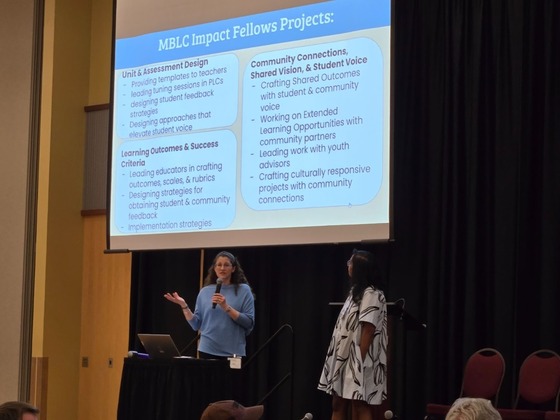
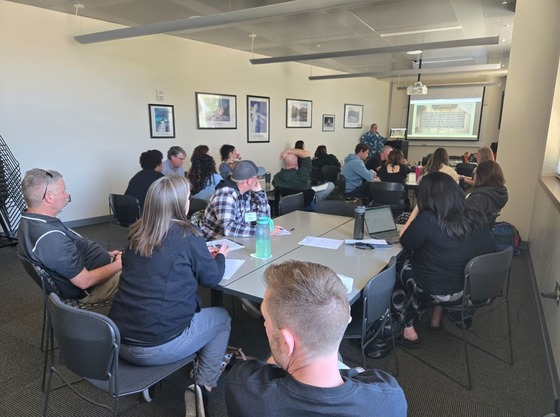
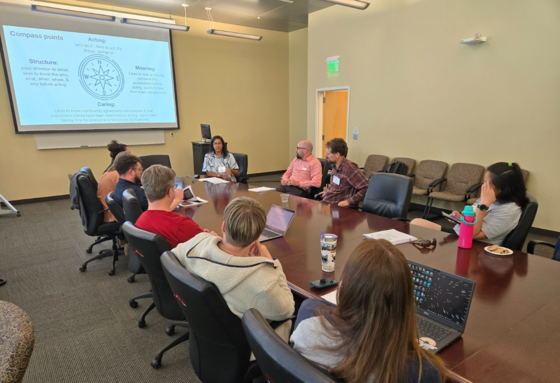
Spring Gathering 2025 Photos
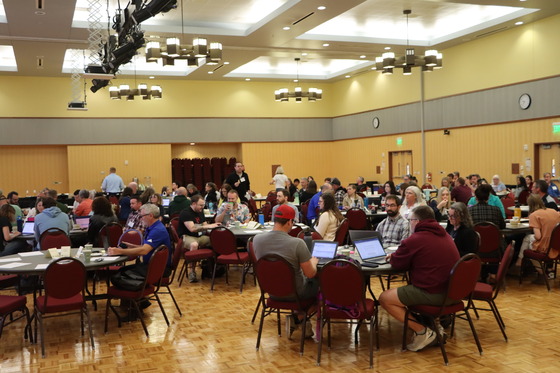
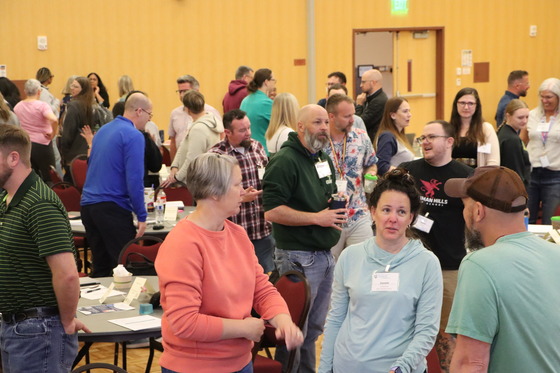
On May 6th, 2025, our MBLC Community gathered at Central Washington University in Ellensburg, WA to reflect upon the work done over the last few years, to listen to powerful student voices, and to hear from our Impact Fellows. Check out these photos!
Making Re-Dos and Retakes Work for Students and Teachers
By Kate Gardoqui, GSP coach
Two of the central tenets of the CRSE MBL Principles and Practices are: Responsive Pacing and Supports, and Assessment that Supports Learning. Each of these tenets includes references to the practice of allowing students to make up work after an unsuccessful attempt:
- Multiple “at-bats” allow learners to show progress and proficiency in varied ways over time.
- Schedules are designed to provide opportunities for students to practice, access re-teaching and support, and reassess after failure.
These practices are a central component of mastery-based learning (MBL). The goal is often expressed as “making learning the constant and time the variable” - in other words, to ensure that students don’t get the message that learning has to stop because of a failed test or assessment. Proponents of MBL often point to all the ways that adults access retakes in their own lives; on driver’s tests, certification exams, admissions tests, and other high-stakes measures of competency. If adults fail, they can practice more and try again, as many times as they need to. Once they pass, all other attempts are forgotten.
The argument seems simple, but the implementation is not. When schools and teachers begin to offer retakes and re-assessments, they find that it can be difficult to make space for reassessment while still maintaining a system that encourages and inspires students to try their hardest the first time around. In the adult examples of reassessment - retaking a professional certification exam, for example - there is a cost for re-taking, both in terms of paying for the test and the additional time spent. As schools try to create systems that push students to try hard the first time and to go back and address gaps in their learning when needed, they find that it takes a carefully built system to avoid unintended consequences. Here are some strategies that educators have found most effective when implementing retakes and re-assessment policies:
-
Set clear expectations for retakes and reassessment
Many schools establish a consistent process for re-assessment in which the student fills out a form in order to access the opportunity to reassess. These forms achieve a few goals: they help students reflect on their last attempt and make a plan to learn the material more fully, and they impose a bit of a cost on reassessment so that there is an incentive to study and practice the first time. This Assessment Re-take Form from Gilford High School, Gilford, NH is a good example: it is simple and clear, and it focuses students’ attention on their plans for next steps. At the March MBLC Monthly Meeting, Impact Fellow Alex Pacifico shared this classroom resource for retakes: Corrections Worksheet
-
Use UDL approaches to provide alternative ways for students to demonstrate their skills (while maintaining adherence to the standards you are assessing)
In many MBLC schools, I have had conversations with teachers who describe how they sometimes approach re-assessment through conferencing with students and providing a new question or problem related to the same material, but with the opportunity to answer the question in conference with the teacher. As long as the assessment is not designed to assess writing skills, this approach can provide students with another way to demonstrate their understanding. However, in order for teachers to make space for individual conferences, the school’s schedule needs to be designed thoughtfully.
-
Build the schoolwide weekly schedule in a way that provides time for re-teaching, practice and reassessment
A regular intervention block is an essential tool for providing timely and differentiated supports. At the secondary level, schools generally build in a support and reassessment block that happens at least once a week, and use a dedicated software system to allow teachers to select the students they need to see. At the elementary level, schools build systems that allow them to use data to identify students who are struggling with a particular standard or skill, and then they regroup students during a reteaching and enrichment block, with some students reviewing and practicing more to build mastery, while other students work on extensions.
This type of system is described well in this article on Mesquite Elementary School in Arizona and this one on Snow Creek School in Virginia. Each of these schools has achieved high levels of student proficiency by utilizing reteaching and enrichment blocks. In Mesquite Valley, author Mariko Nobori describes these two options like this:
Reteach: Teachers reteach objectives using different lessons for students who need additional time for mastery. The teacher whose students performed best on the previous week's assessment teaches that week's reteach students. Students stay with that teacher for the daily half-hour sessions the whole week to minimize transition.
Enrich: Teachers expand on objectives for students who have mastered the basics. Students in the enrich class rotate to a different teacher each day so they can experience varying teaching styles as well as learn with different peers.
This quote describes the power of the work in Snow Creek: “In the spring of 2004, only 40% of Snow Creek’s students met the reading proficiency on the Virginia state assessment; the state average was 71%. In the 2004-05 school year, principal Bernice Cobbs assigned teachers to collaborative teams. Each team was asked to develop frequent common formative assessments, to monitor each student’s learning of each essential skill on a frequent and timely basis, and to immediately identify students experiencing difficulty. Finally, the school created a schedule to provide systematic interventions at each grade level to ensure that struggling students received additional time and intensive support for learning each day in ways that did not pull them from the classroom during new direct instruction. During that intervention period, classroom teachers were joined by special education teachers and assistants, a Title I specialist, two part-time tutors hired using state remedial funds, and often, principal Cobbs. Groups were fluid, with students moving from group to group as they demonstrated proficiency. In less than two years, Snow Creek had become a Title I Distinguished school. Students surpassed the state performance in every subject area and every grade level. The same group of students that had only 40% of its members demonstrate proficiency in 3rd-grade reading had 96% of those students achieve proficient status by 5th grade. Math proficiency for the same cohort jumped from 70% to 100%."
-
Provide clear incentives for doing well the first time
In addition to requiring students to complete a form in order to access retakes, some high schools specify that the purpose of re-takes is to give students the opportunity to build needed proficiency, not to access multiple opportunities to get the highest grade possible. In these schools, the highest grade that will be recorded in the grade book from a retake will be set at a certain limit depending on the school’s grade scale. This ensures that when teachers are making time to review reassessment forms, review material, and guide additional practice, they will focus those efforts on students who need extra support in order to achieve proficiency in the standards being assessed.
Does your school or classroom have a retake form or re-assessment structure or policy that you can share with the MBLC? If so please send it in to the MBLC Resource Exchange!
Resources:
NATIONAL STORIES & ARTICLES OF INTEREST
This KnowledgeWorks article highlights states such as Indiana and Washington that are successfully implementing CBE. This article also discusses bills in other states that support both work-based learning models and bills that focus on flexible learning and skills-based assessment.
Co-Developing a Student Survey with Washington Stakeholders (A blog post on the Washington MBLC!)
Kelly Organ, Aurora Institute Research Manager and part of the MBLC external evaluation team, describes the process the team went through to co-develop the statewide student survey for the MBLC evaluation.
Getting Smart’s Tom Vander Ark celebrates select schools that are implementing innovative and transformational teaching and learning strategies to illustrate how these strategies and principles can foster belonging, curiosity, and student agency. Note his mention of the Science and Math Institute (SAMI) and Tacoma School of the Arts, both in Tacoma, Washington!
In a competency based or personalized learning environment, classrooms can look very different from both traditional classrooms and from one another. Read about educators across the country as they describe their own unique classrooms.
Dear Embee Elsie:
Our school’s MBLC Team has been doing a study of The UDL Guidelines with our Coach from Great Schools Partnership.
We see a lot of similarities between Universal Design for Learning (UDL) and culturally responsive and sustaining mastery-based learning (CRS MBL). But we’re wondering about the best way to integrate the two.
Do you have any tips?
Signed,
Knickerbocker Academy MBLC Team
Dear Knickerbocker,
CRS MBL allows students to demonstrate learning of knowledge and skills in a variety of ways. UDL gives a lot of guidance on how to design your curriculum, instruction, assessments, and even your classroom culture to elicit student-centered, culturally relevant responses from your students. UDL is all about Learner Agency, which goes beyond Student Voice to include students’ ability to inform their learning experiences. Simply put, Learner Agency is students’ ability to actively participate in making choices in service of their learning goals.
The three UDL guidelines are Engagement, Representation, and Action & Expression. As a teacher or instructional leader, you should think of “Action & Expression” as similar to the MBL focus on meaningful learning and assessment. As it says on the UDL website: Learners differ in the ways they navigate a learning environment, approach the learning process, and express what they know. Therefore, it is essential to design for and honor these varying forms of action and expression.
Chapter 7 of Antiracism and Universal Design for Learning, which focuses exclusively on the “Action & Expression” guideline, recommends that teachers provide options for expression and communication. For example, both teachers and students should use multiple forms of media for communication. This means that teachers should accept students’ demonstration of knowledge and skills in ways other than writing if the students request this. Do students want to do roleplay? Do they want to make an Instagram reel, or an entire Instagram account? Do they want to change the lyrics of a popular song and sing it for the assignment? How about an original song?
Another recommendation is that teachers should design supports that develop students’ executive functioning skills. One way the book suggests to do this is by helping students manage information and resources. First, have students imagine how they will show you that they have accomplished their goals (demonstrated proficiency). Then, work with them to organize the information from the unit / project / course in a way that will help them with their final assessment / performance task. Do this throughout the unit, etc. Finally, help them collect and organize the resources they will need (maybe multimedia?) for their final assessment, etc.
The biggest tip I can give you, which will help you with these other tips, is to co-design units, projects, lessons, and performance tasks with your students. When doing an analysis of your schools and classrooms, include students’ opinions and perspectives along with yours. Co-create community expectations, rubrics, and rewards. Encourage collaboration over competition. Teachers cannot come up with all the ways that students can demonstrate proficiency, so tap into the culture and creativity of your students.
For more tips and specific guidance, here is a Leadership Implementation Guide for the book referenced above (Antiracism and Universal Design for Learning). Remember, as members of your schools’ MBLC Teams, you are tasked with leading this work for your entire school, not just one classroom.
Educationally Yours,
Embee Elsie
Reader, do you have a question for our advice columnist Embie Elsie (aka M-B-L-C)? Please reach her here!
|