|
This document is intended to address questions related to high school crediting for college, or college-rigor, coursework. Although the credit conversion explained below applies to all course-based dual credit programs, questions about implementing it most often relate to College in the High School (CiHS) and Career & Technical Education (CTE) Dual Credit courses.
These dual credit courses are approved by the sponsoring college and delivered by qualified instructors at the high school. Students enrolled in these courses have two ways to earn college credit:
- Enroll in the sponsoring college to earn college credit (CiHS), or
- Request to transcribe earned college credit from the sponsoring college (CTE Dual Credit).
The five quarter or three semester college credits to one high school credit conversion outlined in RCW 28A.230.740 (formerly in RCW 28A.230.090) and WAC 180-51-050 must be followed for these “college or university level” courses. There is no distinction in rule or statute about where the courses must be taken or how they must be delivered, provided they are “designated 100 level or above by the college or university.”
This credit conversion statute dates back to 1994, was recodified in 1997, and has been included in the Running Start FAQ and CiHS FAQ documents since at least 2019.
|
High school credit—Definition.
As used in this chapter the term "high school credit" shall mean:
(2) College and university course work. At the college or university level, five quarter or three semester hours shall equal one high school credit: Provided, that for the purpose of this subsection, "college and university course work" means course work that generally is designated 100 level or above by the college or university.
|
The college-to-high school credit conversion must be applied to all students enrolled in course-based dual credit courses, regardless of whether the students enroll in the college for CiHS or intend to request the college credit for their CTE Dual Credit course. It is inequitable for students to earn a different number of high school credits for completing the same college-level coursework, especially when there may be administrative, financial, or personal factors influencing their decision to pursue college credit.
The equivalent amount of high school credit(s) must be granted for approved college-level courses delivered at the high school. The conversion should not be applied to individual credit-bearing achievements within a course such as passing an exam, earning an Industry Recognized Credential (IRC) or attaining a certification, although some schools may have competency-based crediting policies to award credit for these accomplishments. Under most circumstances, if a five-quarter credit course provides an opportunity to earn an IRC resulting in more college credit, that credit is not factored in and the course remains a 1.0 high school credit course. If the instructional curriculum of a college-level course converts to more than one high school credit, the student should earn the additional full or partial credit(s). If the college course equates to less than one high school credit, the district may award more credit if supplemental high school content is delivered in the same term.
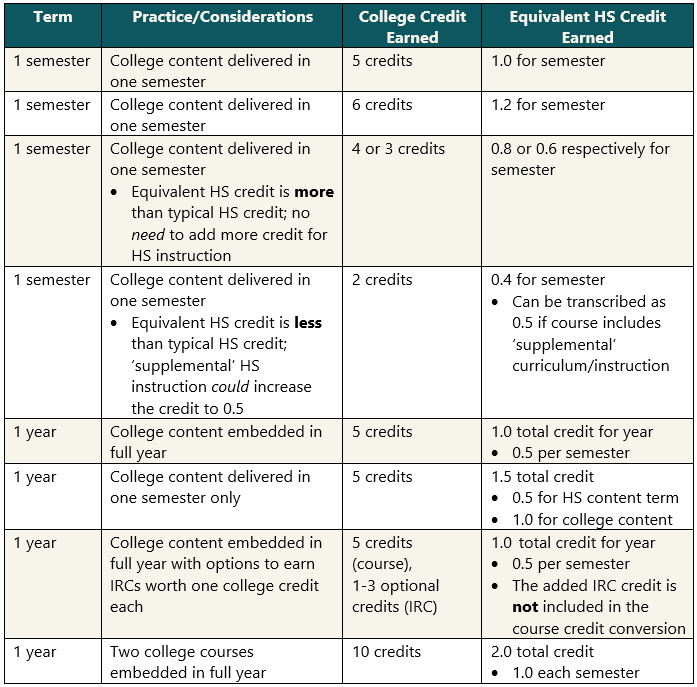
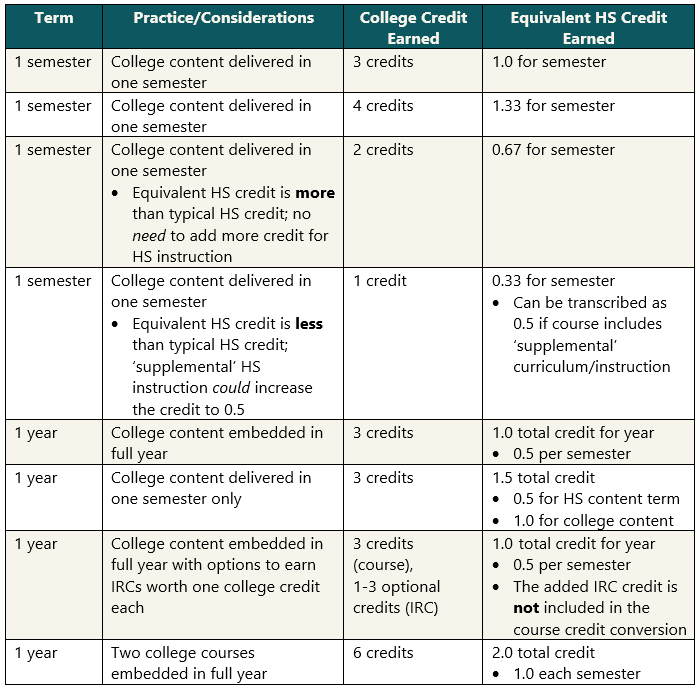
Schools and districts that are not awarding appropriately converted high school credit in accordance with the statute/rule should update earned credits on the transcript for currently enrolled and impacted students as soon as possible, prioritizing students graduating with the Class of 2025, and correct this for the future. The final transcript should accurately reflect the student’s academic record, including the equivalent amount of high school credit(s) earned for college-level work, and whatever grades were earned should be transcribed as the same grades, regardless of the elevated credit count.
Due to the timing of this reminder, we recommend that graduating seniors’ transcripts be prioritized. Those seniors currently enrolled in an impacted CiHS or CTE Dual Credit course should be notified and then the credit conversion should be applied to the current term. After graduating students’ records have been updated, we recommend working backwards on currently enrolled students from 12th to 9th grade to rectify the credit conversion for any dual credit course taken previously. The priority should be to ensure Class of 2025 graduates are properly transcribed and notified before the school year ends.
Further Information and Assistance
For general program/policy questions pertaining to this guidance or any dual credit program, please contact Dual Credit Program Supervisor, Tim McClain, at tim.mcclain@k12.wa.us.
For implementation questions pertaining to CEDARS and credit transcription, contact CEDARS Data Manager, Lisa Ireland, at lisa.ireland@k12.wa.us.
|