April 17-18, 2025
Pullman, WA
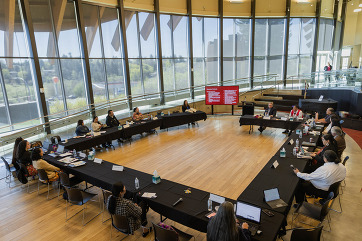
The Office of Native Education (ONE) in collaboration with Washington State University hosted the first annual Tribal Education Leaders Summit bringing together tribal leaders and tribal education departments to discuss critical issues in Native education in Washington, reaffirming the importance of government-to-government relationships. Superintendent Reykdal emphasized Washington's commitment to diversity, equity, and inclusion.
In accordance with Washington State RCW 43.376, which mandates and guides government-to-government relations with Indian tribes, the summit focused on honoring these principles by working directly and respectfully with tribal leaders to address educational challenges and opportunities. The Office of Superintendent of Public Instruction (OSPI), along with ONE, recognizes and values this responsibility, ensuring that our interactions are guided by respect, partnership, and a profound commitment to improving educational experiences for Native students.
Key topics included:
- Impacts of Federal Policy on Native Education
- Data, Accountability, and Tribal Partnerships
- Tribal Language Revitalization
Summary of Discussions & Outcomes:
Federal Policy: Concerns were raised about federal DEI certification requirements and potential cuts to "passthrough funds" which could impact programs like BEST, RAD, and Career Connect Washington. Washington State commits to continuing to engage in transparent communication around federal policy.
Data & Accountability: Tribal leaders highlighted the undercounting of Native students due to inaccurate identification, leading to funding and service gaps. Advocacy focused on better use of the ED506 form and including tribal-specific identifiers during enrollment. Tribal-specific data dashboards, custom MOUs, and data transparency were requested. OSPI expressed openness to formalizing data agreements.
Language Revitalization: Tribal leaders continue to express the importance of language and culture as a top educational priority. This sentiment has been echoed by student voice who stressed the importance of language and culture to their identity and school connection. Successes in language fluency and cultural pride were noted, particularly among Native students in off-reservation schools. Leaders urged place-based learning and fostering school environments where Native identity can be expressed proudly. Tribal languages and values were requested to remain core anchors in education.
Overall, the summit reinforced that tribal sovereignty, cultural revitalization, and educational equity are central to state-tribal collaboration. Key needs identified by tribal leaders include data access/sovereignty, curriculum protection, sustained funding, and inclusion in decision-making. We are inspired by the finalization of our first Tribal Education Leaders Summit report, which we can't wait to share with you soon!
The Office of Native Education extends its heartfelt thanks to Washington State University for hosting this monumental event. Preparations for next year's event, to be hosted by the University of Washington, are already in progress. More information will be provided soon.
|

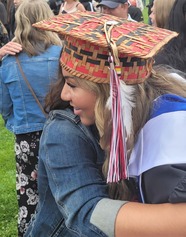
Students' Right to Wear Tribal Regalia at Graduation
Each year, the Office of Native Education (ONE) supports the development of a bulletin to circulate among education leaders recognizing Native Students’ right to wear tribal regalia.
Bulletin 028-25, issued by Superintendent Reykdal, was sent to every district superintendent, school principal, and school counselor. This bulletin reaffirms the inherent rights assured through tribal sovereignty and expressly provides that school districts must allow American Indian and Alaska Native K–12 and higher education students who are members of federally recognized tribes to wear traditional tribal regalia and objects of cultural significance at graduation ceremonies and related events. In addition, school districts and higher education institutions are required, when necessary, to update relevant policies or procedures in accordance with this law.
Image: Graduate Taya Graham in Tribal Regalia graduation attire.
|
Governor Proclaims May as MMIWP Month
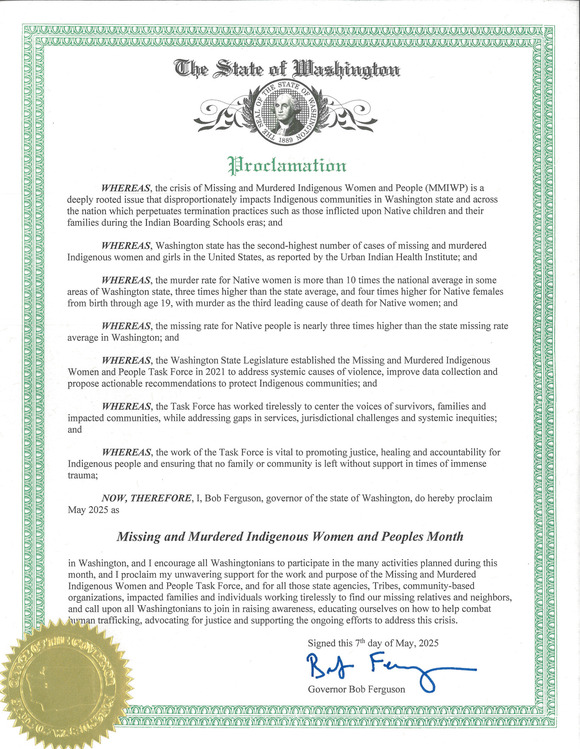 For information about Missing and Murdered Indigenous Women and People, the following resources are provided:
Washington State Missing and Murdered Indigenous Women and People Task Force | Washington State
Missing Indigenous Persons - Washington State Patrol
MMIW - American Indian Studies - College of Arts, Humanities & Social Sciences - EWU - The Region's Polytechnic
Missing and Murdered Indigenous Women (MMIW) - Native Hope
Missing and Murdered Indigenous Women (MMIW)
Missing or Murdered Indigenous Persons Awareness Day - Indian Youth
Missing and Murdered Indigenous People | Indian Affairs
Washington State Coalition Against Domestic Violence (WSCADV)


Administrators Government-to-Government Relationships Training
The Administrators Government-to-Government Relationships Training is required for all Administrators renewing their 5-year Administrator Certificate. For those renewing June of 2026, the 5-hour training will start at the WASA/AWSP Summer Pre-conference scheduled for June 21, 2025. Registration will be on the AWSP Conference website and in-person only.
The ONE Tribal Consultation program is currently working on two other hybrid trainings before the end of June: Bethel School District on June 30 and a Peninsula location to be announced by the end of this month. There will also be one in early October in Spokane and one in December (location TBD), both hybrids.
Registration for all non-WASA/AWSP events will be in pdEnroller with links from the OSPI/ONE Tribal Consultation webpage as they become available. All questions regarding the trainings can be directed to Maxine Alex, Tribal Consultation Program Supervisor, at maxine.alex@k12.wa.us.
|

Supt. Reykdal Gives Statement on Legislature’s Final Operating Budget
OLYMPIA—April 28, 2025—Yesterday, the Legislature concluded the 2025 Legislative Session and passed their final budgets. Despite being faced with a $12 billion shortfall, legislators not only maintained maintenance-level funding in K–12 education—they made crucial investments. Read more.
|

Empowering Native American Educators
Participate in NIEA's National Landscape Analysis Survey
The National Indian Education Association (NIEA) is currently conducting a National Native American Educator Landscape Analysis, which aims to provide to a comprehensive count of Native American, American Indian, and Alaskan Native educators in the public education system, along with their roles.
This analysis will help us gain a deeper understanding of the needs of Native American professionals and the climate of their teaching environments, allowing us to better serve them. The information gathered through this anonymous survey will be used in our analysis and final report. Please take a moment to fill out this survey and help us gather essential information to improve Native American education.
|

Apply Now for AICF Scholarships
The American Indian College Fund (the College Fund) provides scholarships to graduating American Indian and Alaska Native college students enrolled in certificate, undergraduate, or graduate programs at a Tribal Colleges and Universities (TCU) or an accredited non-profit college or university in the U.S.
The College Fund manages a wide portfolio of scholarship programs, and TCU students are eligible for all of our opportunities. Applicants only need to submit one application every year to be considered for the College Fund’s portfolio of scholarships.
Now accepting applications for the 2025-2026 academic year.
Apply now through May 31.
|
5th Grade Teachers, Apply to Attend a Fall Weekend Workshop
CREST is looking for fifth grade teachers in the Whatcom, San Juan, and Skagit area interested in participating in an amazing learning opportunity this summer. See the flier and informational page for more details.
|
|