|

Tribal History & Culture in K-12 Curriculum
NIEA Sends Letter to Administration Regarding Executive Order on Ending Radical Indoctrination in K-12 Schools
"On January 29, 2025, the National Indian Education Association (NIEA) sent a letter to Acting Secretary Carter and Acting Attorney General McHenry regarding the implementation of the Executive Order on “Ending Radical Indoctrination in K-12 Schools.” The letter emphasizes the importance of Tribal consultation in shaping the “Ending Indoctrination Strategy” to ensure that state laws and locally led Tribal efforts to include Tribal history and culture in K-12 curriculum are upheld. It highlights the bipartisan support for teaching Tribal histories in public schools and the need for Tribal representation in policy decisions that impact Native students."
|


Administrators Government-to-Government Relationships Training
The Administrators Government-to-Government Relationships Training is required for all Administrators renewing their 5-year Administrator Certificate. For those renewing June of 2026, the 5-hour training will start at the WASA/AWSP Summer Pre-conference scheduled for June 21, 2025. Registration will be on the AWSP Conference website and in-person only.
The ONE Tribal Consultation program is currently working on two other hybrid trainings before the end of June, location with date to be announced by the end of March 2025. There will also be one in early October in Spokane and December (location TBD), both hybrid.
Registration for all non-WASA/AWSP events will be in pdEnroller with links from the OSPI/ONE Tribal Consultation webpage when it becomes available. All questions regarding the trainings can be directed to Maxine Alex, Tribal Consultation Program Supervisor, at maxine.alex@k12.wa.us.
|

Tribal Language Program
Honoring Our Language Keepers
The Tribal Language Program stands in deep gratitude alongside our language keepers statewide, witnessing the sacred work of awakening ancestral connections that strengthen our Native students' spiritual identity and sense of belonging. Through your dedication to language revitalization, you create healing spaces where Indigenous knowledge flows freely, empowering our youth to reclaim their birthright foundations.
To join in this essential work of language reclamation and cultural stewardship, please contact Destiney Petty at destiney.petty@k12.wa.us.
Your commitment sustains the sacred linguistic threads that connect our youth to their ancestors, traditions, and sovereignty.
|
Native Student Success
Greetings Relatives,
As we navigate the rapid changes in education, one thing remains constant—our commitment to Native Student Success. The Office of Native Education and OSPI recognize the importance of culturally responsive practices, strong relationships, and policies that truly support our students.
One of the ways we continue this work is by centering culturally responsive practices that foster engagement and belonging. From our recent presentation in the OSPI Graduation Equity webinar, here are five key takeaways to guide your work with Native students:
-
Relationships Are Foundational – Strong, trusting relationships create environments where Native students feel safe, valued, and connected.
-
Recognize and Honor Cultural Identity – Affirming Native history, traditions, and languages supports identity development and improves engagement.
-
Focus on Strengths, Not Deficits – A strengths-based approach encourages attendance and participation by recognizing and building on students' talents.
-
Review Policies to Ensure Inclusivity – Policies such as the Right to Wear Tribal Regalia demonstrate the importance of honoring Native traditions.
-
Amplify Student and Community Voices – Partnering with Native students, families, and Tribal communities ensures that education policies and practices are relevant and supportive.
We also invite you to share your insights by completing the Native Student Success Survey The survey is open until March 1 and will help shape our efforts moving forward. Your input ensures that the needs of Native students, families, and educators are centered.
Thank you for your dedication—your role in this work is vital, and we are grateful for all you do.
Bawaajigekwe Boulley Native Student Success Program Supervisor Office of Native Education, OSPI
|

Tracking of 2024-25 Native Education Bills
Each Monday, during legislative session, the Office of Native Education publishes an update on all bills we are tracking in the previous week. If you know someone who would like to receive these updates, please have them subscribe to our newsletter.
|


40th Annual WSIEA Conference
Workshops, Clock Hours, Culture Room, Merit Awards, Vendors, Parent and Teacher Training Opportunities, Native Student College Fair & Post-Secondary Opportunities Day, and much more!
Sponsored by the Washington State Indian Education Association in cooperation with the Office of Native Education/Office of Superintendent of Public Instruction
Register Now for the WSIEA Conference
April 1-3 | Northern Quest Resort & Casino | Airway Heights, WA
|
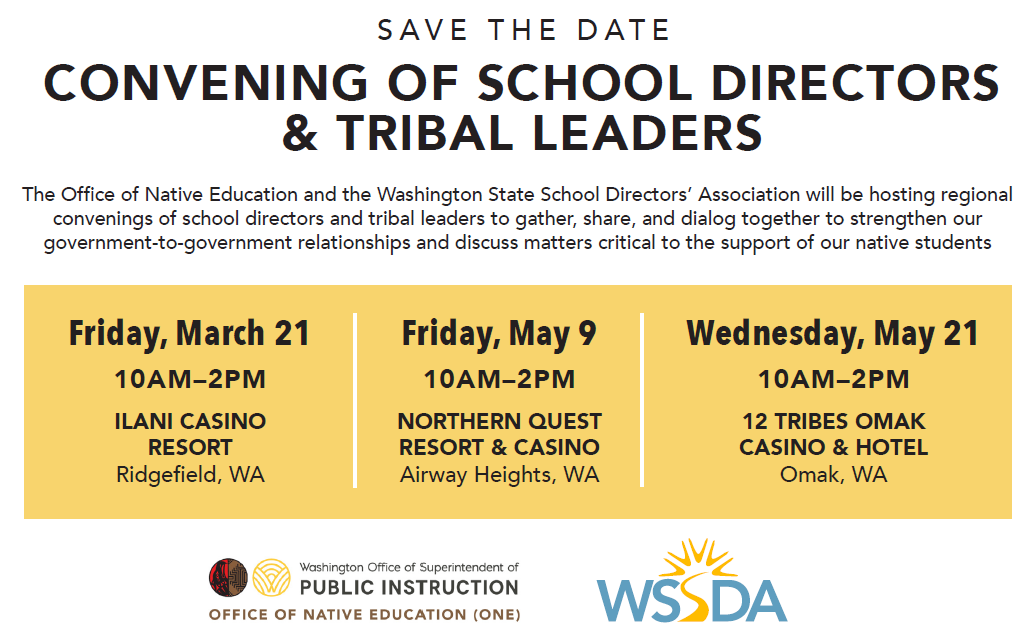 The Office of Native Education Tribal Consultation Program along with Washington State School Directors’ Association invite you to attend Tribal Consultation Best Practices in three different parts of the State. Please attend a Convening to learn best practices from other parts of the State or learn what is going on in your area. March 21st will feature North Thurston School District and the Nisqually Tribe on School Board Policies, JMLSTI Curriculum and other Professional Development Opportunities. The event is free, and Equity Clock hours will be available.
March 21 | 10am - 2pm | Ilani Casino Resort | Register now!

Apply Now for AICF Scholarships
The American Indian College Fund (the College Fund) provides scholarships to graduating American Indian and Alaska Native college students enrolled in certificate, undergraduate, or graduate programs at a Tribal Colleges and Universities (TCU) or an accredited non-profit college or university in the U.S.
The College Fund manages a wide portfolio of scholarship programs, and TCU students are eligible for all of our opportunities. Applicants only need to submit one application every year to be considered for the College Fund’s portfolio of scholarships.
|

Learn History & Culture of NW Native Foods
Do you want to learn more about traditional Indigenous foods of the Pacific Northwest? Are you interested in incorporating these foods in your program?
Join us to learn about the history of Native people in the U.S., the cultural significance and nutritional benefits of Northwest Native foods, and Native-led food initiatives across Indian Country. This free series strives to provide cultural understanding and build awareness of traditional Indigenous foods as you work to increase student access to these foods.
Sessions will be led by knowledgeable and engaging trainers Valerie Segrest, Maria Givens, and Elizabeth Campbell.
We hope you can join!
Click each training title to register.
Northwest Native Foods
Thursday, February 27, 2-3:30 pm
This training emphasizes the cultural significance and nutritional benefits of Northwest Native foods, including wild greens and berries, roots, salmon, and elk.
Food Sovereignty and Education Initiatives in Tribal Communities
Thursday, March 20, 2-3:30 pm
This is an in-depth look at Tribal food sovereignty, including the history and impact of Native-led food initiatives across Indian Country. This session highlights the importance of food as a cornerstone of community and cultural resilience.
This series supports the provision in the final rule, Child Nutrition Programs: Meal Patterns Consistent With the 2020-2025 Dietary Guidelines for Americans (89 FR 31962, April 25, 2024), which “… amends 7 CFR 210.10(c)(7) and 220.8(c)(4) to explicitly state in regulation that traditional Indigenous foods, in accordance with current meal pattern requirements, may be served in reimbursable school meals.” The Final Rule goes on to state: “USDA understands that this change is just one part of a larger effort to support the service of traditional Indigenous foods in school meals and remains committed to promoting traditional foodways through its policies and guidance.”
This project was funded using U.S. Department of Agriculture grant funds.
|
Be P-12 Prepared in Your EPP
P-12 Listening Session Invitation: Preparing Teachers for the Modern Classroom
The Professional Educator Standards Board (PESB) is looking forward to hosting a series of listening sessions February-March 2025 to hear from P-12 educators. These virtual sessions will delve into four topic areas that new educators need to be prepared for in their educator preparation programs (EPPs), so they are ready for the P-12 school environment. We seek your feedback on the topic areas below.
If you are interested in attending one, some, or all of the meetings, please register at your earliest convenience. You may choose to attend one or more sessions.
|

Save the Date for WA Summer Teaching Institute!
This year’s forum, tmixw (Nsəlxcin), “In this place, we are all related.”
June 2025 marks the return of Washington State’s Indian Education Summer Teaching Institute. Washington PreK-12 teachers, school administrators, board of directors, and post-secondary higher education professionals are invited to attend. Visit the Wenatchee Valley College website or see this flyer for more information.
June 24-26 | Registration begins March 1
Wenatchee Valley College, Omak School District, and Paschal Sherman Indian School
|

ONE to Attend the WSIEA Conference
Office of Native Education Executive Director, Henry Strom, Assistant Director, Willard Bill Jr., and Tribal Consultation Program Supervisor, Maxine Alex, will be attending the Washington State Indian Education Association (WSIEA) Conference to represent Washington State and convey current areas of focus in response to needs and concerns of our 29 Federally Recognized Tribes.
April 1-3 | Northern Quest Resort & Casino | Airway Heights, WA
|

Native Educators’ PLC
Earn free equity clock hours! The Native Educators’ Professional Learning Community (PLC) will meet on the following dates:
Thursday, February 20 | 4–5:30pm
Thursday, March 6 | 4–5:30pm
Thursday, March 20 | 4–5:30pm
Register now through pdEnroller or visit our website for more information.
|
|
|
|
ALL STUDENTS PREPARED FOR POST-SECONDARY PATHWAYS, CAREERS, AND CIVIC ENGAGEMENT.
Led by State Superintendent Chris Reykdal, OSPI oversees K-12 public education in Washington state. Our mission is to provide funding, resources, tools, data and technical assistance that enable educators to ensure students succeed in our public schools, are prepared to access post-secondary training and education, and are equipped to thrive in their careers and lives.
|
|
 |
|
|
|
|
|