|
 |
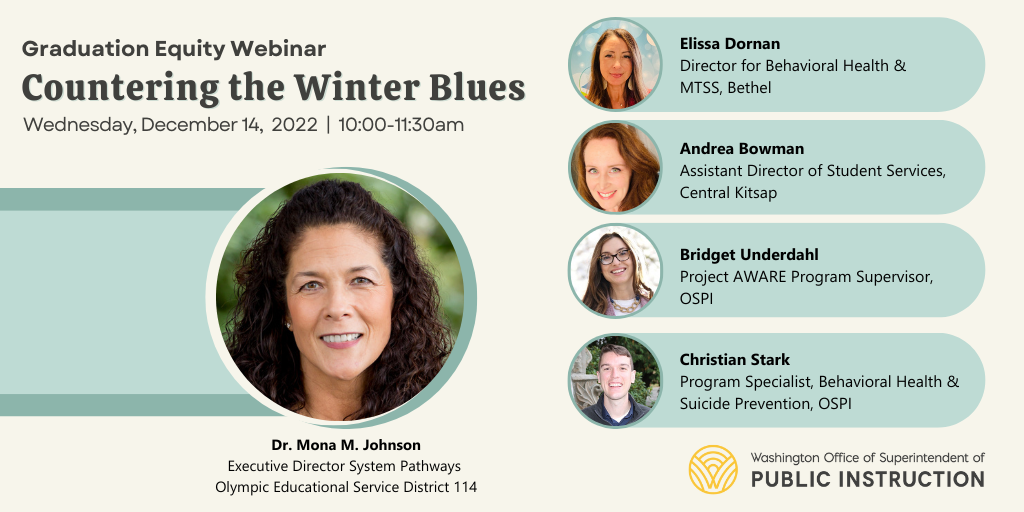
Dr. Mona M. Johnson, Executive Director System Pathways Olympic Educational Service District 114
For more than two years, the COVID-19 pandemic has taken education leaders, teachers, and school systems on a professional roller coaster ride. With very little notice, educators across the United States had to shutter school doors, move into isolation and quarantine, establish universal approaches to virtual learning, and devise innovative ways students could continue to access meals the school usually provides. They've had to learn and implement unparalleled public health mitigation strategies, and continuously reinvent day-to-day operational practices. Many districts closed and reopened classrooms several times and erected hybrid learning structures in the interest of reducing student and staff exposure to the COVID-19 virus.
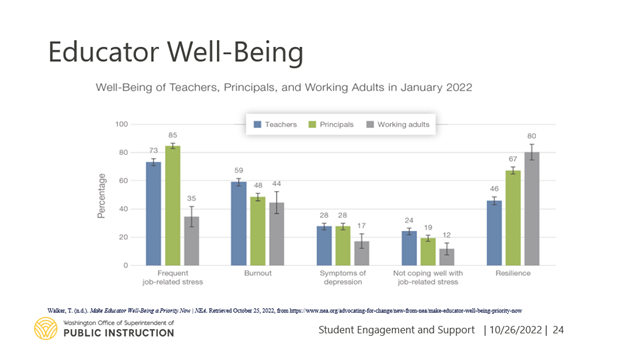
During these years, K–12 educators worked tirelessly and were challenged in countless ways while living the frontline experience of responding to the global pandemic. Each has felt—and may continue to feel—wounded and weary. And leaders and teachers ran this gamut while navigating changing circumstances in their personal lives, too, which were often difficult.
"Teaching through the pandemic has been traumatic. Schools must now prioritize organizational well-being."
Trauma—For Individuals and Systems
The reality is the pandemic affected many school leaders, teachers, and other professionals within the K–12 landscape in ways that can be considered traumatic. Trauma is defined as, "an event, series of events, or set of circumstances that is experienced by an individual as physically or emotionally harmful or life-threatening and that has lasting adverse effects on the individual's functioning and mental, physical, social, emotional, or spiritual well-being" (Substance Abuse and Mental Health Services Administration, 2022). By this definition, coping with this global pandemic has been traumatic for many people, most certainly including educators. And just like individuals, organizational systems can be affected by prolonged harmful or threatening circumstances—and the experience of COVID-19 has been traumatic to schools and districts throughout our country (and across the world). Two-and-a-half years in, the effects of this pandemic are taking a heavy toll on educators and on the schools they work in. Continue reading here…
|
Leadership Team Activities Care Package
Bridget Underdahl, Program Supervisor for Project AWARE, OSPI
Do you want your team to take a deeper look at Countering the Winter Blues? We’ve crafted activities that take 15 minutes, 30 minutes, and 90 minutes for you! Take a look at toolkits, reflection questions, and more. Check out this month’s Care Package.
Social Emotional Learning Modules
For an opportunity to learn more about Social Emotional Learning in Washington State Schools: Building Foundations and Strategies check out their online modules.

Winter Season
Arlie Neskahi, Diné Nation
Arlie Neskahi and our Office of Native Education, remind us all the importance of tradition with the turning of the season.
In our Indigenous Nations across the lands, the Winter season has always been a holy time. Many sacred ceremonies that could not be held during the summer season arise and sacred helpers and caregivers visit the People in their smokehouses, longhouses, dance grounds, hogans, pit houses, kivas and innumerable ceremonial centers. The daylight hours give way to longer nights, and it is a time of great prayers, healing and energy given to help bring about the “renewal” of the coming Spring. In many tribes it is time to tell Creation Stories which are not allowed during the summer months.
In my life, I have gathered many memories and gifts. Like, as a young man I went on my first hunts with my father and older brothers. Warm summer days had given way to the increasing chill, frost, and later ice and snow. Early in the dark before dawn we would rise, leaving the warmth of our house as our ancestors did to take the Hunt. Continue reading...
|
|
|
Social Emotional Learning
Social Emotional Learning (SEL) is broadly understood as a process through which individuals build awareness and skills in managing emotions, setting goals, establishing relationships, and making responsible decisions that support success in school and in life.
Below are several Washington-developed resources available for implementation and updates on the program.
|

Staff Wellness: Communal Care and Systems Level Care
Bridget Underdahl, Program Supervisor for Project AWARE, speaks on building educator wellness into schools MTSS structure. How might a district start or continue to build their capacity and protocols around educator wellness through a systems lens? What are the do’s and don’ts of this work and what resources are available? Please check out
|
Addressing Secondary Traumatic Stress in the K-12 Workforce
Educators working environment is students learning environment. In 2021, the Washington State Legislature passed SHB1363: Addressing Secondary Traumatic Stress in the K-12 Workforce. SHB1363 directs districts to adopt a policy and procedures to take meaningful steps in supporting staff’s health and well-being.
To help districts implement WSSDA policy and procedure 5515, OSPI and the Alliance for a Healthier Generation partnered to provide free resources and an online assessment.
|
Professional Quality of Life Measures
Professional Quality of Life (proQOL) is intended for any helper - health care professionals, social service workers, teachers, attorneys, emergency response, etc. Understanding the positive and negative aspects of helping those who experience trauma and suffering can improve your ability to help them and your ability to keep your own balance. Find it here.
Alliance for Healthier Generation School Wellness Committee Toolkit
This guide was created as a resource for school wellness committees to convene, plan and implement their action plans. The tools and other tips contained in this toolkit are meant to coordinate with other Healthy Schools Program resources and technical assistance provided by the Alliance for a Healthier Generation.
|
|
|

Education Celebrations
Special Education Day - Dec. 2nd
A day to celebrate accomplishments, teachers, administrators, students and parents. Special Education Day marks the anniversary of the nation's first federal special education law--signed by President Gerald Ford on December 2, 1975. OSPI's Special Education Resource Library is intended to provide guidance and professional development resources on behalf of students with disabilities.
Computer Science Education Week - Starts on Dec. 5th
Computer Science Education Week is an annual call to action to inspire K-12 students to learn computer science, advocate for equity, and celebrate the contributions of students, teachers, and partners to the field. Feel free tor review the 2020-21 K–12 Computer Science Education Data Summary Report! This report responds to HB 1577, requiring OSPI to post computer science data.
|
Hanukkah: Dec. 18th - Dec. 26th
This year Hanukkah is December 18 - December 26. Hanukkah, also referred to as Chanukah, celebrates the rededication of the second Jewish temple in Jerusalem. For more information about the religions commonly practiced in your community, explore the Pew Research Center's Religious Landscape Study.
|
|
 |
 |
|
International Migrants Day: Dec.18th
This day was selected to mark the anniversary of the 1990 adoption by UN General Assembly of the International Convention on the Protection of the Rights of All Migrant Workers and Members of Their Families. We encourage you all to be intentional with Migrant students and families and learn more about the Migrant Education Program.
|
Kwanzaa: Dec. 26th - Jan. 1st
Kwanzaa is a seven-day festival celebrated in appreciation of African and African American history, heritage, and culture. The festival is observed from December 26th – January 1st. Each of these seven days’ honors particular principles which are thought to have been fundamental in promoting strong, productive communities and families in Africa.
|
|
 |
 |
|
Christmas Day: Dec. 25th
Christmas is an annual festival commemorating the birth of Jesus Christ, observed primarily on December 25 as a religious and cultural celebration among billions of people around the world. It is preceded by a feast central to the Christian liturgical year.
|
|
ALL STUDENTS PREPARED FOR POST-SECONDARY PATHWAYS, CAREERS, AND CIVIC ENGAGEMENT.
Led by State Superintendent Chris Reykdal, OSPI oversees K-12 public education in Washington state. Our mission is to provide funding, resources, tools, data and technical assistance that enable educators to ensure students succeed in our public schools, are prepared to access post-secondary training and education, and are equipped to thrive in their careers and lives.
|
|
 |
|
|
|
|
|