|
Having trouble viewing this email? View it as a Web page.
|
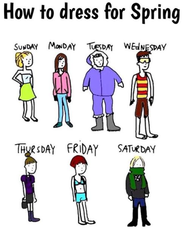
March turned out to be an interesting month in Washington! It sure kept us guessing in the weather department! So far, we've experienced snow, rain, gusty winds and an about face with 75 degrees and sunshine.
Every day lends itself to possibilities... they can be filled with meaningful work and pleasant surprises or sometimes disappointment. We are encouraged by our successes and inspired by "ah-ha" moments.
In Washington, March seems to speak directly to us; letting us know to expect the unexpected. Make the most of each day!
|
|
 |
In This Issue
WaKIDS data from Fall 2018 has been posted to the newly designed State Report Card, the system Washington uses to share data on our public K-12 schools. Just like the State Report Card, WaKIDS data displays have an updated look. The redesign is intended to make the site easier for parents, families, educators, policymakers, and the public to use.
Despite the new visual displays, this fall’s WaKIDS kindergarten readiness data is similar to year’s past, with fewer than half (45.7%) of all incoming kindergartners ready all six areas of development and learning. Math continues to be the lowest area of readiness, followed by cognitive, language and social-emotional development.
Understanding how this data relates to closing gaps continues to be an important opportunity for Washington’s schools.
An updated set of WaKIDS Fall 2018-19 Data Files has been posted to WAMS. These are the same test records as previously released – no additional students or changes to overall domain/area determinations – but are updated to reflect:
- Updates to English Learner, Special Education, and Free-Reduced Lunch status based on CEDARS data as of January
- Correcting the ‘Year’ column from 2017-18 to 2018-19 – this was an error in the initial release in December, but the data were (and are) from Fall 2018-19
- Objective score columns are expanded to two digits, replacing asterisks with the two-digit numeric score values
For more information, please contact:
OSPI Data and Student Information
assessment@k12.wa.us
(360) 725-6348
OSPI is excited to announce an updated WaKIDS 101 training model starting this summer (2019). In the past, kindergarten teachers new to WaKIDS, the Washington Kindergarten Inventory of Developing Skills, were required to attend a two-day, face-to-face training to learn how to conduct WaKIDS, including the mandatory assessment component.
The updated training model offers teachers the same high-quality experience in a one day face-to-face training, hosted in each of the ESD regions, followed by a six-hour online course through The Learning Space. Teachers will have two weeks from the date of their face-to-face training to complete the “day-two” online training OSPI will monitor teacher involvement and completion. Districts will be notified if teachers do not complete both sections of the training. Teachers who don’t complete the training are not permitted to conduct WaKIDS.
Districts will be reimbursed through iGrants up to a cap for new teachers who will conduct WaKIDS to participate in both the face-to-face and online training portions of the new WaKIDS 101 training model.
In addition to the standard WaKIDS 101 training content, teachers who attend WaKIDS 101 will have the option to remain within their online community in The Learning Space throughout the year for continued learning and support.
You will be able to register for summer training dates soon by searching our Events and Training page.
Are you Ready for Fall 2019?
It might seem too early to think about next fall but it is right around the corner and we want you to be prepared – especially to begin the Family Connection component of WaKIDS!
Family Connection provides an opportunity for families to meet individually with their child’s kindergarten teacher at the beginning of the school year.
Here are three things you can do now to make sure you are ready!
-
Review the requirements for Family Connection: Revisit the purpose of these important meetings. It’s not a time to assess children! This is an important time to get to know students and their families and begin building relationships. Guidelines for teachers can be found here.
-
Make your plan! Establish the Family Connection meeting days, prepare teachers and front office staff, print Introducing Me! booklets and create the invitations. Guidelines for principals can be found here.
-
Print Introducing Me! booklets: Available in 19 languages, this booklet guides the Family Connection conversation between families and their child’s kindergarten teacher. Booklets can be printed in color or black and white. These will no longer be provided to districts by OSPI or Educational Service Districts. Schools may also choose to print the Entering Kindergarten brochure which invites families of incoming kindergartners to get involved in WaKIDS and to find out what to expect.
This winter, a team of cross-sector state partners successfully applied for the opportunity to receive technical assistance from the National Center for Pyramid Model Innovations (NCPMI) to build the capacity of our state systems to implement and sustain the Pyramid Model for Promoting the Social Emotional Competence of Infants, Toddlers, and Young Children (Pyramid Model) in Washington State.
The Pyramid Model is a multi-tiered framework focused on creating environments that support the social-emotional development of young children with easy-to-implement strategies to improve learning, while also preventing challenging behaviors. The Pyramid Modelalso offers strategies that help identify and support young children when persistent, challenging behavior occurs.
The Pyramid Model framework is comprised of a continuum of evidence-based practices for the prevention, promotion and intervention that aligns with Multi-Tiered Systems of Support (MTSS) to provide a seamless system of behavioral supports with significant potential for addressing the emotional and behavioral concerns of children and youth from their early years of development into adulthood.
Members of the Joint State Leadership Team include representatives from Partners for Action, Voices for Empowerment (PAVE), the parent organization for Washington’s Parent Training and Information Center; the Washington Council of Special Education Administrators; the University of Washington; Educational Service Districts; Catholic Community Services; the Department of Children, Youth, and Families; and OSPI. Members share many core values including inclusion, collaboration and continuous growth and improvement.
Over the next two years, members of the Washington State NCPMI Joint State Leadership Team will participate in an intensive technical assistance opportunity that will result in the sustainable implementation of the Pyramid Model within local implementation programs that serve children 3-5 years of age with or at risk for disabilities in inclusive environments. Washington State’s vision includes recruiting, engaging, and supporting a state-wide network of program coaches prepared to provide culturally responsive, practice-based coaching with fidelity, through collaborative partnerships with practitioners for the implementation of the Pyramid Model. This vision is aligned with the commitment to increase opportunities for all children to receive high quality early learning services in inclusive environments.
The Joint State Leadership Team has met twice with representatives from NCMPI and will soon begin taking steps to identify local implementation sites. We are excited about this effort and look forward to the potential for making the Pyramid Model available to all early learning settings. We will be sharing more information as the project takes shape!
|
In February, after many years at OSPI, Valerie Arnold, who has most recently served as the Early Childhood Special Education/619 Coordinator, moved to the Department of Children, Youth, and Families where she is now Deputy Administrator for the Early Support for Infants and Toddlers (ESIT) Program. Val’s kindness, creativity and leadership is sorely missed here at OSPI but we know that her talents have not left the field. Val has just moved closer to where her heart resides – with very young children and their families. We look forward to continued collaboration with Val in her new role.
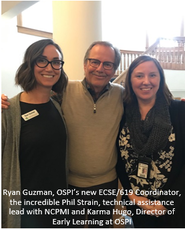
Val’s departure from OSPI created an exciting opportunity to continue the good work she started. We are pleased to share that Ryan Guzman will be stepping into the role of Early Childhood Special Education/619 Coordinator at OSPI beginning in April. Ryan comes most recently from ESD 113, where she was the WaKIDS Coordinator and Regional Administrator of Early Learning and Special Education.
Ryan has significant field experience and has been involved in many key state initiatives. She brings a broad perspective to her work and a reputation for innovation, integrity and fun. We welcome Ryan and look forward to working with her in her new capacity!
WaKIDS Refresher Online Training
Kindergarten teachers currently using WaKIDS are encouraged to join us this summer (2019) for a WaKIDS online refresher course. Whether you were trained last year or 5 years ago, this is a great opportunity to find out what’s new with WaKIDS. Get up-to-date on the approaches used to implement developmentally appropriate practices - in your classroom. Discover ways to use the WaKIDS data to improve your teaching and grow student outcomes. Clock hours will be available.
Watch our Events and Training page for registration details.
|
|
 |
WaKIDS 2018-19 Wrap Up and Planning Webinar
If you support WaKIDS and full-day kindergarten implementation in your district, this webinar is for you! Find out everything you need to know about wrapping up WaKIDS for 2019-20 and preparing for next year. Topics covered will include information about closing out the year in the MyTeachingStrategies GOLD® assessment platform, like saving data and archiving students and classrooms; information about the new WaKIDS 101 training model and other training opportunities; a review of tools available to support the Family Connection component of WaKIDS; and resources for implementing high-quality full-day kindergarten.
One tap mobile
+16465588656,,557149211# US (New York)
+16699006833,,557149211# US (San Jose)
Dial by your location
+1 646 558 8656 US (New York)
+1 669 900 6833 US (San Jose)
Meeting ID: 557 149 211
Moving Beyond Compliance Webinar: Going Deeper with WaKIDS
Are you a curriculum director, special education director, principal or in another role needing to learn more about WaKIDS? Are you interested in strategies used to support kindergarten teachers and students? OSPI is offering an online course just for you! The course provides information regarding the required elements of full-day kindergarten and the WaKIDS assessment. This course will offer opportunities for:
- Collaborating with other administrators
- Learning from each other creative ways to support teachers
- Engaging with the local early learning community
- Smoothing the transitions to kindergarten through the Family Connection meeting
Watch our Events and Training page for open registration this summer 2019.
How can you foster curiosity and learning in your classroom? Through talk! Student-to-student talk can deepen sensemaking, and using a variety of talk formats can help scaffold your students’ learning. In contrast to whole-group discussion, peer-to-peer talk is “lower stress” and can “support linguistic risk-taking” for English Language Learners and better engage students from non-dominant backgrounds.
This year, each Early Learning newsletter has featured information and resources provided by the OSPI Science office to promote early science instruction. If you have resources or science stories to share, please send them our way!
Teaching Strategies Contact Information
For help with the GOLD® assessment and/or its online assessment platform MyTeachingStrategies®, please contact Teaching Strategies directly:
Phone 844-853-4653
Email wakids@teachingstategies.com
Subscription Reminder

Haven't heard from us? Is your information current? Sign up or send us an update and we'll keep you in the know! Click the subscriber services link here to add yourself to our mailing list: Newsletter Mailing List
|
District’s Early Learning Contacts
OSPI keeps a list of “Early Learning Contacts” posted here: Early Learning Contact List and Updates
|