|
|
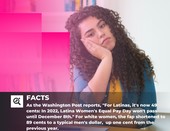
The month of December marks a grim milestone for Latinas this year. On Thursday, December 8th, 2022, we will have statistically earned as much as the average white male earned in 2021. Let me say that in a different way: it will have taken an average Latina 23 months and 8 days to earn what an average white male would have earned in 12 months last year. This is even more shocking as we realize that in the last year, with our economy shifting, we fell further behind: Latina Equal Pay Day was on October 21st last year.
Today, we’ll take some time to highlight facts, figures, and data in this newsletter that we hope will inspire you to visit our website for a more thorough look at the research that the CHA team has gathered for you.
We have a lot of work to do including in how research is compiled: while we have a lot of great data, we are missing intersectional data points that exist in our community. Think of the experience of a Black Transgender Latina: how do you think our sister would be impacted?
But first, let’s dive into good news on the Commission leadership for the next year.
Happy reading!
María
|
|
|
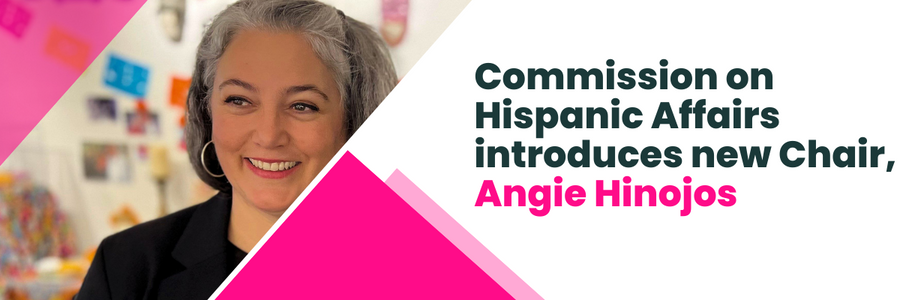
Olympia, Washington, November 2022—During the October 14 Commission meeting, the commission unanimously elected Commissioner Angie Hinojos as the chair of the Commission. The Commission is—for the first time in its history—led by two women in the chair and executive director positions.
Chair Hinojos takes the helm seven years after Gloria Ochoa and one decade after Lilian Ortiz-Self, now a Representative for the 21st legislative district and House Democratic Caucus Chair. Chair Hinojos proceeds Dr. Bernal Baca, who was unanimously elected to serve as Vice Chair alongside Eric Gonzalez. The Commission is—for the first time in its history—led by a woman chair and executive director.
Angie Hinojos is Chair of the Redmond Arts and Culture Commission and serves on the Pandemic After-Action Review Taskforce for Washington State. Angie has also been a community organizer focused on equity in education, with the goal of increasing access to higher education for underserved communities. She was appointed to a partial term in December of 2021 by Governor Inslee to serve on the Commission.
“Chair Hinojos has years of leadership, community organizing and advocacy, and policy development experience that will be an asset as she leads the commission this next year. I look forward to collaborating with her,” Sigüenza said.
Chair Hinojos will preside over her first full meeting on December 3, 2022. To learn more details about this upcoming meeting please visit cha.wa.gov.
|
|
|
It has been nearly 60 years since the Equal Pay Act was passed, and since then, women have made tremendous strides in the labor force. However, women continue to be paid less than their male counterparts in every single state. The wage gap hits women of color the hardest- if today's gaps do not close, over the course of a 40-year career, a Latina stands to lose more than $1 million to the wage gap in 28 states, and the same is true for Asian women in three states, for Black women in 13 states, for Native American women in 17 states and for Native Hawaiian or other Pacific Islander women in 13 states. Across the country, the career losses amount to $1.2 million dollars for Latinas and $964,400 for Black women.
A robust movement to close gender wage gaps has been sweeping across the country, including an increasing focus on requiring employers to be transparent about pay. In the past few years, lawmakers across several states have introduced equal pay legislation in over two-thirds of states and many of these bills have become law. State efforts to close the wage gap not only make meaningful change for women’s and families’ economic security, but they also lift states’ economies.
|
|
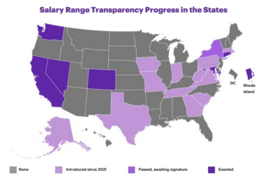 Requiring Transparency Around Salary
When employers aren't transparent about pay, gender and racial wage gaps widen and women and people of color lose out.
Washington amended its previous salary range transparency law to require that employers with 15 or more employees disclose in job postings the wage scale or salary range for a position, and a general description of the benefits and other compensation to be offered. The law defines job posting as any solicitation intended to recruit applicants for a specific available position, including recruitment done through a third party, and postings done electronically or with a printed hardcopy.
|
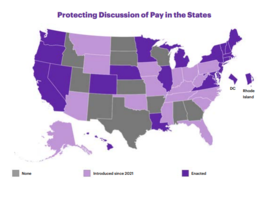 Prohibiting Use of Applicants’ Salary
History in Pay Setting
When an employer relies on a job candidate’s prior salary in setting pay, past pay discrimination follows the candidate through her career. Relying on salary history in pay setting or hiring also penalizes job candidates who reduced their hours in their prior job, or left their prior job of several years to care for children or other family members.
Washington amended its equal pay law to prohibit an employer from seeking a job applicant’s salary history from the applicant or from their current or former employer or from requiring that an applicant’s salary history meet certain criteria. An employer may, however, confirm the applicant’s salary history if the applicant has voluntarily disclosed it or if the employer has already negotiated and made an offer of employment with compensation to the applicant.
|
|
|
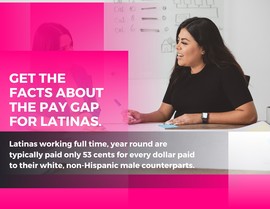
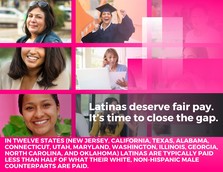
Latinas who work full time, year round are paid just 53 cents for every dollar paid to white, non-Hispanic men. This gap, which amounts to an annual loss of $28,386, means that to make as much as white, non-Hispanic men typically do in one 12-month calendar year, Latinas have to work 22 months— until the beginning of November in the following calendar year.
|
|
 |
|
SOME LATINAS EXPERIENCE SUBSTANTIALLY WIDER WAGE GAPS THAN THE WAGE GAP FOR LATINAS OVERALL.
|
|
|
|
• Latinas of Central American origin experience the highest wage gap and typically make less than half— 47.3 percent—of what white, non-Hispanic men typically make. And Mexican and Dominican women typically make barely more than half of what white, non-Hispanic men make (50.9 percent and 54.5 percent, respectively).
• Cuban (57.1 percent), South American (63.6 percent), and Puerto Rican (65.5 percent) Latinas all make less than two thirds of what white, non-Hispanic men make.
• Latinas of various origins also earn less than their Latino counterparts, although the disparity in pay is less than that between Latinas and white, non-Hispanic men
|
|
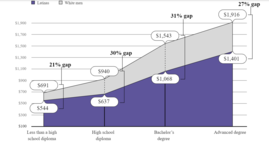
THE PAY GAP WIDENS FOR EDUCATED LATINAS
Latinas are going to college at higher rates than ever before. But education doesn’t eliminate the pay gap. In fact, the gap is largest for Latinas with a bachelor’s degree, who earn 31% less than white men on average.
|
|
EVEN IN THE SAME JOB, LATINAS GET PAID LESS
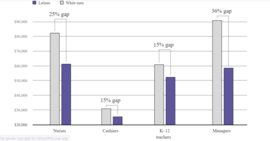
Many people assume that Latinas face a pay gap because they're concentrated in lower-paying roles. But even in the same job, Latinas are paid less than white men. For example, Latina nurses earn 25% less than white men nurses, on average.
|
|
|
Racial inequities compound the motherhood pay gap for many mothers of color. For example, Latina mothers working full time, year round are paid just 47 cents for every dollar paid to white, non-Hispanic fathers. Native American mothers and Black mothers working full time, year round are paid only 49 cents and 52 cents, respectively, for every dollar paid to white, non-Hispanic fathers.
Many mothers of color working full time, year round, therefore, lose tens of thousands of dollars to the wage gap with Latina mothers typically losing nearly $38,000 annually, Native American mothers losing nearly $36,000 annually, and Black mothers losing nearly $34,000 annually compared to white, non-Hispanic fathers.
Mothers need action that closes the wage gap.
Even before the COVID-19 crisis, mothers were losing thousands of dollars annually due to the wage gap, with Black, Latina, and Native American mothers suffering from the largest gaps. Couple that with the economic crisis moms and their families are still facing and mothers have been put between a rock and a hard place. The impact of the COVID-19 crisis underscores the need to close the wage gap and to continue to work to ensure a recovery that centers the needs of Black, Latina, and Native American mothers, who have been shortchanged and undervalued for too long. It is long past time to start paying mothers what they are owed and to stop robbing their families of the financial security they need.
|
|
 DID YOU KNOW?
Nearly 1 in 3 Americans is not aware of the pay gap between Latinas and white men.
|
 DID YOU KNOW?
The pay gap widens the wealth gap: how much Latinas are worth or own. The average Latina’s net worth is less than 1% of the average white man’s.
|
 DID YOU KNOW?
There is a stereotype that Latinas are domestic and not ambitious in their careers, which can make employers assume they don’t want to or expect to be paid well—despite being on average about as ambitious as white men.
|
|
|
|
|