|
Director's Corner
by María Sigüenza
We are embarking on a really important milestone within the Poverty Reduction Work Group: a feasibility study was funded by the 2021 Legislature, and the group is looking for feedback. Below is an excerpt of the executive summary, which is not yet available online. However, if the topic piques your interest and want more information or provide feedback, please reach out to PRWG@dshs.wa.gov.
"In 2021, the Washington State Legislature passed the Appropriations Bill ESSB 5092 which contained a proviso that directed Department of Social and Health Services- Economic Services Administration and Governor Inslee’s Poverty Reduction Workgroup to develop a Universal Basic Income Feasibility Study by June 1, 2022.
The Poverty Reduction Workgroup is committed to centering equity and people and communities historically excluded from social and economic well-being in the policy and program development for this work. The current plan to center lived experience and those most likely to benefit from universal income involves:
History shows that times of profound disruption are followed by significant social, cultural, and economic change. This time will be no different, and the timely release of the 10-Year Plan outlines the strategies and recommendations we can begin implementing today to build a just and equitable future.
Systemic change becomes possible when we recognize the “system” is us – people working in state and local government, non-profits, businesses, and philanthropic entities across the state all have a role to play. It simply takes a willingness to act.
The Universal Basic Income Feasibility Study aligns with the following 10-Year Plan strategies:
- STRATEGY 2: Make equal space for the power and influence of people and communities disproportionately affected by poverty and inequality indecision-making.
- STRATEGY 6: Build an integrated human service continuum of care that addresses the holistic needs of children, adults, and Specifically:
- Recommendation 6d: Increase unconditional cash assistance. Evidence suggests that unrestrictive cash assistance is an effective strategy for poverty reduction. Furthermore, the majority of literature shows that work requirements are just as likely to increase poverty as decrease it and that employment-focused poverty reduction strategies do not result in meaningful poverty reduction. Specifically:
- Pilot a state program that provides unrestricted cash assistance to individuals and families and evaluate its effect on key elements of well-being and return on investment compared to current programs
- STRATEGY 8: Ensure a just and equitable transition to the future
- Recommendation 8d: Develop and pilot a portable benefits model and a guaranteed basic income program. In an economy that does not guarantee full-time work, benefit models must be updated to prevent worsening poverty rates and crises related to it, such as homelessness, mental illness, and addiction."
|
|
|
 By Dr. Randy Nuñez, Commissioner
The Commission on Hispanic Affairs had the opportunity to sponsor the first ever, “Eastside School District Candidates Forum for Latino Families” on a virtual platform.
Several Latina community leaders in the eastern part of King County (Bellevue, Kirkland and Redmond) were connected with families who had children in the local school districts, but did not feel the schools responded to their particular needs. An access point into systemic changes for school districts is the publicly elected school board, which oversees a school district superintendent, and district policy. With an upcoming school board election for two seats with the Bellevue School District, and two seats in the Lake Washington School District, the community leaders felt this was an opportunity to inform the Latino community, mobilize, and demand change. The Commission on Hispanic Affairs was invited to serve as a sponsor for the school board candidate forum.
Preceding the forum, community leaders held a workshop in Spanish to inform the public about the school board, to raise awareness about their purpose, their process, and how families can advocate for change. This workshop prepared families to ask questions at the forum. Questions for the candidates were gathered in advance of the forum, which included the candidates experience working with the Latino community, their position on equity, perceived barriers, and their position on serving undocumented students.
The Bellevue School District candidates forum for Latino Families was held on September 29th, 2021, with all four candidates participating, and the Lake Washington School District forum was held on October 6th, 2021, also with all four candidates participating. The forums were held in Spanish, with English translation, and recorded for future viewing. The candidates were engaged, and the family participants asked follow-up questions.
The forum ended with several demands gathered by Latino families, which included, “We would like to request that the district create a family engagement team, who are all bilingual and have direct connections to the Latino community…” The feedback from the participants at the end of the forum was a resounding appreciation, and desire to continue to host forums with community leaders. The candidates also shared their appreciation for the opportunity to engage with the Latino community, and expressed they were impressed with the organization of the virtual format and hopes of continued engagement.
|
|
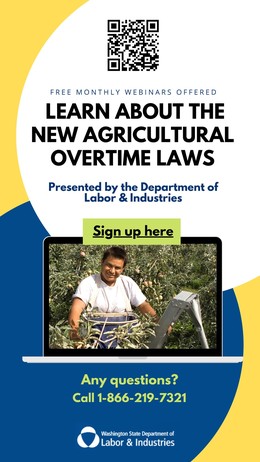 L&I is here to help explain new agricultural overtime rights
A new state law will allow agricultural workers to earn overtime pay starting Jan. 1, 2022. The law includes a three-year phase-in schedule which means agricultural workers will be entitled to earn overtime pay after they work 55 hours in a workweek in 2022, 48 hours in 2023, and 40 hours in 2024.
|
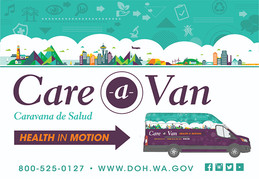 Washington State Department of Health Care-A-Van
The Washington State Department of Health (DOH) is piloting a new mobile vaccination effort across Washington state. We will work closely with
community partners and local health jurisdictions to increase access to vaccine for priority communities.
Site Prioritization
The Care-A-Van serves communities disproportionately impacted by COVID-19. Requests that cover multiple priority areas below will be given higher priority:
• Counties with higher vaccine gaps by race/ethnicity.
• Communities with a high rank on the Social Vulnerability Index (SVI) for COVID-19.
• Sectors with recent outbreaks.
• Communities overrepresented in COVID-19 cases, hospitalizations, and deaths.
• Demographic groups with lower vaccination rates compared to other groups.
• Groups not represented or underrepresented in current DOH data systems that have
likely experienced COVID-19 health disparities and vaccine inequities.
• Geographic locations that have not had a visit from the DOH Care-A-Van.
Interested in bringing the Care-A-Van to your community?
Visit doh.wa.gov/careavan for more
information.
|
|
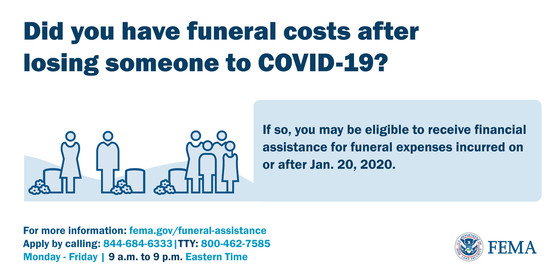
Washington Commission on Hispanic Affairs and FEMA Partner to Support Hispanic/Latinx Communities
BOTHELL, Wash. – The Washington State Commission on Hispanic Affairs (CHA) and FEMA are partnering to expand access to the FEMA Funeral Assistance Program for Hispanic/Latinx communities in Washington. This collaboration is an opportunity for FEMA to work with the Commission to engage with, inform, and reach Hispanic/Latinx community members who have lost a loved one to COVID-19.
“The impacts of the COVID-19 pandemic have—and continue to be—devastating,” says Vince Maykovich, Acting FEMA Region 10 Administrator. “By partnering with CHA, we want to build relationships with Hispanic/Latinx communities in Washington and raise awareness about how to register and participate in FEMA’s Funeral Assistance program.”
“We facilitate access to information and resources to the Hispanic/Latinx communities across the state of Washington. This means that we advise, lead, and help make sure that information is delivered in a digestible, culturally relevant way. We hope to aid in raising awareness about this valuable and important program in our community. COVID-19 has disproportionately affected the Hispanic/Latinx community in our state, and we hope this information encourages our community to apply to this program and help ease the financial aspects of placing a love one to rest,” says María Sigüenza, Executive Director of the Washington State Commission on Hispanic Affairs.
If you incurred COVID-19-related funeral, burial, or cremation expenses on or after January 20, 2020, FEMA may be able to help you with some of those costs. To apply, call FEMA at 844-684-6333. The helpline is open Monday through Friday, 6 a.m. to 6 p.m. PT. Multilingual services are available. If you use a relay service, such as video relay service (VRS), captioned telephone service or others, give FEMA the number for that service. You must be a U.S. citizen, non-citizen national, or qualified alien to apply. However, there is no eligibility requirement for the deceased person to have been a U.S. citizen, non-citizen national, or qualified alien. A funeral assistance video describing eligibility is available in English and Spanish, view and share today.
For more information about FEMA’s COVID-19 Funeral Assistance Program visit FEMA.gov.
Follow FEMA Region 10 on Twitter and LinkedIn for the latest updates and visit FEMA.gov for more information.
FEMA’s mission is helping people before, during, and after disasters.
|
|
Apply Now to be an Equity Ambassador!
The Equity Ambassador program application is now live with a priority deadline is November 15! Washington Nonprofits is seeking people who love to connect people and resources to help them with outreach and community connection.
Do you know of folks in your community whom people turn to for information, or who enjoy staying connected with a wide range of people? Washington Nonprofits is looking for community-minded folks to do outreach for and provide feedback to Washington Nonprofits. Equity Ambassadors is an essential part of Washington Nonprofits’ Community Engagement program. They keep Washington Nonprofits connected to communities across the state. They identify unmet needs, enhance program relevance, and extend the reach of programming within underserved communities.
This is a paid opportunity, and Ambassadors will be classified as independent contractors. Total payment for each 12-week period will be $2,500. That the scope of work will take about 72-96 hours to complete (6-8 hours per week).
They are looking for applicants who have nonprofit experience and knowledge of Washington State. They are prioritizing recruitment of lived experience and connection to Black, Indigenous, Persons of Color, immigrant, rural, LGBTQ2S+ and disability communities. They are also seeking to recruit people from different geographic communities in Washington.
|
On March 15, 2018 House Bill 2759 was signed into law by
Governor Jay Inslee, establishing the Washington State
Women’s Commission.
The Washington State Women’s Commission improves the life of every woman and girl by ensuring equitable opportunities and removing systemic barriers through engagement, advocacy, and public policy, while being
inclusive of our diverse populations.
Biennial Report 2018-2020
Based on the Biennia Report:
- 23% of Latina WA women who did not see a doctor in the past 12 months due to cost, 2019.
- 42% of Latina Single mothers in WA State are living below the federal poverty level, 2019
- 22% of Latina WA women who report fair or poor health status, 2019.
COVID-19 Impact:
There is an urgent need for better data, as racial and ethnic information needed to fully understand the impact of COVID-19 on communities of color has been inconsistent, underreported, or misclassified. As a result, women of color, who face the compounded harms and challenges of their intersectional identities, are especially likely to
face amplified inequity as a result of the pandemic.
|
2022-23 FINANCIAL AID APPLICATIONS NOW OPEN
|
October 1 marked the first day people can apply for financial aid for the 2022-23 school year. Completing a financial aid application opens up more options for the future, so please share this information with friends, family, and neighbors. This year, a family of four making up to $102,000 can qualify for financial aid in Washington. In order to receive any state or federal financial aid, students must submit a financial aid application. But far too few students apply for financial aid in Washington, with only about half of high school seniors filing a FAFSA (Free Application for Federal Student Aid) in recent years. Get more details on how to apply at the Washington Student Achievement Council’s website: https://bit.ly/3as6XEx
Why Apply for College or Training? Information for Students & Families
Want More Money and More Options? Get More Education Beyond High School.
Even in uncertain times, you can secure a better future. A college degree, certificate, or other training beyond high school can lead to a good job, higher wages, and more. And financial aid helps make college or training affordable.
Why apply for college or training? Adults with a college degree or certificate:
- Are more likely to enjoy their work.
- Can change careers more easily.
- Are less likely to be unemployed.
- Live longer, healthier lives.
- Earn around $1 million more over their career than high school graduates.
Need to start working sooner than later? Move beyond minimum wage with an apprenticeship or other job training. Even a one-year program at a community college or technical college can increase your future earnings. And in an apprenticeship, you earn while you learn. In many cases, apprentices can get paid to work and use financial aid to cover out-of-pocket costs like tuition, fees, and materials.
Put your passion to work. More education means more job stability and higher earnings. For life.
Learn more and plan your future on the Washington Student Achievement Council website.
REGISTER FOR CREDENTIAL ENGINE STATE CONVENING ON NOV. 30
We encourage you to register for Credential Engine’s fourth annual State Convening from 10 a.m. to 1 p.m. on Tuesday, November 30. It’s a (free!) virtual meeting where participants will learn how to work “Toward a More Transparent Credential Landscape Through Policy, Leadership, and Equity.” Nearly one million unique credentials are available in the United States, each one representing an opportunity for people to get ahead. But a lack of necessary and timely information makes it difficult for people to find the best education and training opportunities. State policymakers and agencies can help ensure their residents have the information they need to make well-informed decisions, especially during this time of economic recovery and continued labor market uncertainty. https://bit.ly/3mHLgq6
Hispanic Heritage Month Wrap-Up
Vice Chair Brian Moreno shares one of his favorite books, Mikey and the Dragons by Jocko Willink and shares what he loves about being LatinX in honor of Hispanic Heritage Month.

|
|
NAVIGATING DIFFICULT TIMES: SUPPORT AND RESOURCES
by EAP Washington State
Energy, Food and Housing
Legal and Financial Assistance
National, State and County Crisis and Emergency Support
Mental Health, Substance Use and Addiction
|
|
|
Hispanic/Latinx Demographic Reports Cards are now live!
|
|
|
|
|