|
Having trouble viewing this email? View it as a Web page.
April 3, 2026
Dear Friends and Neighbors,
As baseball fans know, if there’s a statistic to be kept, someone is keeping it – no matter how trivial it may seem. For example, the Seattle Mariners didn’t hit a single in their first two games of the 2026 season – all nine hits were for extra bases, and that hasn’t happened to a team since 1900.
In Olympia they keep statistics about the Legislature. Some, like the number of bills passed by the Senate and House in a session, are easily available through the legislative website. Others are compiled by our very able staff – like the number of bills containing what’s known as the “emergency clause.” I’ll explain the significance of that, but first let’s get caught up on a bill which doesn’t contain the emergency clause but something close: the new state income tax.
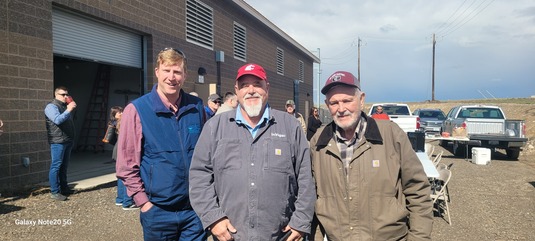 From right: Dennis Swinger, Dennis Swinger Jr. and Hans Hunt, assistant chief for the Western Region with the USDA's Natural Resources Conservation Service. I was among those who spent several hours yesterday showing our special federal guest around the Odessa Groundwater Replacement Program, starting at the EL 47.5 pump station several miles from Warden.
It's official: Governor signs income-tax bill
As a somewhat critical editorial in The Seattle Times observed about Gov. Bob Ferguson following the end of the 2026 session, and the final passage of the bill to create Washington’s first income tax since 1932: “While lawmakers come and go, Ferguson has now attached his name in history to the governor who brought an income tax to Washington.”
Ferguson literally attached his name to Senate Bill 6346, the new 9.9% income tax, on Monday. That was purely symbolic, though. His only real choice was whether to veto it, and considering the governor was promoting the income tax in December, no one figured that would happen.
When the majority party brought this latest income-tax proposal forward for a vote, there were many reasons to oppose it. My overall concern was that an income tax on anyone in our state will eventually become an income tax on everyone.
Senate Bill 6346 is called a “tax on millionaires.” But the million-dollar income deduction contained in the text is a marketing gimmick. It’s in a single sentence, meaning future legislators could reduce the size of the deduction through a simple majority vote. Republicans supported amendments to lock in the deduction but each was rejected.
Here are a few of the other reasons I voted no.
- The policy in SB 6346 clearly seems unconstitutional. Taxes are required to be the same (or “uniform”) on the same class of property, and since the 1933 state Supreme Court ruling against Washington's original income tax (issued exactly 10 months after the tax was approved), income has been considered property. The new 9.9% income tax doesn’t treat all income the same.
- It’s unfair that SB 6346 includes language blocking the people’s constitutional right to reject new laws through a voter referendum. The amendments we supported to protect that right also were unsuccessful. (The right to a voter initiative is not affected, however.)
- An income tax is unnecessary. State government is already collecting more tax dollars than ever. Olympia doesn’t need another $3.2 billion each year to spend irresponsibly.
As for what’s next: Voter initiatives were filed with the secretary of state’s office regarding the income tax soon after the governor signed it, and there are strict limits on what legislators can say in their official communications (like this report) about proposed ballot measures. Therefore, I’ll end by saying that whatever is next for the income tax will happen outside of the legislative branch.
Nearly half of this year’s ‘emergency clause’ bills became law, blocking opposition
Bills passed during a legislative session are to take effect no sooner than 90 days from the day lawmakers adjourn. That’s usually not an issue, except with budgets: last year they were all passed April 27, leaving far less than 90 days before the new fiscal year began July 1.
The solution is to include what’s called the “emergency clause” in the bill – which declares the bill to be (quoting from the state constitution here) “necessary for the immediate preservation of the public peace, health or safety, support of the state government and its existing public institutions.”
The use of “immediate” means the bill takes effect as soon as the governor signs it. That’s an appropriate use for budgets and other bills that are truly time-sensitive – like this year’s capital budget, which the governor signed Wednesday.
Unfortunately, the majority Democrats have taken to weaponizing the emergency clause, as it can be use d to make any bill immune to a referendum.
Soon after the Legislature adjourned March 12 the Senate committee staff director sent around a list of the bills that contained an emergency clause this year. There were 57, of which 26 were signed – a 47% rate, which was much higher than the 27% a year ago (47 signed of 169 containing the clause).
Only four of those 26 from this year are either budget- or bond-related. So what else did Democrats see as an emergency – meaning the change in law couldn’t wait a few months? The anti-sheriff bill (Senate Bill 5974), which was signed Wednesday, is one, along with the anti-mask bill that attempts to dictate what federal officers wear (SB 5855) and yet another anti-Second Amendment bill (House Bill 2320).
The income-tax bill won’t take effect until June 11. But it contains a modified version of the emergency clause – “The tax imposed in this act is necessary for the support of the state government and its existing public institutions,” and that’s enough to also block a voter referendum.
It’s outrageous how those on the political left talk about saving democracy and complain about authoritarianism, then turn around and suppress efforts to oppose the laws they make.
‘Good Bill of the Week’ becomes a good bill of the session
My first commentary from February, a few weeks into this year’s session, featured Senate Bill 6103 as the Good Bill of the Week. I’m happy to report it was signed by the governor March 18, after passing unanimously in the House on March 4 – exactly one month after the Senate’s unanimous vote.
To repeat some of what I wrote then, this new law provides a lifeline for the East Adams Hospital in Ritzville, as it seeks to become the first Rural Emergency Hospital in Washington. Because state law hasn’t addressed the handling of Medicaid claims made by REHs, East Adams was looking at a reduction in reimbursement without the necessary offsets to survive.
That should be fixed now, through SB 6103, and give other rural communities facing a similar financial situation the legal framework to keep their health-care doors open.
Wins for rural parts of Washington, especially rural health care, can be hard to come by Olympia. SB 6103 came from my Republican colleague and fellow farmer, 10th District Senator Ron Muzzall, who is our lead on health care, and I was glad to be a co-sponsor.
Congratulations to 9th District academic and athletic state champions!
I knew about the Colfax boys’ basketball team winning the state 2B title this winter because Sen. Judy Warnick, my Republican colleague from Moses Lake, is the proud grandma of one of the Bulldogs’ leading players... and kept the entire Senate informed!
On top of that athletic achievement, five teams in our 9th District also are academic state champions. Davenport notched two wins, for 2B boys’ wrestling and for cheer; Liberty, for 2B boys’ basketball; Pomeroy, for 1B girls’ basketball; and Pullman, for 2A girls’ bowling.
Well done to all!
From the calendar: Growth, and water
- On Wednesday evening I went to Davenport for a get-together with a group of forward-looking folks who see population growth and housing development coming toward Lincoln County and want to be ready for it – both the pros and cons.
The goal of this informal but productive meeting wasn’t to solve a problem, but to get the conversation going. I was invited largely because of my work on water issues over the years, including what I do as Senate Republican lead on the state’s capital budget.
As the invitation wisely put it, “the development pressure won’t politely stop at the Spokane County line waiting for us to prepare for it.” This was time well spent.
- Readers of my commentary know I keep close track of the Odessa Groundwater Replacement Program. Yesterday’s meeting in Moses Lake featured a tour of the OGWRP with a special guest: Hans Hunt, assistant chief for the Western region of the USDA’s Natural Resources Conservation Service. He’s a former Wyoming state representative with a ranching background.
The NRCS supplies funding to match the water-related investments made in our state’s capital budget, so I appreciated the opportunity to talk with him as one legislator would to another.
 |
Let me know if you need help or have an idea
If you wish to discuss an issue or concern with me, or if you need help with a problem involving state government, please reach out to me by email at mark.schoesler@leg.wa.gov or give my legislative office a call at 360-786-7620. I'd like to hear from you!
* * *
I welcome your comments about anything in this newsletter and questions about what I’m doing on your behalf in the state Senate. Please call, email or write using the contact information at the end of this report.
Click here to visit my legislative webpage!
Legislative Email: Mark.Schoesler@leg.wa.gov
Legislative Phone: (360) 786-7620
Toll-Free: 1 (800) 562-6000
Olympia Address:
417 Legislative Building
P.O. Box 40409
Olympia WA 98504-0409
|