|
Having trouble viewing this email? View it as a Web page.
January 23, 2026
Dear Friends and Neighbors,
There are more than a few problems facing Washington thanks to years of Democrats running the Legislature and state government.
Some of the trouble Olympia needs to fix – and soon – lies with the state’s social-insurance safety net – its paid family and medical leave, unemployment insurance and workers’ compensation programs.
 Washington's Capitol at dusk.
My guest editorial on the glaring problems in these costly programs was published by The Seattle Times on Wednesday. Below is the text, which appeared under this headline: “Alarm is sounding on WA’s social insurance programs. Olympia must act”:
Olympia, we have a problem. And no, it’s not just the billion-dollar shortfall facing the general fund that you might have already heard about. Three programs comprising the backbone of Washington’s social-insurance safety net — paid family and medical leave, unemployment insurance and workers’ compensation — all are quietly facing severe fiscal turmoil.
At the Employment Security Department, the paid family and medical leave program has seen astounding growth in less than six years of existence. By 2022, after being notified that PFML was facing insolvency, lawmakers took action based on stakeholders’ recommendations to get the program back on track. But even with those changes, program use has continued to skyrocket and benefit costs have repeatedly ballooned following new legislation.
Once again, ESD projects the program is headed toward drastic insolvency. Estimates show PFML being at least $350 million in the red by 2029.
If structural changes aren’t made soon to stabilize what has become an unsustainable program, it may go belly-up. Legislators need to rein in the program’s excesses before it goes bankrupt. We must also ensure that any bill expanding the program is reviewed by the Legislature’s fiscal committees.
ESD also projects new trouble ahead for the state’s unemployment insurance program. Until recently, Washington has enjoyed one of the most stable UI programs in the country, while providing the highest benefit available nationally. It’s why we were able to get through the pandemic and provide for workers without taking federal loans like many other states.
But a new analysis of the UI fund now shows there will not be enough in the fund to cover the reserves required by law. The agency’s fix? A “solvency surcharge” — that’s Olympia-speak for about $700 million in additional taxes imposed on employers. Rather than force even more taxes on business, especially taxes automatically imposed without legislative input, we need to explore possible program changes that would avoid the need for a tax in the first place.
At the Department of Labor & Industries, things aren’t any better. Driven by recent bills and policy changes that affect ongoing claim durations and the growth of costly post-traumatic stress disorder claims, L&I has been quietly spending more and more on workers’ compensation claims while taking in less. The department currently estimates that for every dollar collected in premiums, it spends $1.80 in benefits.
In response, L&I has been subsidizing rates by dipping into backup reserves year after year to keep rates down — this year to the tune of about $240 million. But this method of artificially keeping rates low unsustainably masks the real problem. We must take a hard look at what’s driving up these costs and get them under control. And my fellow legislators need to put the brakes on bills that appear to add new bells and whistles to workers’ comp but just drive up costs.
Notably, because these programs are funded through accounts separate from the state’s general fund, legislation surrounding these three programs often skips the traditional fiscal-committee review. Despite proposals burdening these accounts by millions of dollars, they’ll often never come before the Senate Ways and Means or House Appropriations committees. This allows bills to pass into law without the scrutiny they deserve.
Legislation has been filed to address some of these problems during this year’s session. Senate Bill 5889 would limit supplemental benefits for public employees’ leave while on paid family medical leave. Senate Bill 5927 would cap the rate of increase for future workers’ compensation cost-of-living adjustments. These proposals are just the start. Similar bills are likely to be introduced soon.
The lack of true oversight put us in the situation we’re in today. Olympia must get serious about fixing these programs before it’s too late.
Ferguson’s budget receives cold reception from… ‘tax spenders’
When Governor Ferguson released his supplemental operating-budget proposal a few weeks ago, my fellow Republicans and I were less than thrilled – because he also took that opportunity to voice support for a state income tax, even though it would have no direct bearing on the changes he wants to make in the budget he signed back in May.
During the first week of the session our Senate Ways and Means Committee held a public hearing on Ferguson’s proposed supplemental budget. It’s standard procedure for any budget submitted to us by the governor.
From my seat on the committee it was apparent that his plan was not exactly popular with groups that benefit from larger state budgets. I’ll refer to them here as the “tax spenders.”
The Washington State Standard noticed the chilly reception as well. Its article noted that, “In the course of six hours of public hearings over three days last week, dozens of people criticized the governor’s approach to closing a projected $2.3 billion shortfall.”
The “tax spenders” worry about possible cuts to a state operating budget that has become more and more bloated over the years thanks to the inability of Democratic governors and legislators to rein in state spending and refuse to raise taxes. But I can guarantee the tax spenders are not too concerned about the various tax hikes that Democrat-run Olympia has crammed down the throats of hard-working Washingtonians.
Just last year, we saw the Ds impose tax or fee hikes on a bunch of things, ranging from a huge business-and-occupation tax to a tax on storage units, and increases on hunting and fishing licenses, and the Discovery Pass. Democrats even passed a sales tax on services that even hit K-12 education, children’s dances and orchestras.
I must point out that the non-partisan Ways and Means staff has calculated the budget shortfall at $1.5 billion over the current budget cycle, which runs through June 2027. While that’s still not small, Democrats are notorious for inflating shortfalls in the course of trying to sell their tax proposals.
While no income-tax bill has been introduced yet this year, the Ds have made it clear that they’re thinking long-term: Passing one now would simply allow time for legal challenges and perhaps a public vote. They approached Washington’s capital-gains income tax the same way, passing it in 2021 with an effective date in 2023.
As for taxes in the short term, don’t be surprised to see the passage of a “jobs tax” that will hurt more than 3,000 Washington businesses. Democrats also are looking at tax hikes on paper grocery bags, bottles and cigarettes, among other items.
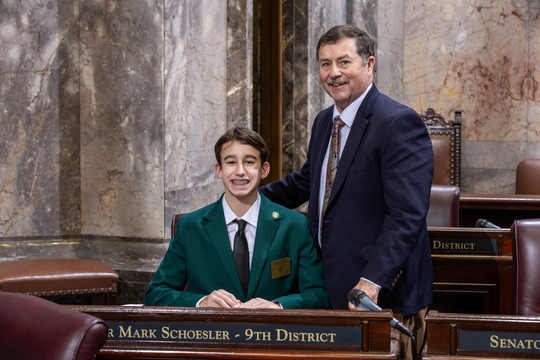 Senator Schoesler with Senate page Conrad Baumgartner.
Congressman’s son works as Senate page
I always enjoy sponsoring area students as Senate pages during our sessions. It’s nice for them to spend a week in Olympia and get a close-up view of how the Legislature operates. Plus, they earn some money and make friends with other pages from around Washington.
This week I had the honor of sponsoring the son of a former state Senate colleague. Conrad Baumgartner’s dad is none other than U.S. Rep. Michael Baumgartner, who serves Washington’s 5th Congressional District now but began with two terms in our Senate from Spokane’s 6th Legislative District. Conrad did a great job as a page, and I enjoyed getting to know him.
Do you know a teenager who would like to spend a week in Olympia working at the Capitol? Applications to be a Senate page this session still are being taken. The application form is here. For more information about the Senate Page Program, please go here. You can also email the page program at SenatePageProgram@leg.wa.gov if you have questions.
The last day to apply for the Senate Page Program for the 2026 session is Feb. 20, 2026, or until all available openings are filled. Page applications for the 2027 legislative session open Nov. 1, 2026.
Plenty of meetings this week
This week I had a busy schedule of meetings with different groups and individuals.
Monday was devoted to our state’s wheat industry. That morning I met with Washington Association of Wheat Growers officials, followed by lunch with WAWG President Gil Crosby. That night I attended the wheat growers’ legislative reception at an Olympia restaurant. The Wheat Ambassadors joined me for that dinner.
On Wednesday morning I met with a group of teachers from the Spokane area, followed by a meeting with architects from the 9th District and a meeting with Boeing officials.
Yesterday’s schedule included meetings with:
- Eastern Washington University students.
- State Office of Financial Management officials.
- Three Whitman County school superintendents: Trish Jeffries of Endicott, Julie Price of Rosalia and Bob Maxwell of Pullman.
- Washington Dental Association officials.
- State Public Works Board officials.
- Washington Farm Bureau officials.
I then had lunch yesterday with Eastern Washington University President Shari McMahan. We discussed issues impacting EWU during lunch.
Last night I was honored to attend the Columbia Basin Development League’s "Champions Dinner” in Olympia.
Today I had lunch with former Ritzville resident Shaun Cross, who donated his time to several important issues in our community.
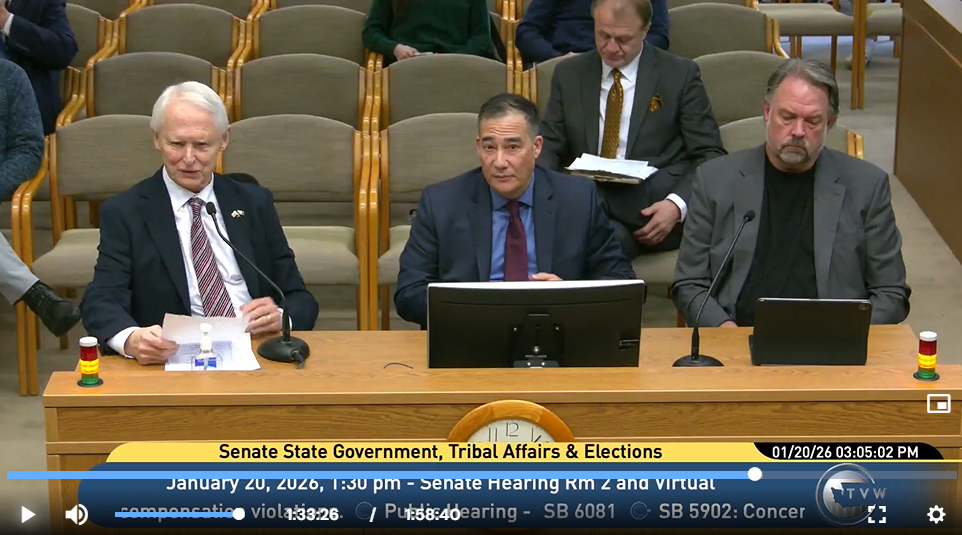 Former Secretary of State Sam Reed (left) and current Secretary of State Steve Hobbs (middle) testified this week against Senate Bill 5973, which targets the state’s initiative system.
Bad Bill of Week: Senate Bill 5973
In recent years we’ve seen Democrats introduce bills that try to weaken our state’s initiative system, which has existed for more than a century. This year there is a Senate bill fitting that description.
It is Senate Bill 5973, which was introduced by Senator Javier Valdez, the chair of the Senate State Government, Tribal Affairs and Elections Committee. Nicknamed the “Initiative Killer Bill” by some, SB 5973 would ban initiative campaigns from paying canvassers by the signature, a practice that became common in the 1990s. The measure also would impose a new requirement on initiative campaigns that they submit 1,000 signatures when they file a measure, a process that could cut into the time available to collect signatures to qualify for the ballot.
During Tuesday’s public hearing on SB 5973 before this panel, many people testified against it, including current Secretary of State Steve Hobbs, a Democrat, and former Secretary of State Sam Reed, a Republican. You may view their testimony against the bill here. When the current chief elections officer in our state and one of his predecessors team up to speak against a bill, we all should take notice. I hope Senator Valdez and others on this Senate committee noticed as well. I also hope the Democrats on the committee and in the Senate will keep in mind that more than 10,000 people signed up against this bill.
Apparently, all of this significant opposition to the bill was not enough to sway Senator Valdez and his Democratic colleagues on the committee, as they voted this morning to move it forward.
Senator Wilson, the Republican leader on the Senate State Government, Tribal Affairs and Elections Committee, sent this news release following Tuesday’s hearing on SB 5973 to criticize the proposal.
It notes Democrats have pointed to a “recurring pattern of fraud” by paid signature gatherers. But Wilson noted there have been only a handful of cases of signature fraud over the last three decades, all were detected by state elections officials or by the campaigns themselves, and none have been reported in the last 13 years. As Wilson, R-Longview, said. “This bill would allow Olympia politicians to push their agendas without interference from the people.”
That’s why SB 5973 is my Bad Bill of the Week.
Good Bill of the Week: SB 6104
As all of you likely know, I’m a fifth-generation wheat farmer who cares very much about agriculture, especially here in Washington.
I watch for ag-related bills that are either good or bad. One of the proposals offered this session that supports Washington ag is Senate Bill 6104. This proposal, which is the Good Bill of the Week, would require an agricultural-impact statement on agency-request legislation, reports, rulemaking or policy development, including proposals for mitigation. The bill would require the state Office of Financial Management (OFM is the governor’s budget office) to do ag-impact fiscal notes on new legislation. SB 6104 includes language that mitigation that deprives property owners of beneficial use must be compensated from the habitat conservation account. Finally, the bill would require cities and counties to prepare agricultural-impact statements before annexing farmland.
The point of this bill is that state agencies need to be aware of the impact their actions have on agriculture. If landowners are required to pay or lose financially from complying with regulatory actions, the state needs to pay for it. Also, cities and counties need to be cognizant of preserving ag land when making land-use decisions.
SB 6104 is scheduled for a public hearing in the Senate Agriculture and Natural Resources Committee on Thursday next week.
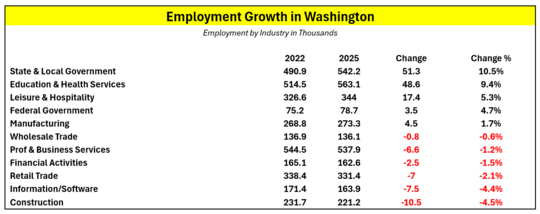
Another reminder about government growth in WA
Over recent months, I’ve pointed to statistics that show how government is the leading “industry” in Washington in terms of job growth. Need more proof? Here it is. Check out this chart (above) showing the growth in state- and local-government jobs in our state in the last three years compared to other job sectors.
It’s both remarkable and scary that several private-sector industries have fewer jobs than three years ago. To add to my concern over the growth in government jobs vs. private-sector employment, the state economist forecasts 0.0% job growth in 2026, albeit with state/local government employment still projected to grow.
Let me know if you need help or have an idea
If you wish to discuss an issue or concern with me, or if you need help with a problem involving state government, please reach out to me by email at mark.schoesler@leg.wa.gov or give my legislative office a call at 360-786-7620. I'd like to hear from you!
* * *
I welcome your comments about anything in this newsletter and questions about what I’m doing on your behalf in the state Senate. Please call, email or write using the contact information at the end of this report.
Click here to visit my legislative webpage!
Legislative Email: Mark.Schoesler@leg.wa.gov
Legislative Phone: (360) 786-7620
Toll-Free: 1 (800) 562-6000
Olympia Address:
417 Legislative Building
P.O. Box 40409
Olympia WA 98504-0409
|