|
Having trouble viewing this email? View it as a Web page.
October 29, 2021
Dear Friends and Neighbors,
Governor Inslee has been having press conferences most every Thursday for months, and usually they are pretty much confined to COVID-19. Not yesterday. Inslee announced he will represent our state at the international climate change conference starting Sunday in Glasgow, Scotland. Later in the press conference, when asked about natural gas, he commented that our state does not have enough laws to “restrain” the use of fossil fuels. I didn’t hear any reporter ask what should have been an obvious question: If you’re so concerned about the use of fossil fuels, Governor, why don’t you appear at the conference in Scotland remotely? Why do you need to jet off to talk about the climate again, like you did in 2018?
Regulatory agency keeps door open for Inslee vaccine mandate on all employers
When Governor Inslee issued his COVID vaccine mandate for most state employees and health-care workers in both the public and private sectors, we wondered if and when he would try to extend that mandate to all private employers. This week the agency known for cracking down on employers over other COVID mandates set the stage for the governor to make that next move.
In short, the Department of Labor and Industries has effectively extended the emergency rules dating from May 2020 that allow it to enforce the emergency COVID-19 proclamations which apply in the workplace. The extension is for 120 days, which tells me a couple of things. First, Inslee is in no rush to end the state of emergency he proclaimed more than 610 days ago. Second, he is prepared to ignore the Biden administration, which announced in mid-September that it is working on an all-out vaccine mandate for the private workplace.
In May the governor used new workplace rules to force Washington employers to verify the vaccination status of employees who wish to work without wearing a face covering. He is certainly capable of using the same tactic against them now, to force vaccinations. As the saying goes, “never let a good crisis go to waste,” and a vaccine mandate for all private employers would fit with many of the other extreme actions we’ve seen from Inslee during the pandemic.
Our Senate Republican leadership counsel suspects the L&I emergency rule would allow Inslee to exert even more control over the private sector, across a wider set of topics, than anything the Biden administration is planning. For that reason the people of our state should ask: What else does the governor have up his sleeve that would need L&I enforcement?
Chapter 34.05.350(3) of the Revised Code of Washington allows any person to petition the governor to immediately repeal the emergency rule, and a group of Republican legislators did that this week. The governor must either grant the petition and order the immediate repeal of the emergency rule or deny the petition with a written basis explaining the denial. That could give the people some insight into what the governor has planned for their lives.
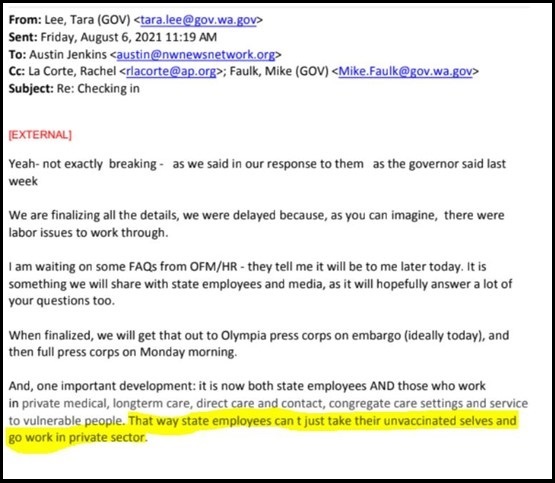
One more thing: I’ve been asked why Inslee extended his vaccine mandate to nurses and other health-care workers in the private sector, on top of so many public-sector employees. The answer comes from an August 6 email from the governor’s chief spokesperson to a pair of Olympia-based reporters, uncovered through a recent public-records request: “That way state employees can’t just take their unvaccinated selves and go work in [the] private sector.” Consider that alongside the fact that Inslee chose to exempt in-home health-care workers from his vaccine mandate – workers who tend to be members of SEIU 775, which has been a big supporter of the governor and his allies. The obvious conclusion here is that Inslee’s rules don’t apply to everyone equally.
|
Local elk population hits 30-year low; what will state do?
My circle of fellow deer hunters has some good results so far this year, including a fine buck taken by son Cody. But I’m going to take this year off from the traditional elk camp in the Blue Mountains, and the reason is in an article in the Spokesman-Review several days ago: The elk population in the Blues is way, way down. I and my good friends from elk camp could see this coming a couple of years ago, but the Department of Fish and Wildlife seems to be just now figuring it out.
According to the report, the state DFW director advised members of the state Fish and Wildlife Commission to avoid jumping to conclusions, because the mortality data needs more study. Maybe so, but let’s see if the agency ultimately tries to pin this more on drought and wildfires, which would be in line with Jay Inslee’s climate crusade, and less on the fact that there are four wolf packs on the Washington side of the Blues, which is double what was reported in 2017.
Will the state take any action to promote the survival of elk calves in the Blues? Well, look at how these new mortality numbers compare to the mortality of the southern resident orcas. From 2012 to 2020, according to the federal Marine Mammal Commission, 17 orca calves were born and six either died or went missing, which is a mortality rate of roughly 33%. The orca population is down about 20% from a peak in the mid-‘90s but above where it was almost 50 years ago.
Just by the numbers, what’s happening to the Blue Mountain elk is more alarming than the orca situation. But I just can’t see Jay Inslee, or U.S. Sen. Patty Murray, or environmental activists and related interest groups rushing to stand up for the elk. Can you?
Advisory votes help hold legislators accountable
If you’ve looked at your Nov. 2 general-election ballot and wondered what those three “advisory votes” are, they are the result of the Initiative 960 law, approved by the voters in 2007. It requires new laws that raise taxes, when approved by a majority of the Legislature, to be put to a non-binding vote of the people. The same law also requires the Office of Financial Management (the governor’s budget office) to produce an analysis of proposed tax and fee increases that projects the cost to taxpayers over 10 years.
As a longtime member of the Senate Ways and Means Committee, I appreciate the 10-year cost projections. There was a time when I questioned the value of the advisory votes, and although my Democratic colleagues continue to attack their purpose, I’ve come to view these votes as useful for holding legislators accountable. Yes, it’s interesting to see whether people think a tax increase should be “repealed” or “maintained,” but I like the fact that the advisory votes serve to either inform or remind taxpayers of actions the Legislature took earlier in the year. I have no problem with people asking me about these tax bills, and why I voted as I did. So the advisory votes are a conversation starter, and beyond that a good example of open government!
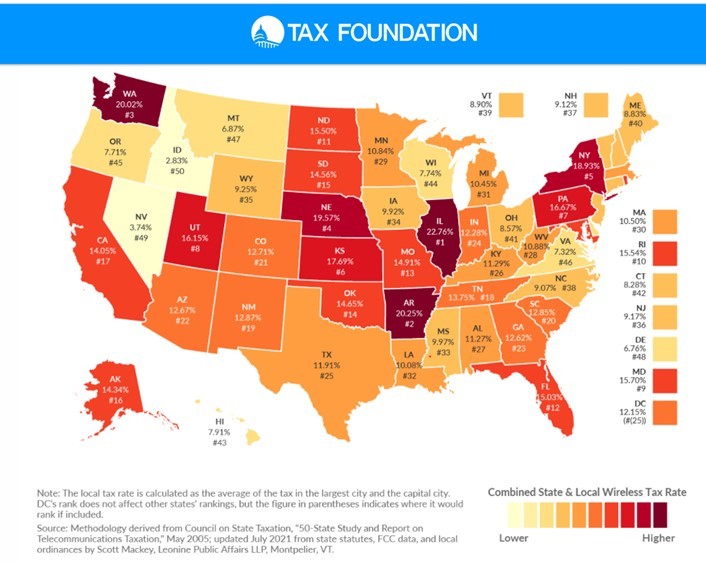
The advisory votes on this year’s ballot include the new state income tax on capital gains (click here for more on that from the Washington Policy Center), and the legislation that gives Washington the third-highest cellphone tax in the country, while Idaho’s is the lowest. I’d like to know what you think of those -- so please vote!
Another week... another city bans local income tax!
My previous commentary mentioned how local income taxes had been banned in nine Washington cities or counties. The list is now at 10, just a week later, with the addition of Longview, the largest city in Cowlitz County.
Longview becomes the second community west of the Cascades (more specifically, southwest Washington) to ban the adoption of a local income tax. Like other local governments, its council is taking action in anticipation of a move from either the Washington Supreme Court or the Legislature that could allow local income taxes.
This line from the council's resolution says it all: "Such a tax would be in direct conflict with the high value the City places on promoting economic development through the attraction and expansion of financially healthy, family wage paying employers." The Washington Policy Center has a write-up here.
* * *
I welcome your comments about anything in this newsletter and questions about what I’m doing on your behalf in the state Senate. Please call, email or write using the contact information at the end of this report.
Click here to visit my legislative webpage!
Legislative E-mail: Mark.Schoesler@leg.wa.gov
Legislative Phone: (360) 786-7620
Toll-Free: 1 (800) 562-6000
Olympia Address:
204 Newhouse Building
P.O. Box 40409
Olympia WA 98504-0409
|