Dear Friends and Neighbors,
One of the questions I get asked most often after the Legislature adjourns is, "So, do you get a break now?" I usually smile and tell people, "Not if you farm."
Summer is one of the busiest times of the year on our family farm. The crops don't stop growing because the legislative session ends, and livestock certainly don't check the calendar before deciding they need attention. Farming has taught me that if you ignore a problem today, it usually becomes a much bigger one tomorrow.
The same is true in public service. While the Legislature isn't meeting in Olympia every day, I've spent the past several months traveling throughout the 10th Legislative District and across Washington listening, learning, and working on the issues that matter most to our communities.
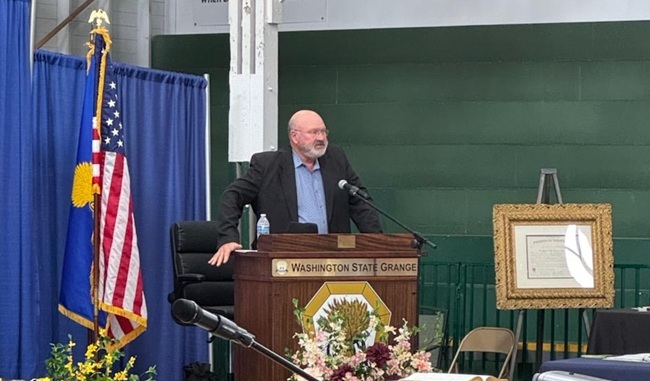 Since May, I've spent a lot of time traveling throughout the 10th Legislative District and across Washington, meeting with constituents, local leaders, and organizations. Here's a snapshot of my interim:
- Washington State Ferries Ferry Advisory Committee discussion on ferry service.
- Oak Harbor Chamber of Commerce meeting.
- Oak Harbor Public Safety Training Center ribbon cutting.
- Oak Harbor Fire Station No. 82 ribbon cutting.
- Visit with Washington State University President Elizabeth Cantwell at our family farm to discuss agriculture, higher education, and rural Washington.
- Washington State Grange Convention discussion on agriculture and the challenges facing Washington farmers.
- British Columbia-Washington Legislature Interparliamentary Group meeting.
- Rural Nursing Leadership Symposium panel discussion on rural health care.
- Rural hospital tour with the Senate Health and Long-Term Care Committee.
- Meeting with Health Care Authority Director Ryan Moran on Washington's health care system.
- Interim committee work in preparation for the 2027 legislative session.
Those conversations covered everything from transportation and agriculture to public safety and higher education. But no matter where I was or who I was talking with, one topic seemed to come up time and again: Health care.
We have to stop treating the symptoms and start fixing the problem
Whether I'm talking with young families, seniors, nurses, physicians, hospital administrators, or employers, health care is almost always part of the conversation.
It isn't hard to understand why. Families worry about whether they'll be able to see a doctor when they need one. Employers worry about rising insurance premiums. Rural communities worry about keeping their hospitals open. Hospitals worry about finding enough nurses and physicians to keep providing care.
These aren't just policy issues to me. They're personal. Like many of you, I have children and grandchildren. I want them to have access to quality health care close to home. I also want to know that when someone in Coupeville, Oak Harbor, Friday Harbor, Mount Vernon, or Stanwood needs emergency care, that hospital will still be there.
Unfortunately, our health care system is under tremendous strain. Hospitals must care for everyone who walks through the door, whether or not they have insurance. Medicare and Medicaid often reimburse hospitals less than what it actually costs to provide care. Charity care demands continue to grow, while labor, equipment, prescription drugs, and regulatory costs continue to climb.
If you've ever run a small business while selling your product for less than it costs to produce, you know exactly what happens. Sooner or later, the math catches up with you. That's where many of our hospitals find themselves today.
A lot of people asked me about the 340B bill
One of the biggest health care debates during this year's legislative session involved Senate Bill 5981 and the federal 340B Drug Pricing Program.
The 340B program was created by Congress more than 30 years ago to help hospitals and community health centers that serve large numbers of low-income and uninsured patients. The idea was fairly straightforward. Eligible hospitals could purchase certain outpatient prescription drugs from manufacturers at discounted prices. Those savings could then be used to help support services like charity care, behavioral health, cancer treatment, and other programs communities depend on.
But over the years, the program has become much larger and much more complicated than Congress originally envisioned. Today, many prescriptions are filled not by the hospital itself but through contract pharmacies. Those arrangements have grown dramatically, with many involving some of the nation's largest pharmacy chains, including CVS, Walgreens and Rite Aid, as well as pharmacy benefit managers. In Washington, roughly 70 percent of contract pharmacies participating in the program are large chain pharmacies, and many arrangements involve the largest pharmacy benefit managers in the country.
One thing that often surprises people is that patients do not receive the 340B discount directly when they pick up a prescription. They still pay their normal copay or insurance cost-sharing. Instead, the financial benefit stays within the health care system and is used by participating hospitals to support operations and patient services.
Why I voted "no"
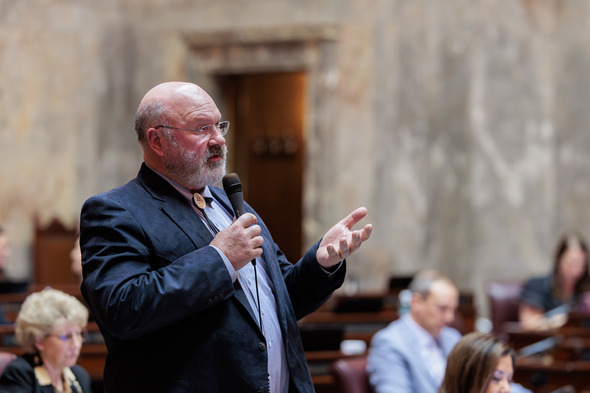 After spending months studying this issue and talking with hospitals, health care providers, and policy experts, I came to one conclusion. Senate Bill 5981 doesn't fix what's broken.
It expands a financing system that's already being asked to do too much. During debate on the Senate floor, I explained why I believe Washington needs a long-term solution to support our hospitals instead of another stopgap measure.
You can watch my Senate floor remarks on Senate Bill 5981 here.
One example I shared involved the University of Washington Medical Center. Last year, the hospital provided more than $600 million in charity care. The 340B program generated about $85 million to help offset those costs.
Think about that for a moment. Even with 340B, the hospital was still carrying hundreds of millions of dollars in uncompensated care. That tells me our hospitals absolutely need help. It also tells me this program isn't solving the larger problem. Instead, we're continuing to build layer upon layer of financial arrangements to prop up a system that is fundamentally out of balance.
As a farmer, I think about it this way. If your tractor won't stay running, you can keep replacing belts, hoses, and filters. Each repair might buy you a little more time. But eventually you have to ask whether it's time to rebuild the engine.
That's where we are with health care. The economics no longer work. Hospitals are reimbursed below the cost of care. They're expected to absorb growing amounts of charity care. Insurance premiums continue to rise for families and employers. Meanwhile, increasingly complicated financial arrangements move dollars through hospitals, insurers, pharmacy benefit managers, manufacturers, and large corporate pharmacy chains before they ever reach the patient.
I believe we can do better. Rather than expanding a system that increasingly benefits large corporate intermediaries, we should be addressing the reasons hospitals need these complicated financing arrangements in the first place.
I'd rather spend our time fixing reimbursement rates that don't cover the true cost of care, reducing unnecessary regulations that drive up costs, helping rural hospitals recruit and retain doctors and nurses, and building a health care system where hospitals don't have to depend on one workaround after another just to keep their doors open.
Looking ahead
These conversations have only strengthened my commitment to improving health care in Washington. As your senator and the ranking Republican on the Senate Health and Long-Term Care Committee, I'll continue to meet with providers, patients, community leaders, and constituents throughout the interim to identify practical, long-term solutions that strengthen our rural hospitals and improve access to care.
As farmers know, there's a big difference between getting through one more season and building something that will last for generations. That's the kind of thinking I believe Washington needs when it comes to health care, and it's the approach I'll continue bringing to Olympia on your behalf.
We also have a difficult budget cycle ahead, despite the new taxes enacted this year. As those budget discussions begin, I'll work to ensure our communities' priorities are represented and that the 10th Legislative District has a strong voice at the table.
If you'd like to keep up with what's happening in Olympia, I invite you to visit my legislative website for the latest news, constituent email updates, videos, opinion pieces, and information about what I'm working on.
I also enjoy getting out into our communities. If your service club, civic organization, neighborhood association, or community group is looking for a speaker, I'd be happy to join you. It's always a pleasure to provide a legislative update, hear your concerns, and answer your questions.
Thank you again for the privilege of serving the people of the 10th Legislative District. It is an honor I never take for granted.
Yours in service,

Senator Ron Muzzall
10th Legislative District
Share my E-newsletter
Please be sure to subscribe to my newsletter if you have not already. You can unsubscribe at anytime by clicking here. Feel free to share this with others that live in our district. You can forward this email to them or click on the share button below.

Contact me
Olympia Office:
310 Irv Newhouse Building
P.O. Box 40410, Olympia, WA 98504
Olympia Phone:
360.786.7618
Email:
Ron.Muzzall@leg.wa.gov
Website:
Click Here
|