Dear Friends and Neighbors,
We’ve reached the end of the 2026 legislative session. Sine Die was Thursday, March 12 — and as always, there’s a lot to report.
This is a longer update than usual, but it’s important you have the full picture of what happened this session and what it means for your family. Let me start with the issue that dominated this session: the state’s operating budget.
$80 billion in — Still coming up short
The Legislature approved the 2025–27 supplemental operating budget, pushing total spending to $80.206 billion. To put this in perspective: When Republicans last led the Senate in 2017, the budget was $38 billion. Since Democrats took control, it has grown by an astounding $42 billion.
That kind of growth should deliver results. Instead, we’re seeing the opposite: spending is rising faster than family incomes. And when that happens, the next step is always the same — more taxes. That’s exactly what we saw this year.
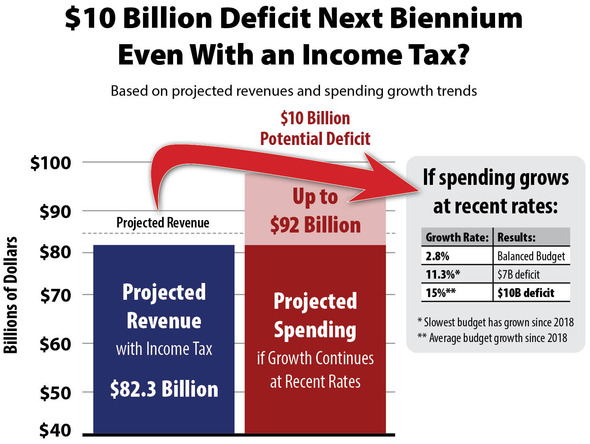
In fact, the state expects about $82.3 billion in revenue. But at current spending levels, we’re headed toward roughly $92 billion, a gap of up to $10 billion. We’re spending more than ever, and still coming up short. See the chart below.
Even worse, to balance the budget this year, the majority leaned on one-time fixes: draining reserves, tapping the rainy-day fund, shifting money from other priorities, and assuming hundreds of millions in spending will simply never happen. Washington can’t afford this kind of budgeting.
A new state income tax
Senate Bill 6346 creates a 9.9% tax on income above $1 million starting in 2028. It’s being sold as a “millionaire’s tax.” It isn’t. It’s an income tax, and once it’s in place, it won’t stay limited.
If it were truly just for millionaires, the majority could have locked it in with a simple amendment. They didn’t. That tells you everything you need to know; all it takes is a simple majority vote to lower the threshold.
And we’re already seeing the warning signs. High earners and job creators are leaving Washington, whether Olympia wants to admit it or not. These aren’t theories. These are real decisions — with real consequences.
So… What do we get for all this money?
Which brings me back to the question I hear more and more from constituents, and one I’ve been asking myself: What are we getting for all this money? Over the past decade, state spending has increased by more than $40 billion.
Have we solved homelessness? No, it has increased significantly. Are energy costs going down? No, families are paying more at the gas pump and on their utility bills, and those costs ripple through everything, from groceries to keeping the lights on at home. Are our schools delivering better outcomes? No, test scores have declined even as spending has increased.
Meanwhile, families are feeling the squeeze in their own budgets. Costs for housing, groceries, insurance, and child care continue to rise. Many households are working harder just to keep up — and in some cases, falling behind.
All this spending. Now, an income tax. And still, these are the results.
What could we have done instead?
Imagine what the state government could do if the majority hadn’t dramatically increased spending over the past decade. We could:
-
Eliminate the state’s one-third portion of the property tax.
-
Eliminate the sales tax on prepared food and clothing.
-
Fund transportation with the existing sales tax on motor vehicles instead of continuing to raise the gas tax.
-
Eliminate the Climate Commitment Act’s impact on gas prices, reducing fuel costs by up to 60 cents per gallon.
- Make housing more affordable by reducing the cost of government impact fees on new home construction
Instead, families are being asked to pay more and more — and getting less in return.
A better way: Start from zero
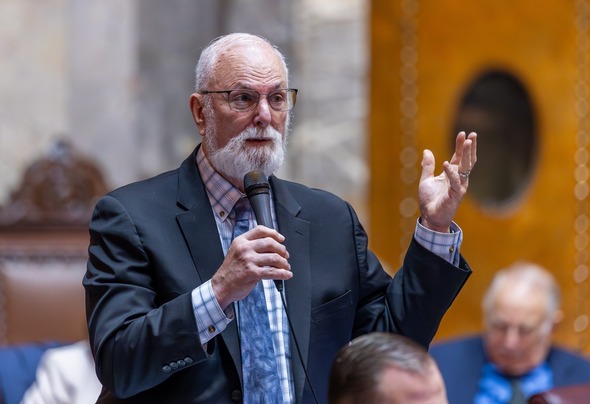 That’s why I pushed a different approach this session: zero-based budgeting.
Instead of automatically increasing spending each year, it requires agencies to justify every dollar from the ground up. Right now, we start with last year’s budget and add more, rarely asking whether programs are still working. Zero-based budgeting would change that. It brings real accountability and a clear look at where your money is going.
Unfortunately, the majority rejected my proposal.
What’s next
Stay tuned — in my next update, I’ll walk through the finalized transportation and capital budgets and highlight projects affecting our region.
If you ever have questions, concerns, or ideas about legislation or state government, please don’t hesitate to reach out. Hearing directly from you helps guide the work I do on your behalf.
You can also stay informed between updates by following the Senate Republican Caucus on Facebook, X, YouTube, and Instagram, or by visiting my legislative webpage for the latest news and updates from Olympia.
It is an honor to serve you in Olympia,
Phil Fortunato
31st District Senator
Contact Me:
Mail
PO Box 40431, Olympia, WA 98504
Olympia Office
341 Irv Newhouse Building
Phone: (360) 786-7660
Email: Phil.Fortunato@leg.wa.gov
www.SenatorPhilFortunato.com
|