Greetings Friends and Neighbors,
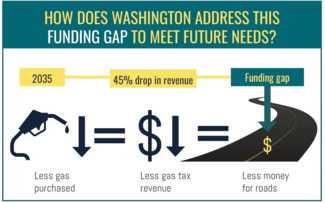
Under Washington’s constitution, highway projects across the state are funded primarily through a state tax on fuel. The gas tax has gone up three times in the past 16 years, most recently in 2015, and is now the second-highest in the nation. It’s been claimed for some years now that the revenue from the gas tax is declining, due to people driving vehicles that are more fuel-efficient, so the state’s transportation commission (which is appointed by the governor) has been looking for new ways to fund transportation projects. The list of options is headed by additional tolls and now a pay-per-mile tax, which supporters call a “Road Usage Charge” or RUC – calling it a “charge” avoids having to say “tax” (because people don’t like taxes).
Earlier this year I made a point of joining the steering committee for the RUC pilot project so I could learn more about this proposed mileage tax. That allowed me to be present for some of the “focus group” interviews that will feed into the final recommendations that are due to the Legislature. I have linked to the the seven-year, $7,000,000 (I have decided to use all the zeroes in future correspondence) study for your information. Click here to read.
The argument for a mileage tax is that gas-tax revenue is declining (a claim that has been challenged), while transportation costs are increasing with inflation. However, charging by the mile does not address those inflationary increases, and it also offsets the benefits of buying fuel efficient or electric vehicles. During the RUC pilot program, people driving the least fuel-efficient vehicles paid less per mile than electric vehicles! Also, owners of electric and hybrid vehicles already are contacting me out of frustration that 2019 brought them additional registration fees. It’s clear that a mileage tax would further reduce the incentive to buy more fuel-efficient vehicles.
The pilot program referred to in the study was “revenue-neutral,” meaning the participants (who were volunteers) wouldn’t be stuck with a pay-per-mile bill that would be higher than what they’d pay under the current gas tax. That is probably why many responses from participants showed little concern about the cost. However, because the purpose of this proposed change is to raise more money than the gas tax does, I felt that aspect of the pilot program was somewhat deceptive. If the pay-per-mile cost was double or triple the advertised cost, which is what will have to happen to meet our state’s infrastructure needs, I suspect the participants would have been much more alarmed.
A mileage tax would also disproportionally affect eastern Washington and other rural areas, where people simply have no choice but to drive farther to do things. Another issue is that the funds raised from a mileage tax are not constitutionally protected; they could be diverted to transit and bike lanes, which is not true of the gas tax – it can only go to roads. Below is a breakdown of how that money is allocated.
I am not a supporter of the proposed mileage tax, but as your representative I need to know what you think. I’ve been working on a plan that fundamentally changes how our state pays for transportation to address the real problem – which is inflation, not road usage. State government needs an inflation-linked transportation-funding source, and the good news is that we already have one, in the form of –the tax being collected on the sales of motor vehicles. There simply is no need for a new, costly, inefficient and intrusive mileage tax. A non-partisan analysis demonstrated as much. For more details on my plan click here.
Click on the image below to take my brief survey. In addition, you can click here to tell the Road Usage Charge Steering Committee your thoughts directly. But hurry, you only have until Nov. 15.
|