 A note from David Chapman, King County's Public Defender
On Nov. 4, the Metropolitan King County Council voted to end the practice of charging those residents who seek a public defender a $25 screening fee. It happened quietly and with little fanfare. But the decision, made at the urging of the new Department of Public Defense, reflects a much broader change that is under way in King County.
Public defense is now under one roof. And with this reorganization has come an unwavering commitment to build a department committed to holistic public defense and equity and social justice in every aspect of our work. The four former nonprofit agencies that handled public defense before this new department came into existence exemplified this commitment as well. But by bringing the collective force of those former agencies into one department with several divisions, we now have a bigger voice, a stronger presence and the opportunity for a much greater impact on those policies that shape public defense in King County.
The $25 screening fee is a case in point. It started in 1991 as a $5 fee; in 1998 it was raised to $25. It applied to every person who walked through the doors seeking a public defender, no matter how poor they were. And many were very poor. Ninety percent were found eligible for public defense services. When the budget process began earlier this year, DPD staff advocated for an end to the fee. The Executive agreed, as did the County Council, and within a matter of months, a fee that disproportionately affected poor people in King County ended.
We’re now working with the King County Sheriff and the Prosecutor’s Office to make sure new marijuana laws governing smoking in public places are fairly enforced. We’re working to make sure programs that provide alternatives to incarceration – such as the new Parenting Offender Sentencing Alternative for parents of minor children – are fully understood and embraced by the criminal justice community in King County. And we’re playing a lead role in trying to address serious problems at the county’s Mental Illness Court, where an over-burdened system has sometimes meant mentally ill people are strapped to gurneys awaiting their hearing for hours on end.
Creating a new department has been a daunting task. And we still have much to do to make our new department operationally seamless. But we’re getting there, thanks in no small part to a shared vision of what public defense can and should be and the tireless work of our employees. Public defense in King County is considered among the best in the country – and little wonder. The people who do this work are deeply committed to their clients; they’re smart, zealous and determined. And now, working as one department, we stand to have an even bigger impact.
|
King County voters overwhelmingly passed a charter amendment in November that establishes a foundation for the new Department of Public Defense, helping to ensure it remains a quasi-independent department within the executive branch of King County government for years to come.
Charter Amendment No. 1 passed with 61 percent of the vote in the Nov. 5 General Election. The amendment’s passage, coupled with an ordinance approved by the Metropolitan King County Council that details the charter’s implementation, puts the structure and role of the new department into clearer focus.
The two pieces of legislation mean DPD is now a charter-based department headed by a Public Defender who serves a four-year term coterminous with that of the county’s prosecutor. Of particular note is that both the charter amendment and implementing ordinance underscore the importance of equity and social justice in the delivery of public defense services.
The legislation also means an 11-member Public Defense Advisory Board will be created that will act as an advisor to the Department of Public Defense, review the department’s proposed budget and issue an annual report on the state of the county’s public defense system, including an assessment of the department’s progress in promoting equity in the criminal justice system. The advisory board will also conduct a national search and submit names of candidates to the Executive when the position of Public Defender is vacant.
Positions for the advisory board are expected to be filled within three months. As spelled out by the implementing ordinance, the board will include one representative from each of the following: the Washington Association of Criminal Defense Lawyers; the Washington state Office of Public Defense; the Washington Defender Association; the King County Bar Association, and a minority bar association. It will also include representatives from nonpartisan organizations active on mental health issues; substance abuse issues; issues concerning military veterans; issues related to poverty; juvenile justice, and immigration.
David Chapman has been named the interim Public Defender, a position he’ll hold while the process of selecting a permanent Public Defender unfolds. In a statement to DPD’s 400 employees last month, Chapman said the amendment’s passage means DPD is “well on its way to becoming a department with a clear mission and vision and a structure that will ensure independence, promote equity and social justice and help us remain a national leader in public defense.”
The passage of the charter amendment caps a long process, a reorganization of public defense – triggered by a lawsuit – that put what were once separate agencies into one department.
Councilmember Julia Patterson, the prime sponsor of the implementing ordinance, said she’s pleased by the amendment’s passage and the shape and direction of the new department.
“The Council’s challenge was to make sure we maintained the nationally recognized model of service we are known for, while developing a new in-house system of public defense,” she said. “I believe that with this ordinance and charter amendment in place, we will preserve our excellent public defense system well into the future.”
Public defense advocates have formed a new national organization singularly dedicated to supporting the day-to-day work of frontline staff in public defense and advocating for policies helping to ensure indigent defense systems are robust, independent and effective in jurisdictions across the country.
Called the National Association for Public Defense, NAPD was launched after an intensive, two-day meeting of 40 leading public defenders and assigned counsel from across the nation at the University of Dayton Law School in September. Anne Daly, a division director in the county's Department of Public Defense and a long-time champion of indigent defense, was on the steering committee that created the new organization and is now a member of its board.
NAPD is the first organization of its kind, Daly said, a nationwide nonprofit that brings the public defense community together, provides resources, training and information and advocates on a national level for improved services and effective counsel. "It's a unique organization because it's been founded by public defenders," she said.
The fact that the organization was started this year – the 50th anniversary of the landmark U.S. Supreme Court case, Gideon v. Wainwright – is not coincidental, Daly added. The anniversary has given rise to commentaries about the “failed promise of Gideon," a growing realization that in many parts of the country, adequate public defense is far from guaranteed.
"The only way the system’s going to change is if we change it ourselves," Daly said.
The organization, which costs $25 to join, is open to anyone who plays a role in public defense work, from attorneys to social workers to investigators. Members will have access to a blog of original articles by contributors from across the country, access to free webinars, private online forums for public defense staff and more. The organization's executive director is Ernie Lewis, Kentucky's former Public Advocate. Tim Young, the Ohio State Public Defender, chairs the board.
|
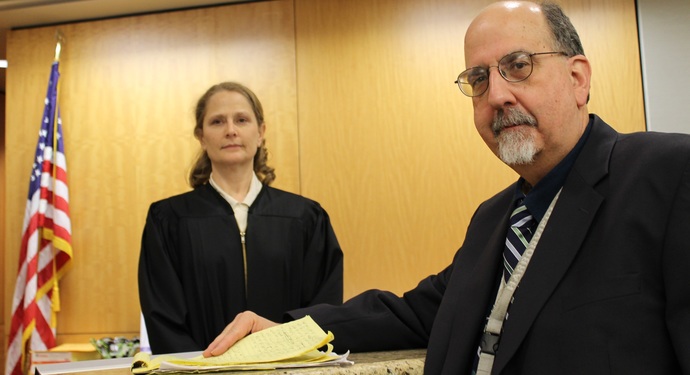 Superior Judge Beth Andrus and Mike DeFelice, a supervising attorney at the Department of Public Defense, are working to improve the county's Mental Illness Court.
In the last few years, according to King County Superior Judge Beth Andrus, the caseload at the county’s already fast-paced Civil Commitment Court has exploded. Since 2010, the number of involuntary commitment hearings has escalated 39 percent, while the number of new cases has climbed 19 percent.
Recently, she spoke to a Chelan County Superior Court judge who noted that he had had 50 involuntary commitment cases this year. Judge Andrus and her colleague, Commissioner Hollis Holman, have that many almost every single day.
Now, Andrus, Holman, public defenders, prosecutors and court administrators are working together to address a situation that many agree has become untenable and stressful – particularly for the vulnerable people who come before the court.
Andrus and Holman are working to address bottlenecks in the court’s calendar, so as to decrease the number of continuances due to court congestion. They’ve revised forms to make them easier and faster for both public defenders and prosecutors to use. They’ve completed a pilot project using video cameras at Northwest Hospital, enabling geriatric patients in the psychiatric ward to have their day in court without leaving the hospital.
Councilmember Kathy Lambert has played a leadership role, working to pull stakeholders together and advocating for technological and systemic improvements. The Department of Public Defense, meanwhile, is working to secure much-needed space near the court for additional attorneys and staff.
“Our goal is to make this an efficient process, while recognizing the due process rights of the people we’re serving,” Andrus said.
They’ve already seen progress, Andrus noted. The number of continuances due to court congestion has gone from a high of 84 in May to fewer than eight a month since July.
Mike De Felice, a senior attorney who supervises the public defense team at the Civil Commitment Court, said he’s encouraged by the changes. “Clients are getting their hearings in a timely fashion. And that’s vital.”
But he remains concerned by the high number of cases he and his colleagues carry and the cramped quarters they find themselves in. Attorneys work three to five in an office and often have to interview witnesses in crowded waiting rooms. Long hours also plague the defenders. After spending the day in court, they need to drive to hospitals throughout the county to visit clients with hearings the next day.
De Felice is also troubled by broad-based systemic problems, such as a lack of inpatient beds, insufficient outpatient services and the absence of diversion programs that could keep people out of the Mental Illness Court altogether.
“The major concerns that we have really are tied to lack of resources,” he said. “Olympia’s got to address a lot of these problems.”
The Civil Commitment Court – often called the ITA, or “Involuntary Treatment Act,” Court – is located on the second floor of the Ninth and Jefferson Building, where two courtrooms – one of them a converted waiting room – are center stage in a daily and oft-repeated drama: Should the respondent be civilly committed to a hospital for 14 days due to grave disability or because he or she poses a threat to self or others? Or is the respondent stable enough to return home, even if that home is the streets? Prosecutors petition to have the person civilly committed; because respondents stand to lose their liberty, public defenders represent them, arguing for their freedom from involuntary detainment.
It can be a gut-wrenching place. Respondents can be strapped to gurneys and parked in a hallway for hours while awaiting their hearings. But this is also a place where small miracles happen, where lives begin to get put back together. De Felice said DPD’s two social workers are extremely skilled at connecting the respondents to services. Most get committed to a 14-day stay in a hospital because the threshold for commitment – a preponderance of the evidence – is low. But once they’re in the hospital, Henry Zimmerman and Nina Elmore, the two social workers, begin piecing together a plan for their re-entry, services that can have a long-term impact on their clients’ lives.
The role public defenders play is invaluable, De Felice added. “The mentally ill do not normally get a chance to be recognized and heard and have their rights protected. We make sure that happens,” he said. “And that alone makes a difference. We empower them to make the decision about how their case is going to proceed.”
This over-burdened court is hardly perfect, he noted, but it’s far better than the scene a century or two ago, when a husband could get his wife placed in mental institution out of spite or children could lock up a parent who had become a burden. “The ITA Court is giving those people a voice,” he said. “And that’s what’s great about it.”
Judge Andrus agreed, adding that she’s pleased so many people are trying to improve conditions at one of the state’s busiest courts. “There’s been a lot of effort by everybody to come up with solutions,” she said.
 Bopha Sanguinetti, a social worker for the Department of Public Defense, connects easily to the clients she helps in large part because of her own life experiences. She and her family came to the United States as refugees from Cambodia when she was 4 years old. And while Bopha embraced American life as a child growing up in Southwestern Washington, she clearly remembers those times when she felt like an outsider.
Now, when she’s helping immigrant parents confront what many of them find mind-boggling and bewildering – the possibility that a judge could take away their children due to problems in their home – she often flashes back to her own early days in America.
“I know what it’s like to not understand what’s going on,” Bopha said.
Little wonder, then, that her colleagues consider her a gifted social worker, particularly effective when working with people from other parts of the world. “She’s extremely culturally competent,” said Cynthia Skow, Bopha’s supervisor in DPD’s Defender Association Division. Bopha speaks three languages (English, Cambodian and Laotian), Cynthia noted; but more than that, she added, Bopha is able to ask the right questions, understand family dynamics in a cultural context and convince clients to take advantage of resources that can turn their lives around.
“By the time they’ve come to us, they’ve just had it. They come to Bo pretty bruised,” Cynthia said. “But she somehow manages to motivate people even in the face of that. … It’s just magic.”
Bopha became a social worker (or mitigation specialist) for The Defender Association five years ago. Before that, she was a children’s mental health counselor for the Asian Counseling and Referral Center. She graduated from Seattle University in 1999 and got her MSW from the University of Washington in 2005. Today, she works primarily with parents facing dependency petitions – an effort by the state to make their children wards of the state because the parents, in the state’s opinion, are no longer able to care for them.
It’s challenging work, Bopha said, but also deeply rewarding. In her own life, she says, she was “blessed to have cultural brokers” – teachers, coaches and other adults who helped her walk the fine line of being an Asian-American youth in a rural part of the state. These days, she sees herself playing a similar role to struggling parents, helping them get the resources they need – drug treatment, parenting classes, counseling, housing and more – to rebuild their lives.
“Everyone makes mistakes,” she said as she sat in her small office, toys stuffed in bags along the wall. “Sometimes it takes a big intervention to get you off one path and onto another. … That’s what mitigation specialists can do. We offer a set of skills, a different perspective from the legal one that the public defender provides.”
Bopha was recently part of a team that had a big win, successfully convincing Judge Jeffrey Ramsdell that the state shouldn’t terminate a young mother’s parental rights. The mother was homeless, drug-addicted and mentally ill. Now, in large part due to Bopha’s help, she’s living in safe transitional housing and receiving mental health treatment. Bopha also put together a safety plan, outlining what the mother should do if she found herself in a crisis. The mom still isn’t reunited with her children, but she now sees them twice a week – a far cry from the situation she faced a few months ago, when she stood to see her children taken away forever.
“She’s doing great,” Bopha said of the mother, noting her remarkable turn-around.
“I love this work,” Bopha added. “You’re rooting for the underdog. And growing up, I was the underdog. That’s what public defense is all about – helping people succeed. Who wouldn’t want that?”
|
WDA anniversary event a celebratory affair
The Washington Defender Association held its annual meeting in December, a celebration marking the 30th year of this statewide advocacy and membership organization. The event at the Seattle Marriott Waterfront included several CLEs and was capped by a lively reception, made all the more celebratory because of U.S. District Judge Robert Lasnik's recent decision affirming the importance of public defense (see story above).
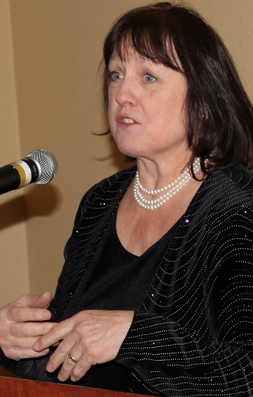
State Supreme Court Chief Justice Barbara Madsen (pictured right) told those gathered that the federal judge's decision underscored that the right to counsel means "the right to effective counsel." The Supreme Court's work on caseload standards, she added, is another critical step in that direction.
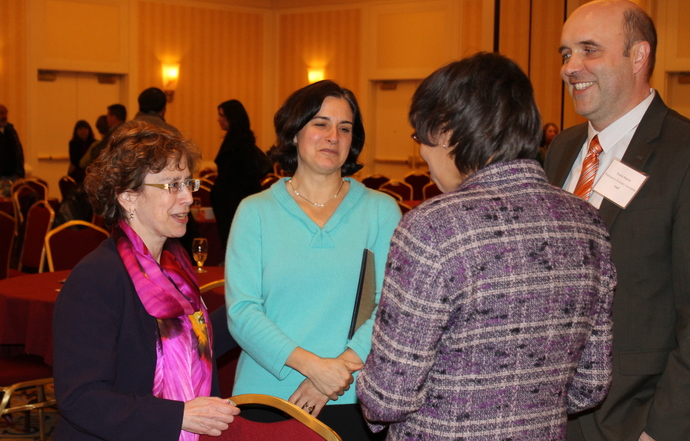
The event also included a talk by State Supreme Court Justice Sheryl Gordon McCloud (pictured below, left), who described the remarkable story of Clarence Gideon, charged with burglary in 1961 in Panama City, Florida. It was his hand-written appeal to the U.S. Supreme Court that led to a landmark case, Gideon v. Wainwright, extending the right to counsel to indigent defendants in every state in the nation.
|
|
 |
|