|
|
Having trouble viewing this email? View it as a Web page.
We currently offer Spanish and Somali translations of our newsletter through Google Translate. This may help you find information in the language you read, but the tool is not perfect. Automated translation may be inaccurate or errors may display. Google Translate is an external website. King County does not control the quality or accuracy of translated content.
|
|
|
This month’s email from the Public Health – Seattle & King County (PHSKC) Child Care Health Program (CCHP) includes the following topics:
Health & Safety Information for Child Care Providers
Information to Share with Staff & Families
Continuing Education & Training Opportunities
|
|
Respiratory Illness Reminders for the 2026-2027 Season
It’s officially fall, and right on time, children and staff are likely experiencing respiratory illness symptoms like cough, fever, and runny noses. Below are a few reminders about the upcoming respiratory virus season.
Exclusion guidelines:
This Respiratory Virus Illness Guidance One-Pager, published by the WA State Department of Health (DOH), has information on COVID-19, flu, and RSV symptoms, when to stay home, and when to return to normal activities. (Also available in Russian, Somali, Spanish, and Vietnamese.)
Our Keep Me Home If poster provides WAC guidance around illness, specifically for child cares and early learning programs.
Key points:
-
WHEN TO STAY HOME: Individuals with symptoms of a respiratory illness need to stay home if:
- they do not feel well enough to participate in classroom activities (for example: unusually tired; cranky or fussy; or crying more than normal).
- They have a fever (temperature 100.4⁰F [38ºC]) or higher along with other symptoms.
-
WHEN TO RETURN: Children and staff who are experiencing symptoms of a respiratory illness may return to the child care when BOTH of the following have been true for at least 24 hours:
- Symptoms have improved, meaning the individual is feeling better overall and can fully participate in regular classroom activities, AND
- Fever has resolved, without the use of fever reducing medications.
The Keep Me Home If posters are available in Amharic, Arabic, Simplified Chinese, Traditional Chinese, Oromo, Russian, Somali, Spanish, Ukrainian, and Vietnamese.
|
|
|
Reporting requirements
COVID-19 continues to be on the Notifiable Conditions list (see Coronavirus infection). According to WAC 110-300-0205, child cares are required to report cases of Notifiable Conditions to their local health jurisdiction. Individual cases identified through at-home testing are not required to be reported.
Programs must report:
- Any case of COVID-19 diagnosed by a medical provider or laboratory.
- Outbreaks (defined as 5 or more people who test positive or 20% of a group is out sick).
To report:
- or call PHSKC Communicable Diseases Epidemiology and Immunization Section at (206) 296-4774
Tools to help keep illness from spreading in your program:
- Use our Upper Respiratory Illness notification letter when you do not know the cause of respiratory symptoms, but you want families to be aware there is illness in the classroom or program. Please use the COVID-19, Influenza, or RSV letters to notify families if a child or staff member has been diagnosed with one of those illnesses. All of our Communicable Disease Letters for Families are available in multiple languages, so share with families in the language they are most comfortable reading.
-
Our illness prevention checklists explain how staff can prevent and control the spread of illness in their classrooms and programs. These checklists provide actions to take, explain why each action is important, and explain how illnesses spread. There are two versions available:
- Our handwashing poster for kids and the staff handwashing poster provide great reminders on all the times adults and children need to wash hands. These posters and their translations are available at Illness prevention resources - King County, Washington. Proper handwashing remains one of the best ways to stay healthy.
|
|
Child Passenger Safety Reminders
If you are a child care or early learning provider who transports children, please make sure you are practicing car seat safety. This means properly installing and using the right car seat every time. Visit kingcounty.gov/carseats for more information.
As a reminder, WAC 110-300-0480 requires early learning providers to follow Washington's Child Passenger Restraint Law (RCW 46.61.687) if they are transporting children. This law requires:
- Children up to age 2 must be properly secured in a rear-facing car seat.
- Children ages 2 to 4 must ride in a car seat with a harness (rear or forward facing).
- Children 4 and older must ride in a car or booster seat until they are 4' 9" tall.
- Children over 4' 9" tall must be secured by a properly fitted seat belt (typically starting at 8 to 12 years old).
- Child restraint system must comply with U.S. Department of Transportation standards and be used according to vehicle and child restraint manufacturer.
For the best protection, follow the American Academy of Pediatrics’ guidance:
- Children should continue to ride rear-facing for as long as possible, until they reach the highest weight or height allowed by their car seat’s manufacturer.
- Once children have outgrown the rear-facing car seat, they should use a forward-facing car seat with a harness for as long as possible, up to the highest weight or height allowed by their car seat’s manufacturer.
If you want a safety check of your transportation vehicle or car seats, reach out to trafficsafety@kingcounty.gov to get connected with a Certified Passenger Safety Technician.
Additional resources:
- To take a free e-learning course on Car Seat Basics, Child Passenger Safety Learning Portal has a 60 minute module on rear-facing and forward-facing car seat use, as well as booster seat and seat belt use.
|
|
Information to Share with Staff & Families |
|
Respiratory Virus Vaccine Recommendations for 2026-2027
Vaccination can help protect people from serious illness, especially young children, older adults, pregnant people, and people with certain health conditions. If you’re confused about which vaccines are recommended for the upcoming respiratory virus season, check out the West Coast Health Alliance’s 2026-2027 Respiratory Virus Season Immunization Recommendations. It is based on the latest recommendations from trusted national medical organizations, like the American Academy of Pediatrics.
|
Who should get a flu vaccine?
Everyone 6 months and older should get a flu vaccine every year. Getting vaccinated by the end of October gives your body time to build protection before flu spreads widely.
Who should get a COVID-19 vaccine?
|
|
 |
-
Everyone 6 months and older should get an updated COVID-19 vaccine. The number of doses you need depends on your age and previous COVID-19 vaccinations.
- Washington’s COVID-19 vaccine standing order allows people 6 months and older in Washington to receive a COVID-19 vaccine without needing a prescription from your health care provider.
-
Children and adults at higher risk for severe illness or with weak immune systems should get 1 or more doses of COVID-19 vaccine.
-
Adults ages 65 and older: Get 2 doses of an updated COVID-19 vaccine at least 2 months apart, whether or not you have received COVID-19 vaccines before.
Who should get RSV protection?
-
Infants and some young children age 8-19 months should receive RSV immunization to protect them against RSV.
-
Pregnant people should get 1 RSV vaccine at 32–36 weeks of pregnancy between September through March 1, to help protect their baby.
-
All adults ages 75 years and older, those who are ages 50-74 years and at increased risk for RSV, and 19 years and older with weak immune systems should get 1 dose of RSV vaccine.
All vaccines recommended by DOH – including COVID-19, flu, and RSV – remain available at no cost for children younger than 19 through Washington's Childhood Vaccine Program. Uninsured adults ages 19 and older can receive recommended vaccines at no cost through the Adult Vaccine Program.
To find a list of clinics and pharmacies where vaccines are available for children and uninsured adults, kingcounty.gov/vaxmap allows you to search locations by zip code, city, or facility name.
-
Vaccine supplies are limited, and availability varies by location. Many facilities require you to register as a patient before getting vaccinated.
- You may be able to get multiple vaccines at the same time so you don’t have to return for another appointment.
Car Seat Safety Check Events to Share with Families
There are several child safety seat check-up events in the Puget Sound area throughout the year. Registration may be required.
- Seattle Children’s Hospital offers free car seat checks in Bellevue, Federal Way and Seattle by appointment.
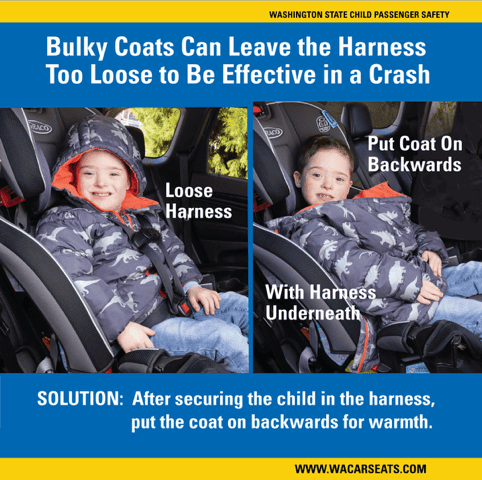
As the weather cools and children start wearing bulkier coats, please share this important safety message with your families.
|
|
Continuing Education & Training Opportunities |
|
Free ASQ Workshops: Virtual on Nov 9 & 10 and In-Person on Dec 10
Early identification of developmental concerns of the physical (fine and gross motor), problem-solving, communication (speech), social-individual, and social-emotional skills are essential for supporting young children’s growth and success.
The Ages & Stages Questionnaire (ASQ-3) & ASQ: Social Emotional (ASQ:SE-2) are widely used, family-friendly screening tools designed for children from birth through age 6.
Register now for these BSK-sponsored interactive (virtual or in-person) workshops intended for early childhood educators, program directors, family support specialists, and anyone involved in developmental monitoring and early intervention.
*VIRTUAL* Foundation of Developmental Screening Tool, Ages & Stages Questionnaire (ASQ-3) & ASQ: Social Emotional (ASQ:SE-2)
-
Monday, November 9, 1PM – 4 PM and Tuesday, November 10, 1PM – 4 PM
*IN PERSON* The Foundation of Developmental Screening Tool, Ages & Stages Questionnaire (ASQ-3) & ASQ: Social Emotional (ASQ:SE-2) | Best Starts for Kids
- Friday, December 4, 9:30AM – 4:30PM
|
|
|
|
|