|
|
Having trouble viewing this email? View it as a Web page.
This is our first attempt at providing translations of our CCHP Newsletter. We hope this is helpful and can reach more providers. Thank you for your patience as we work through any technical issues.
|
|
Thank you, Child Care Health Outreach Program
at Snohomish County Health Department!
You may have heard that the Child Care Health Outreach Program (CCHOP) at Snohomish County Health Department will be eliminated on September 15, 2026, due to budget cuts. Our team has worked closely with CCHOP for many years collaborating on multiple projects, resources, and policies that inform the early learning community. CCHOP’s team members’ expertise has been invaluable to Snohomish County and beyond. Thank you, Snohomish CCHOP, for your three decades of commitment to the health and safety of child cares and early learning. You will be missed.
CCHOP is offering the community an opportunity to provide feedback on the effects of these budget cuts. If you have comments, thoughts or stories to share, here is a link and a QR code to an anonymous one question survey.
|
|
|
This month’s email from the Public Health – Seattle & King County (PHSKC) Child Care Health Program (CCHP) includes the following topics:
Health & Safety Information for Child Care Providers
Continuing Education, Training & Financial Opportunities
|
|
Vaccine Information and Immunization Requirements
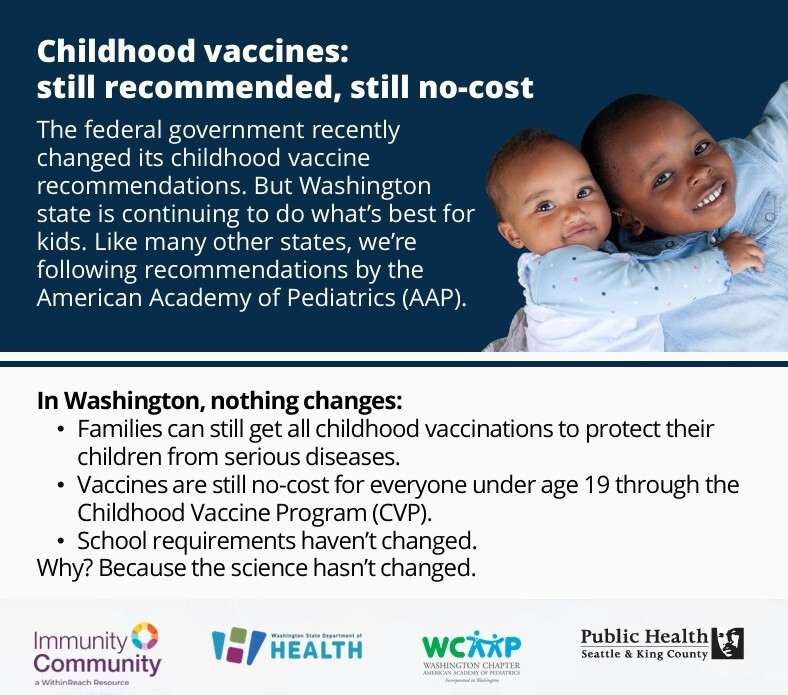
No Changes to Vaccine Recommendations in Washington
Washington’s childhood immunization recommendations have not changed. They are guided by the best available science, informed by recommendations from trusted medical and public health experts, and aligned with the American Academy of Pediatrics (AAP) Recommended Child and Adolescent Immunization Schedule.
|
|
|
Mobile Vaccine Clinics
Do you have families who need to get their child up-to-date on vaccines? See kingcounty.gov/findaclinic (scroll down on the page) for a list of mobile clinics. These clinics offer vaccines for insured and uninsured children ages 18 and younger. Some clinics also have vaccines for uninsured adult caregivers and family members ages 19+.
- For a list of available vaccines, check the registration page.
- Registration is encouraged but not required - walk-in appointments are available.
- Language interpretation is free and available at all clinics.
- No proof of residency is required.
Immunization Requirements for Child Care and Early Learning Programs
The CCHP’s Vaccine Requirements for Child Cares/Early Learning webpage has more information about vaccine requirements for child cares and early learning programs, examples of medically-verified vaccine documentation, and resources for additional support. A few additional reminders:
- Children who are RETURNING to a child care or early learning program need to submit an updated medically-verified record each year showing they have received all required vaccine doses for their age.
- Children who are NEW to a child care or early learning program may only begin attending if:
- they have all of the required vaccine doses they are eligible to receive for their age, AND
- the program receives their medically-verified record (see list below) on or before the first day of attendance.
-
A medically-verified immunization record can be:
- a current immunization record printed from either the WA Immunization Information System (WAIIS) OR MyIR Mobile,
- a handwritten Certificate of Immunization Status (CIS) completed and signed by the health care provider, OR
- a handwritten CIS completed and signed by the parent or guardian with the vaccination records attached.
- Children without medically-verified records, or a Certificate of Exemption (COE) excusing them from vaccinations they don’t have, cannot start child care until the paperwork is turned in, unless they are in foster care or experiencing homelessness.
-
Reminder: Children who are 4 years old or older on September 1 need to have a booster dose of DTaP, polio, MMR, and varicella vaccines.
September is Emergency Preparedness Month
 |
|
Did you know that your Grab and Go bags should only include items you may need in the first hour or so following an emergency or disaster? Why? A Grab and Go bag is just for meeting the immediate needs (hunger, thirst, warmth, etc.) of children for a short period of time while they await pick-up. Store additional supplies – enough for all the children in a classroom and program – in your 3-day disaster kits. |
|
|
|
Does your Grab and Go bag weigh less than 10 pounds? It should be light enough that you can wear it comfortably and not be tempted to put it down on the ground where children could access it. Remember, it must be out of children’s reach at all times.
Your Grab and Go bag needs to go everywhere your class goes. Take it with you every time you go to the playground, on walks, on field trips, do fire drills, or any other planned or unplanned time you leave your classroom.
Check out our Disaster and Emergency Preparedness Resources webpage for more information on Grab and Go bags, First Aid Checklist, 3-day Food and Water Supply List and many more. Print our poster of a Checklist to Prevent Accidental Poisonings and post the Emergency Numbers and Information Sheet after filling out the important contact information and numbers. Many of these resources have been translated into ten languages and some are fillable PDFs so they are easier to fill online and then print and post.
|
|
Continuing Education, Training & Financial Opportunities |
|
Seattle Childcare Workforce Payments, Apply by Sept 30
The City of Seattle Department of Education and Early Learning (DEEL) and BrightSpark Early Learning Services are partnering to award one-time payments for childcare providers within Seattle city limits. Eligibility requirements can be found at 2026 Seattle Childcare Workforce Payments - Education | seattle.gov. Applications must be completed by the employer, or by the licensee if it's an FCC program.
The payments are intended to provide an economic boost to educators who provide access to high-quality learning opportunities and care for children citywide.
Applications close on September 30 and are available in Amharic, Chinese (Simplified), English, Somali, Spanish, and Vietnamese.
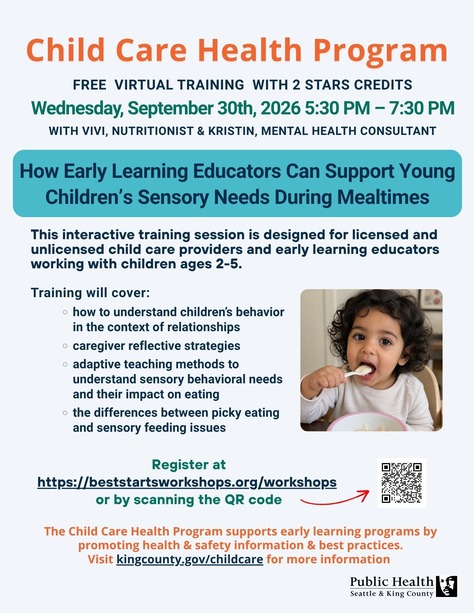
How to Support Young Children’s Sensory Needs During Mealtimes—Free CCHP Training, Sept 30
Join the CCHP Nutritionist, Vivi, and one of our Mental Health Consultants, Kristin, on Wednesday, September 30 from 5:30 to 7:30 PM for a free virtual training on how to address young children’s sensory needs for better nutrition and eating. This training is designed for licensed and unlicensed child care providers and early learning educators working with children aged 2-5. Two In-Service training (STARS) hours will be granted.
Discussion topics will include how to understand children’s behavior in the context of relationships, caregiver reflective strategies, and the differences between picky eating and sensory feeding issues. Participants will learn adaptive teaching methods to meet the social and emotional needs of children and what to do specifically during mealtimes.
Register at https://beststartsworkshops.org/workshops and share this flyer.
|
|
Haring Center Early Childhood Complex Needs Trainings
The University of Washington Haring Center delivers training to support child care providers who care for infants, toddlers, and preschoolers with complex needs. All trainings are virtual, offered at no cost to the provider, and provide In-Service (STARS) hours. Trainings are offered in English, Spanish, and Somali.
|
|
Virtual Workshop on Understanding Infants: Keys to Infant Caregiving, Oct 5, $150
Register now for Understanding Infant Cues, Regulation, Behavior, and States. This virtual workshop is hosted by the UW Barnard Center’s Parent Child Relationship Programs on October 5 from 8:30 AM – 12:30 PM. Participants will be eligible for 3.75 STARS Credits if in WA state.
Understanding Infants is a research-based program for professionals that provides essential information on newborn and infant behavior. Learn:
- Infants’ amazing ability to interact and engage in relationships
- Infants’ internal states and how that influences their behavior
- How to help infants regulate
|
|
|
|
|