|
|
This month’s email from the Public Health – Seattle & King County (PHSKC) CCHP includes the following topics:
Health & Safety Information for Child Care Providers
Information to Share with Staff & Families
Continuing Education, Training & Financial Opportunities
|
|
Health & Safety Information for Child Care Providers |
|
No Changes to Immunization Requirements for Child Care and Early Learning Programs
We have received a lot of questions about immunization requirements and potential changes that may impact the 2026-2027 school year. Federally, there have been changes to the CDC recommended immunization schedule, particularly around the Heb B birth dose. We want to emphasize there are no upcoming changes to the immunization requirements for child care and early learning programs.
- There are no plans to update the existing law at this time.
- The 2024 ACIP childhood immunization schedule aligns with the American Academy of Pediatrics and is backed by decades of research showing immunizations are safe and effective in preventing or reducing harmful diseases in children.
There have been no changes to the child care and early learning immunization requirements in Washington since 2021. State law continues to require documented immunity against Hepatitis B; Diphtheria, Tetanus, Pertussis (DTaP/Tdap); Polio (IPV); Measles, Mumps, Rubella (MMR); Varicella; Pneumococcal (PCV)-until 5 years old; and Hib-until 5 years old. See the most current chart of required vaccines for child care (also in Spanish).
If you have questions or need additional clarification on the school and child care immunization requirements, please email oischools@doh.wa.gov.
|
|
Feeding and Nutrition Resources Available in Multiple Languages
In honor of National Nutrition month, the CCHP would like to highlight the resources we have on our Nutrition and Food Safety webpage. They are translated into multiple languages for you to share with families when appropriate.
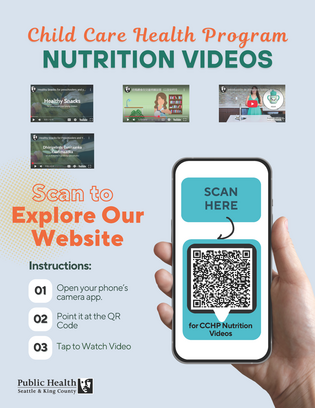
In addition, we have nutrition related videos available in English, Spanish, Somali, Cantonese, and Mandarin on:
- safely introducing solids to infants
- tips on bottle feeding in child cares
- preparing finger foods for toddlers and
- preparing healthy snacks for preschoolers and young children
Please print this handout for your teachers and cooks so they can watch the videos at their convenience.
|
|
Helping Children with Big Emotions
Each day, teachers help children manage their emotions. When children have “big feelings,” these can sometimes appear in the classroom as behaviors that are challenging.
Below are links to different tools, information, and strategies that may be helpful in preventing and intervening with certain emotions and behaviors.
-
Positive Solutions for Families: Family Routine Guide helps find the "why" a behavior is happening and discusses the feelings or emotions behind them and how to respond appropriately to teach children new skills focused on positive solutions. It provides specific scenarios on toileting, washing hands, mealtimes, brushing teeth, napping, and transitioning from one activity to another (in Spanish).
-
The Relationship is the Curriculum reminds us that the safety and security children feel with educators is the foundation of all learning. The “consistent, caring presence” and availability educators offer is what matters most.
|
|
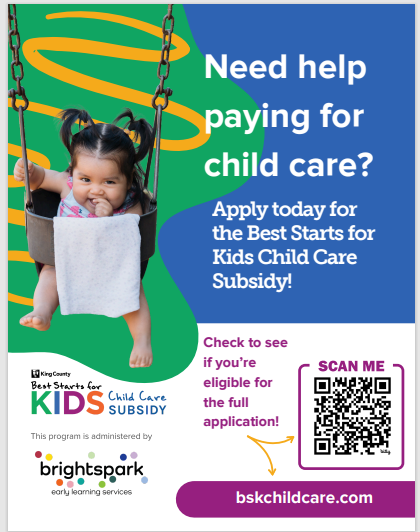
Encourage Families to Apply for the Best Starts for Kids Child Care Subsidy
Best Starts for Kids is actively enrolling families for their Best Starts Child Care Subsidy and they still have space to enroll hundreds of additional children. If families are approved for this subsidy, it could reduce child care costs by an average of about $15,500 per child each year.
Families living in King County can apply for the subsidy if they meet these criteria:
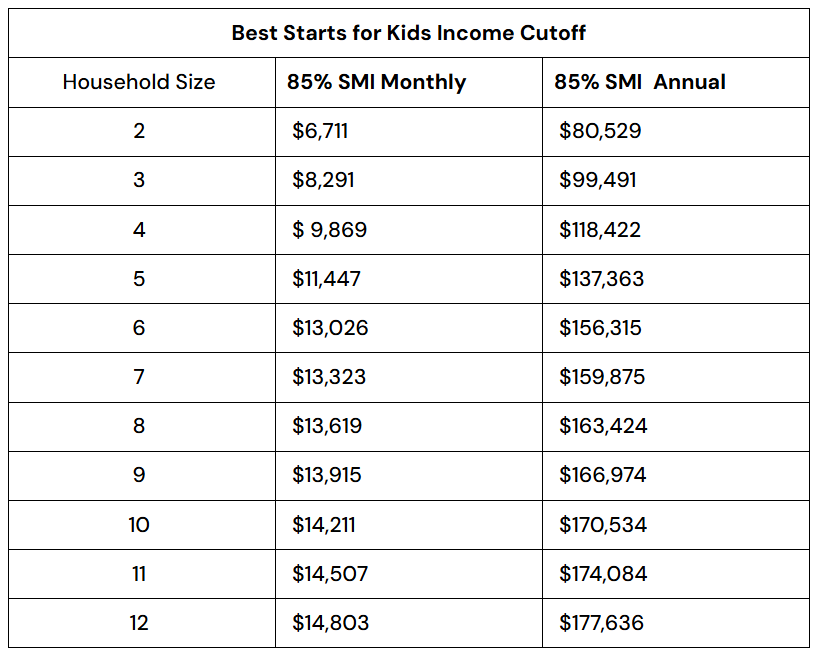
- Fall below 85% State Median Income (SMI) (see table below for snippet)
- Have one or more children 12 years old or younger
- Have selected a licensed child care provider
|
|
|
To apply and start the process, families can fill out the eligibility form. For help filling out the application, the Best Starts for Kids Child Care Subsidy has multilingual specialists who can answer questions.
- Call or text the application support team: 206-208-6865
|
|
Ages & Stages Questionnaire (ASQ-3) & ASQ: Social Emotional (ASQ:SE-2) Workshop, March 23 and 24
Best Starts for Kids is offering an interactive free virtual workshop that introduces participants to the Ages & Stages Questionnaires, Third Edition (ASQ-3) and Ages & Stages: Social-Emotional, Second Edition (ASQ:SE-2).
These are two widely used family-friendly screening tools designed for children from birth through age 6. Early identification of developmental concerns and social-emotional skills are essential for supporting young children’s growth and success.
This workshop is intended for early childhood educators, program directors, family support specialists, and anyone involved in developmental monitoring and early intervention. Participants will learn:
- The purpose and importance of developmental screening in early learning settings.
- Key features and domains of ASQ-3 and ASQ:SE-2.
- How to administer, score, and interpret results effectively.
- Strategies for engaging families in the screening process.
- Best practices for follow-up, referrals, and supporting children’s individual needs.
REGISTER HERE for this virtual workshop on Zoom | STARS credits will NOT be offered.
- Monday, March 23, 1:00 PM–4:00 PM
- Tuesday, March 24, 1:00 PM–4:00 PM
|
|
Seattle Infant Conference – Hosted by Haggard Childcare Resources, April 25
Join Haggard Childcare Resources for the Seattle Infant Conference, a full-day conference on Saturday, April 25 from 8:30 AM to 3:30 PM, held on the Seattle Pacific University campus. It is geared toward child care providers working with children 0 to 3 years of age. Join and share in the joy of caring for very young children.
Find all the details here, including registration information.
|
|
|
|
|