Airport levels up on carbon reduction goals
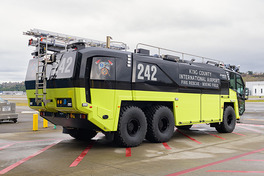
King County International Airport-Boeing Field (KCIA) has taken another step forward in its journey toward becoming carbon neutral. Airports Council International (ACI) recently informed the airport that it has met the standards for Level 3 in the Airport Carbon Accreditation Program (ACAP) by engaging airport tenants and users to reduce their greenhouse gas emissions.
"Reducing greenhouse gas emissions at the airport helps King County residents, especially those who live and work nearby," said King County Executive Girmay Zahilay. "Achieving Level 3 in the Airport Carbon Accreditation Program shows that the airport is making progress at reducing its impact on those most affected."
"We recognize the environmental impact that aviation has on our region, and we're taking concrete steps to reduce that impact," said John Parrott, director of King County International Airport-Boeing Field. "ACAP gives us a yardstick to measure the success of our efforts, and we're proud to have taken another step forward."
Climate change caused by carbon dioxide and other greenhouse gas emissions will have long-term consequences for the environment, the economy, and public health and safety. To do its part to reduce the threat, King County Airport aims to be carbon neutral by 2030 for Scope 1 (direct emissions controlled by KCIA) and Scope 2 (indirect emissions from purchased electricity, heating and cooling in buildings) emissions.
In 2021, KCIA was the first general aviation airport in Washington state to join the ACAP effort and achieve Level 1. The airport received Level 2 accreditation in 2023. ACAP certification is just one part of the airport's work toward meeting targets set out in King County's Strategic Climate Action Plan or SCAP, which was renewed by the King County Council earlier this year.
Read the full media release.
|
WESTDOG network keeps neighbor airport open during historic flooding
When record rain threatened Renton Municipal Airport, Dave Decoteau, deputy director at King County International Airport (KCIA), didn’t sit by and watch. Decoteau, who previously worked at the Renton Municipal Airport, knew the risk to the airport when the Cedar River reached flood stage.
“Within the hour of the initial storm, Dave called me,” said Manny Cruz, director at Renton Municipal Airport. “Once we found out the river was getting to a certain point, Dave called me.”
Cruz asked for help, and King County International Airport sent Renton a large, commercial diesel sump pump.
|
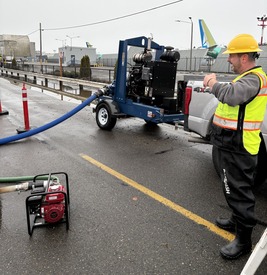
“The main goal for removing the water was to make sure we protected our tenants, their hangars, their airplanes and their assets,” Cruz explained. “We were able to keep everybody’s assets dry.”
“If we didn’t have the pump our Cedar River hangars and our main parking area would have taken on water,” Cruz added. “This one machine allowed us to keep everything operational.”
Cruz has a history at both the Renton Municipal Airport and the King County International Airport before taking on the role of Airport Director for Renton two years ago. He knows the flood history of the airport, and the historic perspective from Decoteau supplemented his knowledge and response. Half the airport flooded back in 1999 in what informally became known as the “Renton Beach Party.” In the early 2000s, a levee was built to keep the Cedar River from flooding the airport.
“This was the first year we’ve had the amount of rain to test it out,” Cruz said. “It worked. We never shut down the airport.”
However, water seeped through the levee wall, which is why Renton needed a powerful pump to protect tenants.
The helping hand from KCIA was part of a regional response through Western Airports Disaster Operations Group, known as WESTDOG. When flooding hit in early December, Decoteau called the coordinator of WESTDOG at San Francisco International Airport. Quickly, a WESTDOG call was organized.
“All the airports can connect to airports near them for support,” Cruz said. Seattle-Tacoma International Airport also lent Renton a pump, which Renton has kept in reserve but hasn’t yet had to use.
“It’s peace of mind knowing we had a group we could talk to,” Cruz said of WESTDOG. “Hearing their experiences and knowledge of how they handled it made my decision process all that easier.”
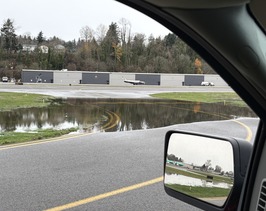
Photos taken at Renton Municipal Airport during the flooding.
|
You're invited to a public hearing on January 22
You’re invited to comment on the Part 150 Study draft Noise Compatibility Program (NCP) at a public hearing on January 22. The public hearing will be held in person at the King County International Airport (KCIA) Flight Service Station, 6526 Ellis Ave. S. in Seattle, with a virtual attendance option via Zoom. The hearing will start at 5:30 p.m. A presentation will begin at 5:45 p.m. followed by a formal public hearing process to accept comments on the draft NCP.
The purpose of the public hearing is to inform airport tenants, community members, and interested parties about the Federal Aviation Administration Part 150 Study process, present the draft NCP, and record public comments. KCIA will only accept comments that specifically address the Part 150 Study and the NCP. For more information about the meeting and to register in advance, please visit KCIAplanning.com. Registration is optional to attend in person. Register for online access and the Zoom link.
Intern spotlight: Tanvi Bathe
Editor’s note: This is another periodic feature about one of the interns at King County International Airport. This month, we feature Tanvi Bathe, a high school intern.
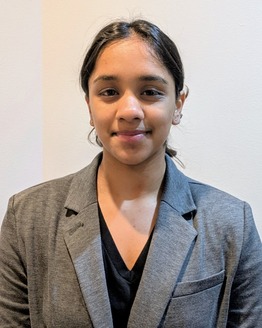
Tanvi Bathe is the first generation of her family to grow up in America. Her parents immigrated from India, and her ancestral roots and her dad’s philosophy are helping shape her future.
“I come from a long line of warriors in my family in India, historically,” Bathe said. “In my mind I’m using that as a catalyst. It excites me that I can create this on my own,” she said of her future.
“In my life, my dad has always told me he strives to be different in whatever way he can,” she added.
That’s why, at 17 and technically a senior in high school, she already has enough college credits to be considered a junior at the University of Washington. Currently in school full time at Bellevue College through a dual enrollment program, she hasn’t taken a high school class since her sophomore year.
She plans to apply to the United States service academies, such as the United States Military Academy in West Point, New York. In addition to the service academies, she has applied to the University of Washington to pursue engineering.
“A career in the military would provide me an opportunity to defend a nation that I love,” Bathe said. “Attending a military service academy excites me. It's an interesting opportunity to pursue a curriculum that’s designed to develop you mentally, physically and emotionally.”
During her internship at the airport, she has been working on computer-aided design (CAD) projects and developing technical skills essential in any engineering field. She has also been scanning the airport’s historical records. She supports engineering and the airport’s business manager. Besides developing project management skills, she’s learning “soft skills” necessary in any work environment.
“The internship is definitely helping me in a well-rounded manner,” she added. “Boeing Field is such a great place to work, too. I’m learning a lot about different kinds of fields.”
“My dad is a civil engineer. He’s worked at Boeing Field on consultant projects for a long time,” Bathe said. “He would take me onto the airfield and I would touch these big UPS planes. It’s been very meaningful to come and work for the airport I’ve seen growing up.”
Bathe’s internship runs through June.
|
|