|
|
This month’s email from the Public Health – Seattle & King County (PHSKC) Child Care Health Program (CCHP) includes the following topics:
Health & Safety Information for Child Care Providers
Continuing Education & Training Opportunities

|
|
Health & Safety Information for Child Care Providers |
|
Winter Weather and Emergency Preparedness
The winter months can bring cold temperatures and extreme weather to the Pacific Northwest. Prepare ahead of time.
Cold Outdoor Temperatures
Per the Washington Administrative Code (WAC), children should spend time outdoors each day and child care providers are required to monitor weather conditions and dress children appropriately.
-
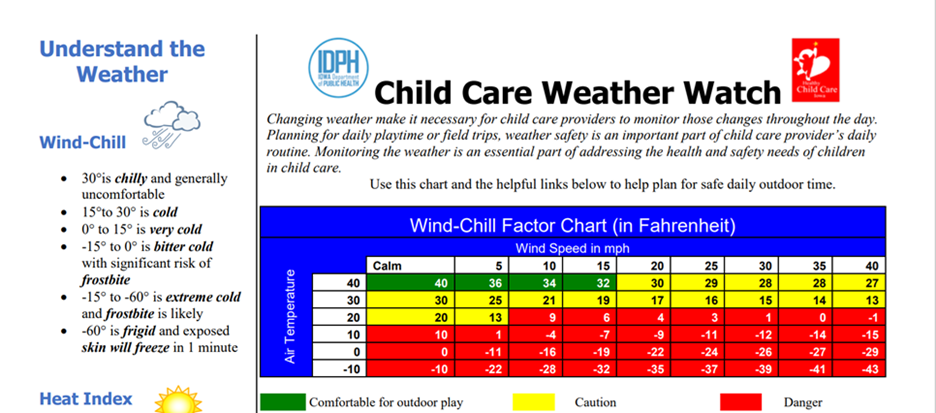
Child Care Weather Watch is a good resource to check when making decisions about spending time outdoors. Keep children indoors if the wind chill factor falls below -15°F (-26°C).
 Share our Playing Outside in Northwest Weather poster with families to remind them to provide hats, gloves/mittens, extra clothes, and warm layers for play outdoors. It is available in multiple languages on our air quality, outdoor safety and weather webpage.
Severe Weather Emergencies
Severe winter weather may impact your early learning program. For example, heavy winds may cause power outages, or snow or freezing rain could prevent parents from picking up their children at the usual time. To prepare for unexpected weather events during colder winter months:
-
Maintain current and accurate emergency contact information for children and staff (include paper copies in your Grab and Go bags).
-
Remind families how you will communicate program updates, such as delays or closures. Will you update a social media page, send an email, or record a voicemail with updates so they can call and check? If you use an out-of-area phone contact, this is a good time to remind families what number they should call for updates.
- Check your flashlights and make sure you have extra working batteries.
- In the event staff or children need to remain at the program past usual hours, make sure:
- emergency supplies, first aid kits, and 3-day supply of food and water are unexpired, fully stocked, and all staff members know where they are stored;
- each child and staff who requires daily life-sustaining medication(s) has a 3-day supply of medication and medical supplies kept at the program. See our care plan documents for more details. Make a plan for medications that may require refrigeration, for example insulin for diabetes.
Important WAC reminders related to severe weather:
- Your program may need to close if it loses power and heat or cannot maintain the indoor temperature at or above 68ºF (20ºC).
- Portable heaters (e.g., space heaters) must not be used inside early learning program space during operating hours.
- Fuel-powered generators can only be used in case of emergencies but must be at least 20 feet away from buildings, windows, doors, or ventilation intakes.
Preparing Your Child Care for Immigration Enforcement Activities
We know that there have been a lot of concerns and fears around Immigration and Customs Enforcement (ICE) activities in our communities and at or near child care and early learning programs.
We received feedback from child care community members that the resources we shared in the February edition were helpful. However, more advice is wanted around what to do during active moments of confrontation with immigration officials.
Now is the time to build out and practice your safety plan. To get started, see:
- Our Disaster flipcharts describe how to respond to a Dangerous Person or Lockdown situations. While these are not comprehensive plans, they are excellent starting points if you do not currently have a plan in place.
Make sure your plan includes:
- Who will speak with unknown visitors, authorities, and emergency services and who will alert other on-site staff to the situation.
- Getting updated emergency contact information for two or three reliable adults who are authorized to pick up children, if needed. Make sure to have emergency contacts for your teachers and staff, as well.
- Notifying families if immigration enforcement or other activities are occurring near the child care, so they can choose to have one of their designated emergency contacts drop off or pick up their child(ren) instead.
- Clearly labeling your facility as “private” if your program has a shared entrance or common areas with other organizations.
Unless the threat is inside the building (fire, flood, or armed person), the safest place for children to be is inside the building because it has:
- Locked doors
- Known staff and friends
- Familiar sights and sounds
- Food, water, heat, etc.
Encourage families and staff to:
- be observant of their surroundings, especially around drop-off and pick-up times, and immediately alert program staff if unknown or suspicious vehicles or people are near the program;
- save the Deportation Defense Hotline on their cell phones: 1-844-724-3737. It is a statewide multilingual hotline open Monday through Friday from 6 AM to 6 PM and is staffed by the Washington Immigrant Solidarity Network (WAISN), which reports and tracks ICE/Customs and Border Protection activity.
For families who want more support, please share:
Download, print, and post:
|
|
Continuing Education & Training Opportunities |
|
Virtual Workshop on Ages & Stages Questionnaires (ASQ-3) & ASQ: Social Emotional (ASQ:SE-2), Dec. 16 & Dec. 18
Best Starts for Kids is offering an interactive workshop that introduces participants to the Ages & Stages Questionnaires, Third Edition (ASQ-3) and Ages & Stages: Social-Emotional, Second Edition (ASQ:SE-2). These two widely used, family-friendly screening tools are designed for children from birth through age 6. Early identification of developmental concerns of the physical (fine and gross motor), problem-solving, communication (speech), social-individual, and social-emotional skills are essential for supporting young children’s growth and success.
REGISTER HERE for this virtual workshop on Zoom | STARS credits will NOT be offered
- Tuesday, December 16, 2025, 1:00 PM – 4:00 PM
- Thursday, December 18, 2025, 1:00 PM – 4:00 PM
Who Should Attend:
Early childhood educators, program directors, family support specialists, and anyone involved in developmental monitoring and early intervention.
Participants will learn:
- The purpose and importance of developmental screening in early learning settings.
- Key features and domains of ASQ-3 and ASQ:SE-2.
- How to administer, score, and interpret results effectively.
- Strategies for engaging families in the screening process.
- Best practices for follow-up, referrals, and supporting children’s individual needs.
Supporting Providers Working with Immigrant and Refugee Families Monthly Group, Dec. 22 and Jan. 26
DCYF and King County are partnering to host an ongoing meeting space to support Early Support for Infants and Toddlers (ESIT) Providers who work with immigrant and refugee families. The space will provide best practice training, guidance, resources, and reflective practice to ESIT Providers, in response to the evolving needs of families. Providers will have the opportunity to process, connect, and reflect with one another.
This statewide group will be held virtually on the fourth Monday of each month.
You can choose to attend one or more of the following sessions.
- Monday, December 22, 2025, 9:30 AM – 11:00 AM
- Monday, January 26, 2026, 9:30 AM – 11:00 AM
|
|
|
|
|