|
WRIA 8 Salmon Recovery Project and Program Updates
Salmon SEEson is Here!!
The WRIA 8-led Salmon SEEson program is in full swing! This program coordinates with program partners to highlight and promote opportunities for the public to see salmon in local streams and rivers when they return this summer and fall. The Salmon SEEson website provides a map and details for several self-guided viewing locations as well as in-person interpretive viewing opportunities.
After some much needed rain this weekend we can expect to see many streams and rivers swimming with salmon! With the turn of the season there will be more opportunities to visit sites with salmon present along with volunteer naturalists to help folks spot salmon and learn more about their life cycles!
Salmon SEEson is coordinated by WRIA 8 with additional sponsorship support from the Saving Water Partnership, the Green/Duwamish and Central Puget Sound Watershed (WRIA 9), the Snoqualmie Watershed Forum, and King County.
Learn more about celebrating salmon season in the recent King County Flood Control District blog post, "Celebrate Salmon Season in King County: Protecting a Northwest Icon".
Fall Restoration Project Site Visits
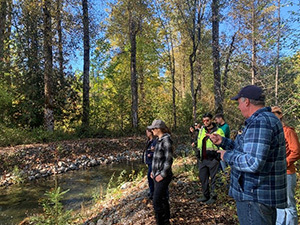
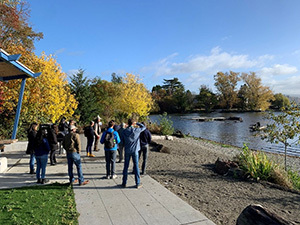
WRIA 8 hosted two site visits this fall, bringing salmon recovery community partners to recently restored sites in the watershed.
On October 14th, Brent Lackey from Seattle Public Utilities hosted a group at the Royal Arch Floodplain Restoration project site, where participants were able to see a recently completed restoration project funded through WRIA 8 by Salmon Recovery Funding Board and Cooperative Watershed Management grants. They also visited the adjacent recently acquired parcel which is the subject of a design project also funded through WRIA 8.
On October 29th, a group visited the Be’er Sheva Shoreline Restoration site, where Rainier Beach Link2Lake has completed in-water restoration, monitoring, and outreach projects using WRIA 8-directed Cooperative Watershed Management funding. Ashley Townes gave a tour of the project and described the subsequent Mapes Creek watch project, which engages community members in monitoring and outreach activities at the site.
Thanks to all who joined us!
Sno-King Watershed Council Stream Monitoring Workshops
Volunteer water monitors collect data on local streams and use it to educate others and advocate for stream protection and watershed health. Learn how it’s done and how you can get involved!
- Streamflow and habitat assessment – Wednesday, October 29, 7:00 pm, via Zoom
- Streamflow and habitat practical – Saturday, November 1, 10 am-1:00 pm, location TBD
To register, e-mail snokingwatershedcouncil@gmail.com or view the website for more information.
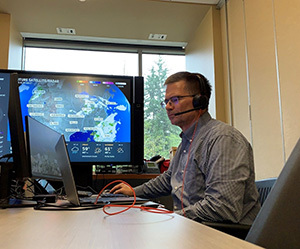
If It’s Raining Hard in Your Neighborhood, Who You Gonna Call? The King County Flood Warning Center!
Did you know when minor flooding is expected in low lying areas in King County, the King County Flood Warning Center opens and is available for 24/7 support? Driving in floodwaters is dangerous; reach out to the Flood Warning Center to identify a safe route or to get help in making sense of weather data and river levels. Peek behind the scenes of the Flood Warning Center’s operations in this interview with Darian and Mary, two Flood Warning Center staff who will be prepared for your call.
And don't forget the following tips to reduce your risk ahead of a flood:
- Learn your flood risk for where you live, work, or commute by entering any address at kingcounty.gov/FloodMap.
- Buy flood insurance. Standard homeowners or renters insurance doesn’t cover flood damage. Contact floodplain managers Laura Hendrix or Ken Zweig at 206-477-4812 with questions or visit floodsmart.gov to learn more and find an insurance agent.
- Build an emergency kit. Include a flashlight, radio, water, medical necessities, and supplies for children or pets visit makeitthrough.com to prepare for any disaster.
- Move hazardous chemicals out of flood-prone areas or dispose of them at one of the County’s hazardous waste sites. This keeps chemicals that can harm people and the environment out of floodwater.
- Clear storm drains and gutters of fallen leaves and other debris to prevent flooding. Get help using “Report a Problem” at kingcounty.gov/Stormwater.
- Before you build or make a repair in a flood-prone area, make sure you have the required permits. Getting the right permits makes our flood-prone areas less dangerous for people who live and work there.
The King County Flood Warning Center is funded by the King County Flood Control District.
State Awards Grants for Projects to Recovery Salmon Habitat
The Washington State Salmon Recovery Funding Board and Puget Sound Partnership today announced the award of more than $61 million in grants to 155 projects across the state aimed at restoring salmon habitat. "These grants fund important work," said Jeff Breckel, chair of the Salmon Recovery Funding Board. "They are funding organizations to undo the damage we have done to our rivers, bays and shorelines in the past and helping us make our waterways more hospitable to salmon."
Puget Sound Partnership Salmon Recovery Hub Updates
The Puget Sound Partnership has made some exciting updates to their Salmon Recovery Hub, visitors will now be able to track legislative activities on the landing page and view the new addendum explorer and the LE strategies tool on the Salmon Recovery Plans page.
Explore the updated webpage!
Updates from the Hatchery!
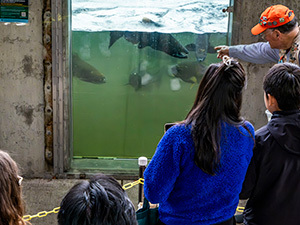
The Issaquah Salmon Hatchery hosted Salmon Days Festival the first weekend of October, a two-day event that draws large crowds. FISH volunteers and staff donate over +1,000 hours for this event and engage with over 15,000 visitors during the weekend.
FISH volunteer Peggy Jackson, regaled visitors with Orca sounds and highlighted the relationship between Orca whales and the hatchery’s Chinook salmon! Orca and salmon are connected through a vital predator-prey relationship, where salmon, particularly Chinook, are the primary food source for Southern Resident killer whales (SRKWs). This connection is crucial for the survival of both species, as the orcas’ diet relies heavily on the high-fat content of Chinook salmon, and their population health is directly linked to the abundance of these fish.
 |
FISH volunteer Daniel Yang, processed and donated over 111 lbs of Coho Salmon to the Renewal Foodbank in Bellevue! Working with FISH and Washington Department of Fish and Wildlife staff, Daniel was able to harvest and process 30 selected salmon during this week's spawn. Salmon typically arriving at the hatchery have endured weeks in fresh water and are not edible, WDFW staff pulled 30 healthy fish from over 1000 that were processed that week (less than 3%).
Manmade beaver dams improve fish habitat in North Creek
Volunteers from Crane Aerospace and Electronics are teaming up with the Adopt A Stream Foundation’s (AASF) Stream Team to install the first of a series of manmade beaver dams, referred to as beaver dam analogs. This stream enhancement project is located in North Creek where it flows through AASF’s Northwest Stream Center in Snohomish County’s McCollum Park.
“The purpose of adding logs in the channel and us acting like beavers in North Creek now is to get ready for the fall rains,” says AASF Stream Restoration Manager Walter Rung. “This is a fun project that we can do quickly that will benefit the creek’s struggling salmon and trout populations and future stream flows."
The volunteers from Crane Aerospace have already been "busy beavers” and successfully installed two other beaver dam analogs with AASF's Stream Team.
Septic System Maintenance Rebate Programs
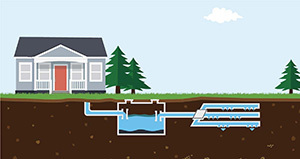
Do you own a septic system and live in King County? King County’s septic system rebate program is offering up to $500 for income-eligible residents to have their septic system inspected, pumped, or have riser(s) installed. The rebate is available throughout all of King County (not just unincorporated areas), however there is an income eligibility requirement for properties outside of Vashon-Maury Island and the Poverty Bay Shellfish Protection District in South King County. Businesses are eligible if they are a small business (the simple definition is in the application). The rebate program website has an eligibility map where you can add an address to and find out what rebates are available for your property.
Salmon in the News
How Humpy the Salmon Became a Mariners Fan Favorite.
Read the full article.
Southern Resident Orca Numbers Show Region Cannot Let Up on Restoration.
Read the full article.
Renton Steps up Projects to Help Salmon Population.
Read the full article.
Grant Opportunities
Conservation Futures Open Space Acquisition Funding Available — Apply by February 9, 2026
The King County Conservation Futures grant round is open, with applications due on February 9, 2026, for awards of 2027 funding.
Conservation Futures land acquisition grants can help governmental agencies and qualified conservation nonprofits purchase land or easements for open spaces and parks for passive recreation. Grants may help purchase land to be used as urban greenspaces, passive parks, natural areas, restoration sites, forests, community gardens, farms, trails, stormwater parks. Along with acquisition, Conservation Futures grants can fund initial site stabilization costs such as demolition.
Visit the Conservation Futures application webpage for key grant-related information and to regiester for workshops offered in mid-November and early December 2025. Contact Ingrid Lundin with questions.
|