Comprehensive Industrial User Survey updates
KCIW conducts the required Comprehensive Industrial User (IU) Survey every five years to protect regional water quality. This fall, KCIW and PRR, the survey consultant, will send about 11,000 surveys to businesses in the region. The main goal of the IU Survey is to identify any Significant Industrial Users (SIUs) who are not currently permitted.
In addition to identifying SIUs, this survey includes questions about “forever chemicals” - also known as 6PPDQ and per- and polyfluorinated substances (PFAS). Survey responses will help King County create best management practices (BMPs) for businesses. The survey also supports King County’s efforts to prevent these chemicals from entering wastewater and local water bodies.
Some industrial users may have already received the survey by mail. This survey is required to be completed by all those who receive it. If a business doesn’t complete the survey, the survey team will follow up by email and phone.
For more information about the survey
Important change coming to required reporting for Significant Industrial Users
Changes are coming that will affect your facility’s required Significant Industrial User (SIU) reporting.
KCIW plans to launch a new Electronic Reporting System that complies with the U.S. Environmental Protection Agency’s (EPA) Cross-Media Electronic Reporting Rule (CROMERR). This EPA rule establishes federal standards for electronic reporting under authorized regulatory programs, such as KCIW. Once an authorized representative of your facility completes identity verification, they can set up an account to use the Electronic Reporting System.
Currently, KCIW receives required documents as email attachments from your facility. However, email submittals do not comply with CROMERR federal requirements. By transitioning to an EPA-approved electronic reporting system, KCIW will be able to:
- Be compliant with the federal electronic reporting rule
- Support your EPA compliance reporting
- Collect signatures electronically
- Ensure secure record keeping
What's happening now:
- KCIW is currently working on designing and testing the new Electronic Reporting System, and our plan is to implement the new system in early 2026.
- KCIW will continue to accept documents via email during the transition period to the new system. Please keep your original, wet ink signed copies of all submittals onsite for at least three years and present them upon request.
-
There is no action needed from you at this time. Please continue to submit reports as you currently do.
What’s coming next:
- After implementation of the new Electronic Reporting System, all SIUs will be required to submit documents only through this online system. Email submittals of documents that require signature will not be accepted.
- KCIW will keep you informed as we move closer to implementation and will share instructions and timelines well in advance.
If you have questions about these upcoming changes or current reporting requirements, please contact us at info.kciw@kingcounty.gov or call 206-477-5300.
Increase in septage sampling at South Treatment Plant
Starting this fall, KCIW will start sampling septage more often at the septage disposal and treatment facility at South Treatment Plant in Renton. This effort is part of our ongoing commitment to protect public health, preserve water quality, and ensure compliance with local, state, and federal environmental regulations.
Why we're sampling
Septage waste from septic tanks, portable toilets, and other sites in King County that aren't connected by pipes to one of the treatment plants can vary widely in composition. By sampling incoming loads, KCIW aims to:
- Monitor for pollutants such as heavy metals, industrial solvents, and other contaminants.
- Ensure safe treatment by identifying materials that could disrupt biological processes at the plant where helpful bacteria break down waste.
- Identify commercial septage and industries that may need KCIW’s approval.
- Gather data to inform future policy and infrastructure planning.
- Waste from some businesses, commercial facilities, and industries may need to seek approval from KCIW. All waste from a residence is considered domestic waste and is not regulated by KCIW. The following chart can help determine if a business that discharges commercial septage needs approval:
May need approval:
|
Do not need approval:
|
|
|
|
|
|
|
|
|
|
|
|
|
|
|
|
|
|
- Restaurants (excluding grease traps)
|
|
|
|
|
|
|
|
|
|
- Print shops/photo processing labs
|
|
- Junior/senior high schools, colleges
|
|
- Shopping malls, warehouse complexes, business parks
|
|
What to expect for commercial vs. domestic
KCIW staff will collect samples directly from the truck while haulers unload septage. Haulers do not need to take any extra steps during sampling. Staff will follow King County’s environmental protocols and safety standards during the process.
- For commercial sources: Provide the King County hauled waste certification form with each load of septage.
- For domestic waste: Provide documentation in the form of addresses of where each load came from.
2025 Annual Septage Haulers Meeting on October 29
Join us for the 2025 Annual Septage Haulers Meeting on October 29 from 4:30 to 6:30 p.m. We encourage all generators and haulers who use the South Plant Septage site to attend this online meeting. We will send a meeting invitation soon to our current contact list. If you would like to join the meeting, please contact Chris Tinnin at chris.tinnin@kingcounty.gov.
2024 EnvirOvation Award goes to Boeing Commercial Airplane – Auburn Facility
KCIW recognizes companies and facilities that lead in environmental protection within the King County sewer service area with the EnvirOvation Award. We present this award to facilities with KCIW discharge approvals that voluntarily go beyond regulations to manage their operations in ways that protect public health and the environment.
In June, KCIW presented the EnvirOvation Award to Boeing Commercial Airplane – Auburn Facility for significantly upgrading its pretreatment system and for the innovative use of technology to reduce pollutants in its industrial wastewater.
Boeing Auburn Facility has been KCIW’s Silver and Gold Awards winner from 2020 to 2024 for maintaining an excellent compliance record with all applicable rules and regulations. In addition to meeting regulatory requirements, the facility voluntarily upgraded its pretreatment system. These upgrades included the installation of three new sand filters using SuperSand media technology, a clarifier to eliminate a potential point of failure, and a single programmable logic controller (PLC) for improved monitoring and control.
These voluntary efforts have improved the quality of the system’s effluent and added extra protection against system upsets. As a result, the facility has consistently lowered chromium levels, which was the main pollutant of concern.
Congratulations to Boeing Auburn Facility!
To learn more about KCIW Rewards and Recognition Program, click to visit our website:
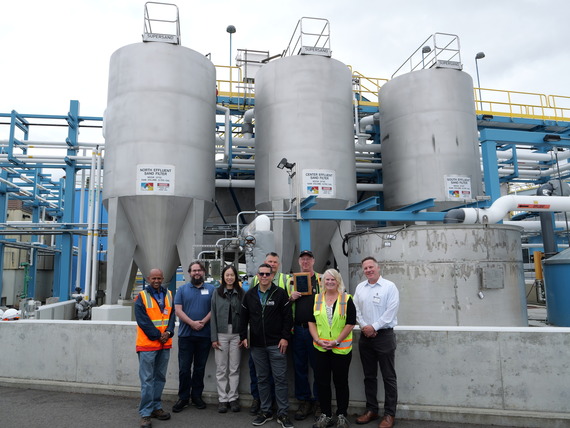 KCIW presented the EnvirOvation Award to Boeing Auburn Facility on June 26, 2025.
Treatment plant tours for industrial users
This past summer, KCIW and the Education and Engagement Team hosted four treatment plant tours for industrial users. Held at Brightwater Treatment Plant in Woodinville and South Treatment Plant in Renton, these tours were designed to strengthen our connections with permittees and provide a behind-the-scenes look at how our facilities are engineered to clean wastewater.
From screening out trash to supporting a healthy colony of microorganisms that break down organic material, visitors saw firsthand how water is treated and cleaned before being recycled or returned to the environment.
During the tours, KCIW emphasized the importance of source control and pretreatment to prevent harmful chemicals and heavy metals from entering the system. Some industrial users were surprised to learn that our treatment plants do not remove heavy metals and that these pollutants can harm the microorganisms, potentially jeopardizing both our treatment capabilities and compliance with the National Pollutant Discharge Elimination System (NPDES) permit. We also discussed how metals can end up at unacceptable levels in our Loop biosolids if they are not removed at the source, which is why we require inorganic pretreatment at some permitted facilities.
Key takeaways
The most critical step in wastewater treatment begins not at the treatment plant, but at the source—through pollution prevention and source reduction. This approach aligns directly with the U.S. Environmental Protection Agency’s (EPA) pollution prevention hierarchy (see table below). Industrial users play an important role by eliminating or minimizing pollutants within their operations before industrial process wastewater is discharged to the sanitary sewer system from their facilities.
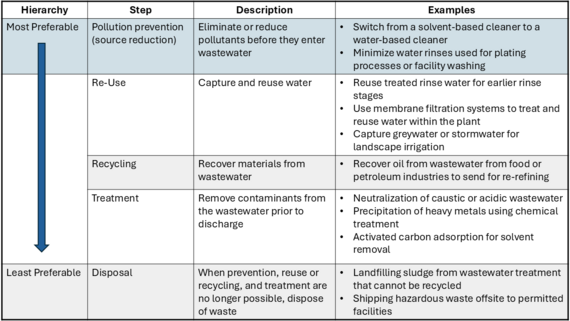 Pollution Prevention Hierarchy Table
We deeply appreciate the participants who joined us in the treatment plant tours. Your continued efforts in pretreatment and partnership are vital to protecting the shared environment of Puget Sound. We’re all connected, and together we’re making a difference. Our gratitude goes to those who attended from these KCIW permitted industries:
AGC Biologics
ASKO Processing
Blue Origin
Fremont Brewing Co.
Inventprise
Marine Vacuum Service
Samson Tug and Barge Co.
Vigor Shipyards
Western Pneumatic Tube Co.
Westland Distillery
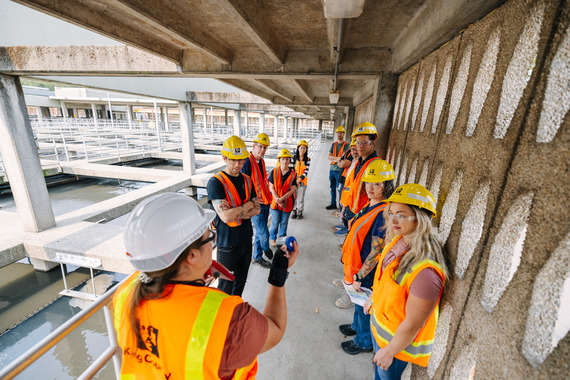 Industrial users toured the South Treatment Plant on September 4, 2025. At the Primary Sedimentation Tank, the group learned from the King County Education Specialist about primary treatment and the removal of organic waste.
“The tour was great. I assumed the treatment process would involve significant chemical usage, so it was amazing to see that the treatment uses mostly natural, simple science. Learning about the different programs and educational outreach offered by King County was inspiring.” – Melanie.
Annual estimate letters are coming soon

KCIW is preparing annual estimate letters for 2026. Companies that pay compliance monitoring and administration (CM&A) fees or surcharge treatment fees will receive these letters by mid-November 2025.
|
|