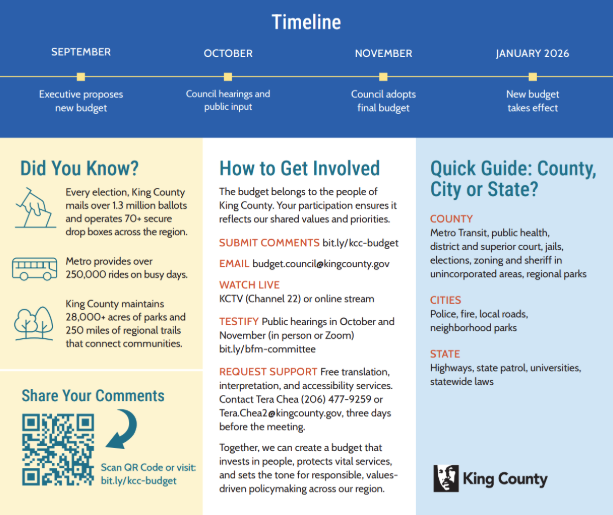
It’s budget time! Here are a few questions I’ve received recently:
Question: Is the recent sales tax increase being used for criminal justice services as intended by the state legislature?
The Executive’s proposed budget uses the recent 0.1% criminal justice sales tax (CJST) to support the sheriff, superior and district courts, the prosecutor and public defenders, jails and behavioral health.
The increase was authorized by the state with HB 2015 and enacted by Council in July. Washington State law mandates that CJST revenues be used to fund criminal justice purposes.
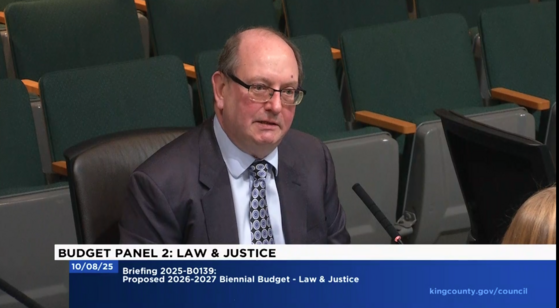
Below is a clip of the King County Budget Director Dwight Dively’s response.
Click above to hear Budget Director Dwight Dively
Question: How does the sales tax support public safety in cities?
Answer: While attention has focused on the recent increase, cities throughout King County also receive a significant portion of the sales tax for public safety since 1994. Per state law, 0.1% of the sales tax – separate from the recent increase- is reserved for criminal justice services. Of that, 90 percent is distributed to the cities and unincorporated areas based on population. King County uses the remaining 10 percent for countywide criminal justice services.
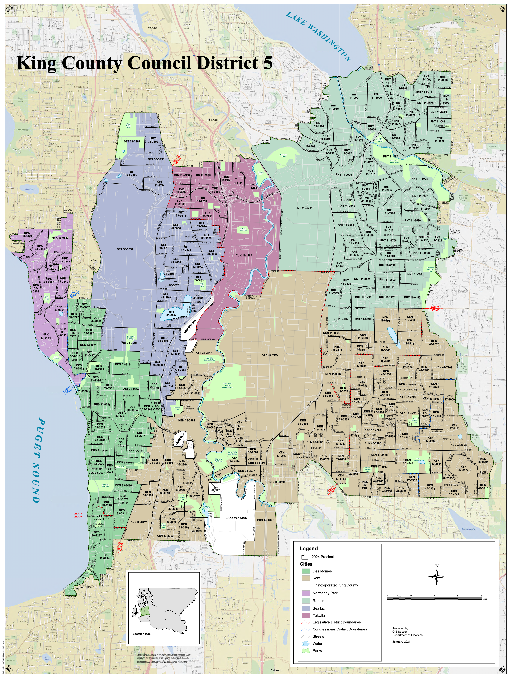
So, District 5 cities including Des Moines, Kent, Normandy Park, Renton, SeaTac, and Tukwila, use the sales tax for funding criminal justice services including police and municipal court services. And, King County uses the sales tax for prosecutor & public defense, superior court, district court, and the jails.
Question: If funding is divided between jurisdictions, how do we improve public safety?
Answer: We work together.
In 2026, the sales tax is projected to generate over $93 million, with nearly $75 million going directly to cities for their criminal justice related service needs like police.
The recent increase in CJST is projected to generate an additional $90-$95 million in 2026 for countywide criminal justice services like prosecutor & defense.
Together, this ensures continuity of services during a time of increased demand due to population growth and increased costs across the board. It also means that the county and cities must collaborate and work together to forge solutions.
As we face the loss of federal support, we must find ways to work better together at the local level.
Question: What about parity between prosecutors and public defenders?
Answer: Council is currently wrestling with, among other issues, how best to balance funding for county prosecutors and public defenders. The Washington State Supreme Court and subsequent negotiations have created parameters to help set appropriate staffing levels. As in all negotiations, the two sides – prosecutors and defenders - do not completely agree but ultimately work together.
Budget decisions are not binary or polarized by nature. They are based on probabilities and consideration of outcomes. Having an “all or nothing” or “I’m right, you’re wrong” approach stifles innovation, creativity and hope. If we limit our thinking to binary terms, we won’t be able to solve problems through dialogue, compromise & ingenuity. We need real-time solutions that are value driven and data informed.
We must solve problems together for the greater good.
King County Joins Nationwide Effort to Protect Local Authority
King County’s Prosecuting Attorney joined nearly 40 other attorneys representing local jurisdictions from across the United States to sign an amicus brief in support of Portland’s lawsuit challenging Trump’s authority to deploy the National Guard in Portland.
After U.S. District Judge Karin Immergut ruled that the federal government could not lawfully deploy either the Oregon or California National Guards to quell protests outside an ICE facility in Portland, Oregon, the President indicated his intent to send the Texas National Guard, claiming the ICE facility is under duress. Facts on the ground do not match Trump’s characterization as the protests have remained non-violent.
Portland Mayor Wilson told CNN, “I continue to maintain that the tactics used by federal agents at the ICE facility are troubling and likely unconstitutional. “Because of these deeply concerning situational unknowns, I intend to explore options to protect our community and our right to free expression.”
Seattle Mayor Harrell this week signed two Executive Orders to protect communities from unlawful troop deployment and unjust immigration enforcement actions. The first, “protects local communities and control over law enforcement resources,” in the event of National Guard troops being federalized and sent to Seattle.
The second, “strengthens services to immigrant and refugee communities and proposes legislation to prohibit the practice of masked, non-uniformed federal agents,” from conducting immigration enforcement raids or staging their activities on City property.
The goal of the D5 e-news* is to share information about King County business, upcoming community events, access to services, opportunities, and ways for us to build an even better King County.
*To translate this week’s e-news into another language, scroll down and click on the language of your choice. Whether you would like to read this e-news more easily or whether you are studying a new language, we are bringing you language technology to help us stay connected.
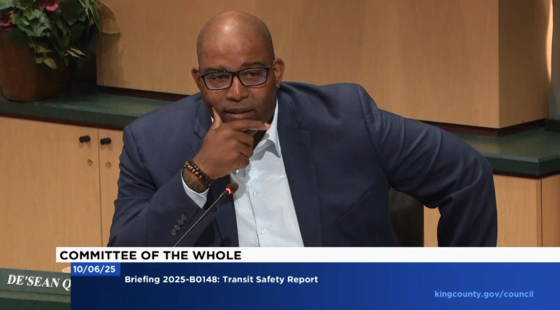
Click above to see CM Quinn’s comments on the Transit Safety Task Force
On Monday, I participated in Committee of the Whole where we received the Regional Transit Safety Task Force Report – a list of 160 recommendations crafted by over 200 community leaders from throughout King County.
The Task Force made recommendations including:
-
Retrofitting existing buses with operator partitions and complete installation of protective barriers on new buses.
-
Build a centralized platform that integrates incident reports and 911 data across all transit agencies to provide real-time access and cross-jurisdiction safety response.
-
Develop and launch a unified Code of Conduct campaign across all regional transit agencies including standardizing signage and public education.
I also met with King County Prosecutor Leesa Manion to discuss the Executive’s proposed budget.
My staff met with Sound Transit regarding services affecting South King County.
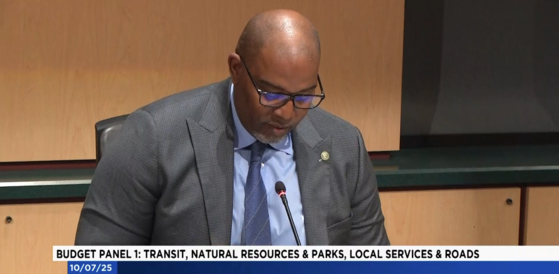
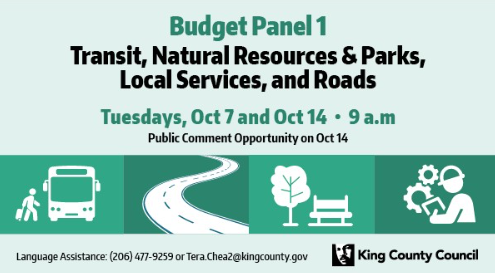
Click above to see CM Quinn’s opening comments at the Transit, Natural Resources and Local Services Panel
The panels are used to identify issues the council would like more information about and changes the council would like to make.
Tuesday afternoon, I participated in a lengthy council meeting where the council heard over 80 people comment. Most comments were regarding the purchase of the Polyclinic building on First Hill in Seattle to use as a crisis care center for people facing mental and behavioral health crisis. The Council voted in favor of making the purchase, dedicated funding toward ensuring neighborhood safety and created a neighborhood advisory committee.
The clinic on First Hill in Seattle is one of 5 crisis clinics approved by voters for King County. The first one was sited in Kirkland. There are 3 more to be sited. All five will serve as places for first responders to take people in crisis due to mental health and/or behavioral health for medical care.
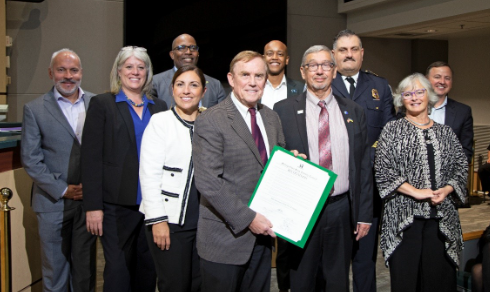
The Council also recognized the City of Algona’s 70th anniversary.
Left to right: CM Baron, CM Balducci, CM Quinn, CM Mosqueda, CM von Reichbauer, CM Zahilay,
Algona Mayor Troy Linnel, Algona Police Chief, CM Perry, CM Dembowski
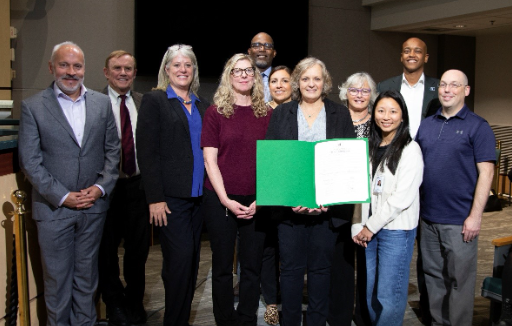
The Council also proclaimed October as National Disability in Employment Awareness Month which is an opportunity to recognize the value of employees with disability in the workplace.
CM Baron, CM von Reichbauer, CM Balducci, CM Quinn, CM Mosqueda, CM Perry, CM Zahilay, with Sara Moorman, King County Disability Services Manager and Peter Hu, Deputy Division Director of the King County Central Employee Services Division and fellow King County staff.
The Strategic Climate Action Plan was delayed one week to the October 14 Council meeting.
The Council approved the ordinance regarding the RapidRide I-line development allowing the use of condemnation in negotiations with 10 property owners to allow for use of portions of property for bus stops.
On Wednesday, I participated in the Law and Justice Budget Panel. We discussed the Executive’s proposed budget for multiple agencies including Sheriff, Prosecutor, Courts – Superior and District Court, Public Defense and Jail. I asked for information about how the recently imposed criminal justice sales tax was used to support these agencies.
I then joined the Budget Leadership Team which is a smaller working group of four councilmembers established to find solutions to budget challenges to propose to the council.
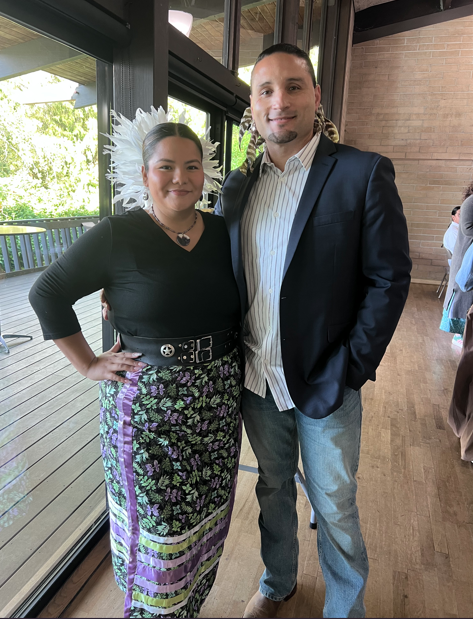
My staff Jazmin Pairazaman represented me at King County Indigenous People’s Day celebration in Normandy Park
My staff Jazmin Pairazaman and DNRP staff Ron Luke
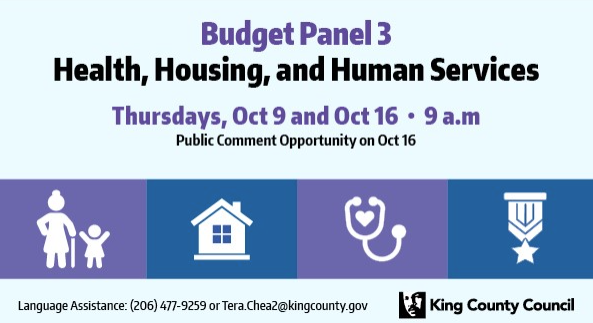
On Thursday, my staff covered the Health, Housing and Human Services Budget Panel which reviewed the Executive’s proposed budget for agencies such as the Department of Community and Human Services. This panel also covered the use of funds including the Mental Health and Drug Dependency (MIDD) fund and the Veterans, Seniors, Human Services levy fund.
I also met with Budget Director Dwight Dively.
On Friday, I met with 2026 FIFA World Cup organizers. I met with Mian Rice from the Port of Seattle. I also met with Matt Sanders the Director of the Department of Public Defense.
You are welcome to attend the following meetings. You are also invited to write emails, letters, or request appointments with your representatives to share your thoughts about the items on the agendas for these upcoming meetings. You can find a list of councilmembers here.
Monday, October 13, 2025 is Indigenous People’s Day – a day to commemorate the cultures that have been in the Pacific Northwest since time immemorial.
This budget panel will take public comment.
Tuesday, October 14 1:30 pm: Council will be voting on the 2025 Strategic Climate Action Plan
Tuesday, October 14: following the Council meeting. The Flood Control District Board of Directors will be discussing the 2026 Flood Control Zone District budget.
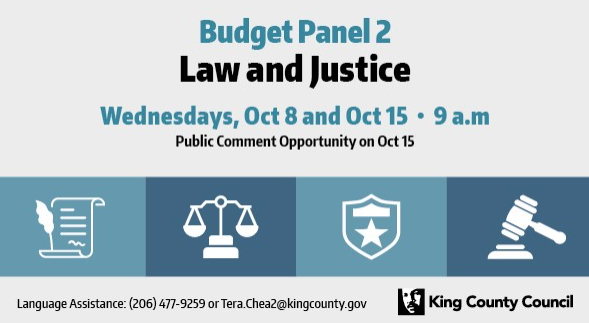
Wednesday, October 15, 9 am: The Law & Justice Budget Panel chaired by CM Jorge Baron will review funding proposed for services including the sheriff, prosecutor, courts, and public defense.
This budget panel will take public comment.
Wednesday October 15, 3 pm: The Regional Transit Committee chaired by CM Baron will review Metro Performance Measures.
You are welcome to watch or participate in person or on-line. There will be a meeting dedicated to public comment at the King County Courthouse on November 12, 2025.
My colleagues, staff and I will also be preparing for the review of the 2026-2027 King County Budget.
|