|
Sept. 8, 2025
King County announces $2.17 million Re+ Circular Economy Grants to support waste reduction projects
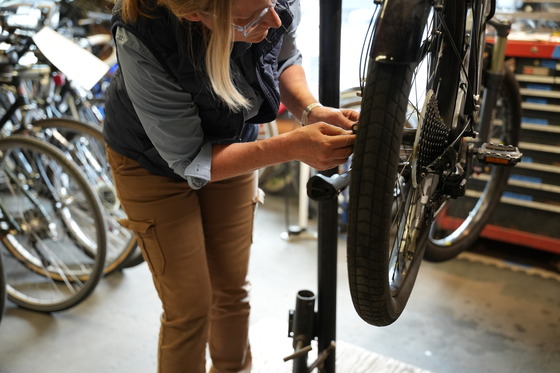 Shoreline Tool Library volunteer repairing a bike
This week, King County Executive Shannon Braddock announced a combined $2.17 million in Circular Economy Grants for 14 projects that will reduce waste and keep valuable resources in the economy and out of the landfill. Each project contributes to Re+ by cutting greenhouse gas emissions and supporting the transition to a sustainable circular economy.
Nearly half of the projects will reduce food waste by collecting unused crops from local farms for culinary training and free meals, reducing waste generated from events, and converting food waste into organic fertilizer for local farmers. Several other projects will make construction more sustainable by converting plastics into 2x4 beams for decking and benches, expanding lumber recovery, and increasing access to a popular tool library.
“Small businesses and nonprofits throughout King County are already producing measurable results that reduce waste and cut greenhouse gas emissions,” said Executive Braddock. “Our Re+ grants increase their capacity and accelerate their efforts, helping our region transition to a sustainable, circular economy.”
This year’s Re+ Circular Economy Grant recipients are:
-
Chomp Energy: Convert commercial food waste into a concentrated liquid and solid biofertilizer for local farms.
-
Sustainable Renton: Increase efforts to rescue surplus edible food and minimize organic waste in south King County.
-
Project Feast: Rescue surplus crops from local farms to support culinary training for immigrants and refugees and provide free meals to food-insecure residents.
-
Franciscan Foundation: Reduce food waste at three hospitals in King County by diverting edible food and providing nourishing meals to local communities in need.
-
Earthwise Architectural Salvage: Expand lumber recovery and reuse by collecting and processing salvaged lumber and offering educational workshops and free lumber to frontline communities.
-
Second Use Building Materials: Establish and operate a drop-off site at the Shoreline Recycling and Transfer station for reusable items such as building materials, furniture and fixtures.
-
Refugee Artisan Initiative: Employ refugee women artisans to design and craft new products using repurposed vinyl billboards, coffee bags and other upcycled materials, increasing reuse, and providing critical employment opportunities.
-
Perennial Zero Waste (Human Eco Consulting): Reduce waste by providing reusable food service ware, an on-site mobile dishwashing trailer, and full compost and recycle waste management services at events in King County.
-
Remakery: Expand plastic recycling program by turning plastic into 2x4 beams and other durable goods for outdoor uses, such as decking and benches.
-
Zero Waste Washington: Reduce waste from milk cartons, milk, and single-use plastic bottles in K-12 school cafeterias by shifting to more sustainable milk and water dispensers.
-
Farmstand Local Foods: Pilot a reusable bin program with farmers and customers to replace disposable boxes for produce storage, transport, and distribution.
-
Furniture Repair Bank: Expand efforts to repair and refurbish furniture and provide it to refugee and low-income families.
-
Seattle REconomy: Expand on the successful launch of the Shoreline Tool Library, a single location that houses a tool library, reclaimed materials store, and educational space.
-
Seattle ReCreative: Expand material reuse efforts beyond Seattle, increasing access to creative reuse, diverting usable materials from the landfill, and inspiring community-based reuse centers.
|
|
Commercial organics technical assistance program supports local businesses
King County’s commercial organics technical assistance program, launched last year, includes in-person site visits, waste assessments, in-language support, resources and other tools to support businesses in unincorporated King County seeking to reduce waste and divert organics from the landfill. The program also helps businesses meet new requirements of statewide Organics Management Laws passed in 2022 and 2024.
This year, Lake Retreat Camp added curbside organics service after working with King County on implementing waste diversion best practices. The camp now reports diverting more waste to compost than garbage after the change! Arturos restaurant received in-language support in Spanish and staff reported notable improvement in trust-building with the business. Pacific Raceways has also worked with staff to implement compostable materials collection and utilized their expertise to help educate customers during the launch of new sort stations and when talking with food vendors on site about switching to compostable service ware when possible. King County organics staff have launched a new round of outreach and support to unincorporated area businesses later this month.
With the beginning of a new school year, King County reflects on the 2024-2025 Green Schools successes
246 King County Green Schools are actively continuing to further reduce and divert waste. In the 17 school districts in King County (outside of Seattle), the average recycling rate increased from 47% to 50% over the course of the last school year!
In the 2024-2025 academic year, the King County Green Schools Program successfully engaged educators and students through 32 assemblies and 442 classroom workshops designed to foster awareness and practical action around resource conservation, waste sorting, and climate-related issues. During the 2023-2024 academic year the program issued Re+ Green School vouchers of over $300,000 to 57 recipients (schools and districts) which diverted an equivalent of 105 100-cubic yard garbage trucks away from the landfill. This year, Green Schools is set to issue additional Re+ School Vouchers, focusing on reducing disposables and promoting additional waste reduction and diversion support.
There’s still time to apply for Re+ Seed Grants powered by NextCycle!
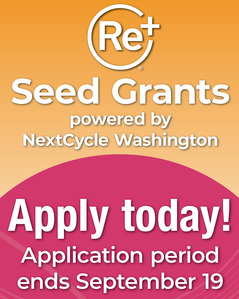
We’re currently accepting applications for the next round of Re+ Seed Grants, powered by NextCycle Washington. The grants provide funding and technical assistance for early-stage ideas that divert waste from landfills. Selected projects will be supported with up to $10,000 in funding along with access to mentors, consultants, and networking to support project execution and growth planning. King County will provide over $120,000 in funding for this program.
Interested applicants are invited to schedule 1-on-1 technical assistance and coaching with the NextCycle team. Please contact circulargrants@kingcounty.gov with any questions.
|
King County and other members of the Northwest Product Stewardship Council awarded the 2025 EPR Local Leader Award
King County is a founding member of the Northwest Product Stewardship Council (NWPSC) that was recognized by the Product Stewardship Institute (PSI) with a 2025 EPR Local Leader Award for their outstanding leadership and work on product stewardship and extended producer responsibility (EPR) in Washington. The NWPSC has led the nation with EPR policies and programs covering electronics, mercury-containing lights, unuse medication, paint and batteries in Washington. Most recently, the NWPSC played a key role in the passage of the Recycling Reform Act into law which will transform Washington’s recycling system by creating a producer responsibility organization to require manufacturers and consumer brands to reduce unnecessary packaging, fund statewide recycling services, and ensure recyclable materials are actually recycled.
King County's Solid Waste Division is guided by its vision to achieve zero waste of resources, and to enhance the environment through collaboration and innovation. The division operates eight transfer stations, two rural drop boxes, and the Cedar Hills Regional Landfill – the only operational landfill in the county. Our stakeholders include residents and business owners in unincorporated King County and 37 cities throughout the county. Our mission is to deliver value to our customers and stakeholders, and to continuously improve waste prevention, resource recovery, and waste disposal.
To request this newsletter in alternate formats, contact the Solid Waste Division Customer Service Desk at 206-477-4466 or TTY 711.
For more information on Re+, visit www.kingcounty.gov/re-plus.
|
|
|
|
|