|
WRIA 8 Salmon Recovery Project and Program Updates
WRIA 8 Salmon Recovery Council Tours Lower Issaquah Creek Restoration Project
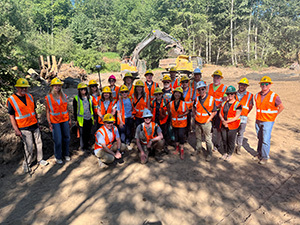
In mid-July, the WRIA 8 Salmon Recovery Council joined Mackenzie Dolstad and Becca Kedenburg from Mountains to Sound Greenway Trust to tour the Lower Issaquah Creek Restoration project in Lake Sammamish State Park. It was impressive to see the scale of active construction and the amount of large wood being added to the creek at several locations. The project included enhancing 4,600 linear feet of Issaquah Creek, placing over 400 pieces of large wood, reconnecting 0.3 miles of new side channels, and restoring 3.5 acres of riparian area (and continuing stewardship on 50+ acres). The WRIA 8 Salmon Recovery Council directed over $5.4 million in grant funding to support the project. The project was featured recently by the Seattle Times – check out the story! Attached is a photo of site visit participants enjoying the sunshine and the project.
Salmon SEEson Program Kicks Off!
The WRIA 8-led Salmon SEEson program kicked off in August, coordinating with program partners to highlight and promote opportunities for the public to see salmon in local streams and rivers when they return this summer and fall. The Salmon SEEson website provides a map and details for several self-guided viewing locations as well as in-person interpretive viewing opportunities.
 |
As of mid-August, this year’s sockeye count through the Ballard Locks is on pace to be one of the lowest returns on record (since 1972) with just 17,571 fish. Unfortunately, sockeye counts have dwindled in recent years and the 2025 count is less than half the 10-year average return. Chinook migrate through the Locks from July to September. So far, biologists estimate 7,555 Chinook have passed through the Locks (as of August 17th). Coho are anticipated to begin their return in early September.It’s important to note that, in recent years, numbers of salmon predicted by the Ballard Locks counts have been much higher than the numbers of salmon observed reaching the hatcheries and spawning grounds. So, although the early Locks counts indicate a strong number of Chinook, the return is likely to still be below the numbers needed on the spawning grounds to meet population recovery goals.
Salmon SEEson is coordinated by WRIA 8 with additional sponsorship support from the Saving Water Partnership, the Green/Duwamish and Central Puget Sound Watershed (WRIA 9), the Snoqualmie Watershed Forum, and King County.
Salmon Day at the Ballard Locks
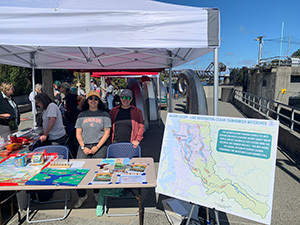
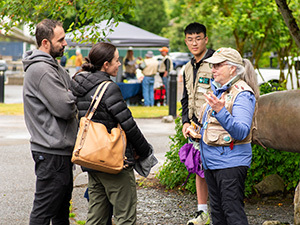
On Saturday August 16th WRIA 8 joined partners from Cedar River Salmon Project, Plant Amnesty, Long Live the Kings, King County Wastewater Treatment Division, and Friends of the Issaquah Salmon Hatchery for the annual Salmon Day at the Ballard Locks! It was an amazing opportunity to connect and educate the public about salmon and salmon health. WRIA 8 would like to the thank the U.S. Army Corps of Engineers for their work in putting this event together annually and providing a perfect setting for sharing information about our work!
Celebrating 25 Years of WRIAs: Spotlight on WRIA 8
This year marks a 25-year milestone of coordinated watershed-based salmon recovery partnerships for the Water Resource Inventory Areas (WRIAs). The King County Flood Control District is proud to be a partner in each of the WRIAs and support the celebration! To mark this important anniversary, the Flood Control District launched a four-part blog series spotlighting successes in each of the WRIAs it supports by providing grant funding through the Cooperative Watershed Management program. Read more about the blog spotlight on WRIA 8 – Lake Washington/Cedar/Sammamish Watershed Salmon Recovery Council at the Flood Control District’s website.
 |
Updates from the Hatchery!
First Adult Fish sighting! Rain weather is Salmon Weather! With the rains on Friday, August 15 it didn’t take long for the first fish to arrive at the hatchery. Sunday, August 17, 2025 the first of the fall salmon run was sighted at the hatchery on Sunday, August 17 around noon. Both a large female ‘hen’ and a smaller male ‘Jack’ were seen at the weir. The fish like to hang out below the bridge and under the exfil water pipe. These are Chinook or King salmon who make their way 42 miles from the Puget Sound and Ballard Locks to the hatchery.
To support salmon-friendly urban environments, FISH joined the adopt-a-drain program this summer and volunteers are cleaning debris from the 30 storm drains at the hatchery on a regular basis as part of hatchery habitat stewardship events. Visit the webpage to learn more about this program.
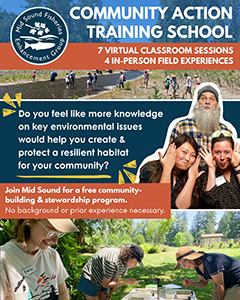
Mid Sound Fisheries Enhancement Group accepting applications for Community Action Training School
Mid Sound Fisheries Enhancement Group is now accepting application for Community Action Training School (CATS). This free 8-week program is a continuing education program for residents in WRIA 8 and empowers participants to become active members of their communities through a series of virtual sessions and field experiences focusing on scientific, social, cultural, and political issues important to watershed health, habitat resiliency, and keystone species recovery. Using the Pacific Salmon as a guide, you’ll learn about strategies to become stewards in your watershed and communities. Apply here!
Salmon in the News
Along the Edges of the Salish Sea, a Blush Presages the Return of the Salmon.
Read the full article.
Seattle’s New Waterfront is Alive if You Know Where to Look.
Read the full article.
Biomonitoring of Contaminants in the Puget Sound Nearshore.
Read the full article.
Grant Opportunities
WaterWorks Grant Program
King County Wastewater Treatment Division’s WaterWorks Grant Program will open the competitive track August 19 to accept proposals through September 30. This is a required first step in the application process and must be completed online. WaterWorks funds projects that help improve water quality and build healthy communities in the region. Nonprofits, schools, tribes, and agencies are eligible to apply, and partnerships are encouraged. Types of projects eligible include raingardens and other green stormwater infrastructure, restoration, education and community engagement on water quality issues, monitoring, research, and pollution prevention. Funded projects can begin in 2026. Visit the webpage to find out more, including how to register for upcoming Information Sessions. For questions, contact water.grants@kingcounty.gov.
|