Reminder - New Permitting System Coming in September
Public Health’s Environmental Health Services Division is transitioning to a new permitting system this September. The new system will be called the Public Health Permit Center. This online services portal will include plumbing and gas piping permitting, a plan review submittal interface, online inspection requests, and more. Once it launches, the Permit Center will replace the current Environmental Health Services Portal. We’ll provide additional information, including the date of the new system’s launch, in future newsletters. You can learn more about this transition on our webpage: kingcounty.gov/PublicHealthPermits.
Note that our staff will be conducting training for the new system in late August, and we will have reduced availability during that time, which will impact inspection response time and other services. Please plan accordingly.
Reminder – '90 Day Final’ being discontinued
As part of the transition to a new permitting system in September, Public Health’s Plumbing & Gas Program will be discontinuing the '90 Day Final’ option for closing out expired permits. When a permit expires, the applicant will need to purchase a new replacement permit in order to close out the permitted work unless a permit extension is approved by the Chief Plumbing Inspector. The newly obtained permit will replace the previously expired permit, and the expired permit will be converted to ‘canceled’ status. More information about the process for obtaining a replacement permit will be provided in a future newsletter.
Water Heater Drain Pans
As soon as the beginning of next year, the Plumbing & Gas Program will start requiring water heater drain pans in more locations where water heater leakage can damage building components. Drain pans will be required to drain to an approved location. Piped connections between drain pans originating from separate tenant spaces, dwelling units, or floor levels will be prohibited.
We will be making this change to more effectively comply with the literal interpretation of Uniform Plumbing Code/Seattle Plumbing Code (UPC/SPC) section 507.5 and to better align with the Seattle Department of Construction and Inspections code enforcement for drain pans below mechanical equipment. We plan to provide additional guidance for water heater drain pan requirements through the end of this year with actual enforcement during inspections and plan reviews beginning in 2026.
90 Day Limit in Effect for Plan Review Responses
With the 2021 Seattle Plumbing Code (SPC) now in effect for most projects, please be aware of a new code provision that requires drawing resubmittals and invoice payments to be submitted within 90 days of the request. Specific details can be found in Section 108.7 of the 2021 SPC. The text of the code section is below.
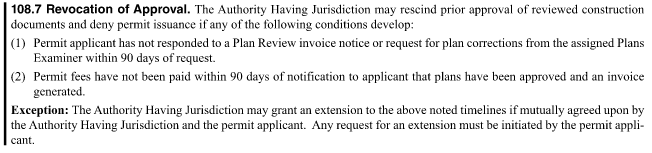 There is a rather broad exception available if needed. To request an extension (in accordance with the exception), contact your assigned plan reviewer, tell them you would like an extension, and provide the estimated number of days your team needs. This code provision is not intended to streamline the review or construction process, but rather to keep ‘zombie’ projects from stacking up in our system.
Dead Leg Enforcement
Another new code section that came into effect with the 2021 code cycle is a definition for ‘Dead Leg’ (UPC/SPC 206.0). This was added in conjunction with (UPC/SPC 309.6) which stipulates dead legs must have a ‘method of flushing’. Part of the difficulty in enforcing this new code requirement is that the text of the code does not provide a specific length of dead-end pipe that should be considered a dead leg.
After a lot of research and discussing the issue with many different entities, we have decided to follow the lead of the American Society of Plumbing Engineers (ASPE) publication ‘Engineering Methodologies to Reduce the Risk of Legionella in Premise Plumbing Systems’ (aka the Legionella Design Guide) to guide our compliance policy for dead legs. Section 3.5.8 of the ASPE document recommends a (6) pipe diameter limit for uncirculated or ‘future’ branches. Adhering to this will help limit bacterial growth in accordance with the intent of the code, while providing some practical allowance for the installation of things such as residential fire/sprinkler pennants in multi-purpose or passive purge sprinkler systems. Note that the pipe diameters being referenced are those of the branch, not the main.
A ‘method of flushing’ can be achieved by providing a valve within 6 pipe diameters of the end of a dead leg, and having a readily removable cap (threaded, flanged, or grooved) to allow for periodic flushing. There is no code requirement for a specific frequency of flushing, but the Centers for Disease Control and Prevention (CDC) recommends flushing uncirculated pipe sections in domestic water systems a minimum of once per week. As such, the method of flushing must be accessible and not covered by drywall or installed above a ceiling without an access panel.
|