|
Health & Safety Information for Child Care Providers |
|
|
As sunnier and warmer days approach, review our webpage on air quality, outdoor safety, and weather. Here are some reminders:
Sunscreen & Sun Safety
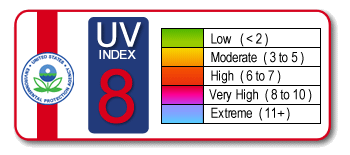
Anyone can get a sunburn, and even on cloudy or overcast days the sun’s harmful rays can still pass through clouds and cause skin damage. Instead of relying on how the weather looks or feels, check the Ultraviolet (UV) Index in your area. The Environmental Protection Agency (EPA) recommends that sunscreen be applied when the UV Index is 3 (moderate) or above.
Review our Sun Protection Guidelines for Child Care and Early Learning Programs (also available in Amharic, Oromo, Russian, Somali, Spanish, and Ukrainian) for more information on:
-
The importance of sun protection.
-
What kind of sunscreen to use.
-
When sunscreen should be applied and WAC rules about sunscreen.
Use sunscreen for children 6 months and older. Sunscreen should:
-
Have both UV-A and UV-B protection.
-
Have an SPF of at least 15.
-
Be applied 20-30 minutes before outdoor activity and reapplied every 2 hours.
As a reminder, child cares need to get written authorization from parents or guardians before applying sunscreen to children in care. You can find these forms, including translations, on the CCHP sun safety webpage.
|
|
Protecting Children During Extreme Heat Events
Extreme heat events make everyone uncomfortable, but high temperatures aren’t the only concern. Heat waves early in summer can put stress on our bodies because we haven't had time to adjust to the hotter temperatures that summer brings. Many hot days in a row, without cooler evenings, make it hard to cool down and recover. In addition, humidity – the measure of water vapor in the air – makes us feel hotter than the actual temperature. Normally, sweat helps us cool down, but when there is high humidity, sweat doesn’t evaporate as quickly.
Although anyone can suffer from heat-related illness, very young children are a high risk group because they have:
- smaller bodies that heat up more quickly than adults
- fewer sweat glands, so they can’t release as much heat via sweat and evaporation as adults
- less ability to communicate their symptoms, which can make it harder to catch the early signs of dehydration and heat exhaustion.
The CCHP's Weather & Extreme Heat webpage has a lot of information on how to mitigate extreme heat and excessive sun exposure including:
-
Information on using the Heat Index instead of just the temperature outside to decide if outdoor play is safe.
-
Tips and tools to help cool the air and block the sun, such as installing window shades, providing shady areas when children are outdoors, and having families dress children as cool as possible.
-
Information on keeping children hydrated.
|
|
 |
Watch for signs of heat exhaustion:
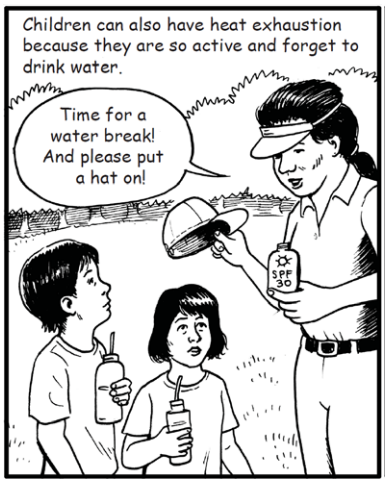
If a child or staff has signs or symptoms of heat exhaustion (such as headache, nausea or vomiting, dizziness, muscle cramps, and irritability) or dehydration (thirst, heavy sweating, fewer wet diapers), move them to a cooler place and give them liquids to drink. You can also remove unnecessary clothing, such as shoes and socks, and try to cool the person with cold compresses. If they do not feel better after trying these things, get medical attention for them immediately.
For more information on extreme heat, visit these resources:
-
The CDC HeatRisk tool uses a 5-level scale to indicate how risky the heat level is to health in your area – just type in your zip code.
|
|
Preparing for Wildfire Smoke Season
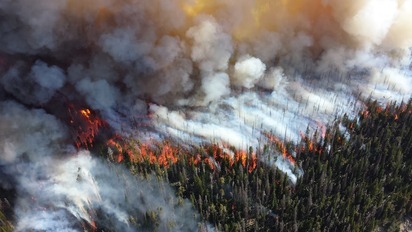
During summer months, our region may experience more days with poor air quality due to wildfire smoke. By preparing early and monitoring the air quality before spending time outdoors, you can help keep children in your care safe from the impacts of poor air quality.
-
Children and people with chronic health conditions, such as asthma, are more sensitive to the harmful effects of wildfire smoke.
- If staff members have asthma, you may need to make alternative staffing plans.
-
Make sure you have an up-to-date and complete care plan for any children who have asthma. You can find care plan documents for asthma on our care plan documents webpage.
-
Check to make sure asthma medications are in the Grab ’n Go Bag, are not expired, and have doses available.
When there is wildfire smoke in the area:
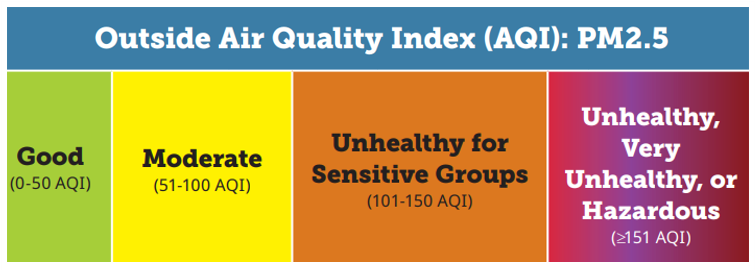
- Check the Washington Smoke Blog for current Air Quality Index (AQI) data, forecasts, and health information. Air quality can change quickly, so it’s important to check the AQI right before spending time outdoors.
- Use the DOH Washington Children and Youth Activities Guide for Air Quality chart to determine if outdoor activities are appropriate or if you will need to make activity modifications for outdoor play.
-
When the AQI is in the orange to purple range, you should stay indoors. Some children with certain health conditions may need to stay inside in more moderate air quality.
For more information on air quality and wildfire smoke, visit: http://www.KingCounty.gov/WildFireSmoke.
Improve indoor air quality on smoky days
-
Smoky days often overlap with hot outdoor temperatures. When it is hot out, use air conditioning or fans to keep indoor air cool. Set your AC or HVAC system to recirculate the air rather than bringing in outside air.
-
To help keep the indoor air clean, keep windows and doors closed as much as possible. If you have to choose, opening the windows for a short time to cool off and letting some smoky air inside is safer than overheating.
-
Consider getting HEPA air filters that provide 99% or higher filtration to reduce fine particles from wildfire smoke.
-
For a low-cost option, you can make a DIY filter fan using a box fan, a MERV-13 filter, and a bungee cord or tape. Watch this how-to video for instructions.
Physical activity is still important. When you must stay indoors, you can lead structured activities that provide an opportunity for physical movement.
Watch for symptoms of wildfire smoke exposure
Symptoms of wildfire smoke exposure may include coughing, headache, sore throat, burning eyes, and wheezing. If children or staff experience any of these symptoms, they should move indoors as soon as possible.
|
|
Other Reminders & Information |
|
August 15 is the Last Chance to Sign Up for WAIIS!
The Washington Immunization Information System (WAIIS) makes immunization tracking easier and allows child care and early learning programs to:
-
access a roster showing each child's immunization status
-
run an “at risk report” to see which children are not up-to-date on their immunizations (without having to go through paper records), which could come in handy if there is a disease outbreak in your program
-
print parent letters for children missing immunizations
In addition, providers who use this system do not need to fill out the annual immunization report for DOH, another time saver.
Don’t Delay! DOH will stop accepting new Information Sharing Agreements (ISAs) from child cares after August 15. This means they will pause onboarding new child cares, and any ISAs submitted after that date will be not be processed until January.
You can find the ISAs on www.doh.wa.gov/SchoolModule. Please also see the CCHP’s step-by-step guide to help you with getting access to the Module.
|
|
|
|
|