New fixture types may soon be added to plumbing permits
Last year, we sent surveys to a volunteer group of respondents to gauge support for adding certain fixture types to plumbing and gas permits. After reviewing the results of those surveys, the Plumbing and Gas Program has developed a final draft list of fixtures that will be listed on plumbing and gas permits this fall when our permitting software is updated.
There are several new items on the final draft list, including hose bibbs, icemaker supply outlet boxes, and pressure reducing valves. The final draft fixture list has been distributed to our Policy Advisory Committee for review and comment. More information will follow in a future newsletter.
Do you need a gas permit? What about a backflow permit?
When plans are submitted for plan review, it is common for the plumbing plans to include fuel gas piping and backflow assemblies when those systems or devices are applicable to the project. The plan review will include review of the fuel gas system and of the placement and types of backflow devices listed. When there is both plumbing and fuel gas reviewed as part of a single drawing set, the approved plans will be stamped with a “Plumbing & Fuel Gas” stamp, similar to what is shown below.
When fuel gas is shown on the plumbing drawings, you do not need to submit a separate drawing set for review of the fuel gas system. You will however need to purchase a separate over-the-counter fuel gas permit to cover the fuel gas portion of the project prior to calling for your first fuel gas inspection.
If there is no fuel gas shown on the plumbing drawings, the approval stamp will only list “Plumbing”, like what is shown below.
If the project includes a fuel gas system that is subject to plan review and that system is not shown on the plumbing drawings, then a separate drawing set showing the fuel gas system needs to be submitted for plan review and a separate fuel gas permit will be issued as part of that process. Similarly, even though backflow devices are shown on plumbing drawings and reviewed along with the plumbing system, a separate over-the-counter backflow permit is required prior to calling for any inspection involving backflow assemblies. Current Washington Labor & Industries Rules require all backflow devices within a building to be installed by a licensed plumber and tested by a WA State certified backflow assembly tester.
Upcoming stakeholder meeting fabricated stainless steel fittings
Late in 2023, Public Health paused enforcement of 3rd party listings on locally fabricated stainless steel fittings. In the jurisdiction's judgement, these fittings needed to be tested and listed to both NSF 61 and a separate fitting standard before they could be considered safe for installation in potable domestic water systems. Some of our industry partners had a different opinion and held the view that fabricated fittings were more or less the same as a welded joint and asked that we pause enforcement of this requirement until the issue could be studied more thoroughly.
We have set a tentative meeting in mid-May to discuss this issue in detail and hopefully come to a resolution that all parties can agree to. Prior to scheduling the meeting, we connected with the various stakeholders and experts we believe need to be involved in the conversation, including professional welders, regulatory bodies (International Association of Plumbing and Mechanical Officials and NSF), large and small manufacturers, organized labor (Local 32), and local trade groups (Mechanical Contractor’s Association and Plumbing-Heating-Cooling Contractors Association).
More information on the outcome of this proposed meeting will be shared when available.
By Dave Price, Assistant Chief Plumbing Inspector, Public Health - Seattle & King County
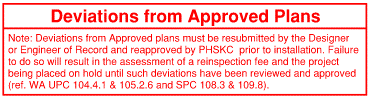
We’ve previously mentioned that when a set of plans is reviewed and stamped ‘approved’ by our department, those approved plans need to be generally adhered to when installing the related plumbing or gas system. The last page of our Plumbing Design Guidance document covers this in some detail, and we have begun providing a separate stamp on the cover sheet of approved plans to notify the contractor of this requirement (see example stamp below).
In most construction projects, there are times when an element of a design may need to be changed because of installation challenges, availability of components, unforeseen cost increases, etc. This article explains what types of design changes may trigger a plan resubmittal, and other options that may be available for receiving jurisdictional approval for a design change depending on the scope of the change.
The three main options for approval of design changes
Depending on the complexity of the change, a drawing resubmittal may not always be necessary. There are three primary ways to have a design change approved after drawings have already been stamped:
- Approval by field plumbing inspector or Senior plumbing inspector
- Approval by Engineer of Record
- Approval by original plan reviewer (drawing resubmittal)
Now that we have laid out the different options, let’s begin to look at the circumstances each option may be applied to.
Approval by inspector
This option is allowable when the following conditions are met:
- The design change is relatively minor
- The installed configuration meets the original design intent
- There are no pipe size changes or connection revisions that would be impractical to assess for code compliance during an inspection
- There are no changes to fixture count*
When the above conditions are met, the field inspector may approve of the design change directly, or may seek input from a senior inspector before approving or disapproving the change. If these conditions are not met, or the inspector is not comfortable approving a particular design change, then we move on to the next option.
Approval by Engineer of Record (EOR)
This option is reserved for design changes that need to be reviewed by the EOR to confirm compliance with the original design intent or specific project requirements that may be built into various construction contracts. Examples of when this option may be appropriate are:
- Material changes not impacted by design loading (Drainage, Venting)
- Make/Model changes of non-critical system components
- Slight relocation of a system component or fixture
- Change in method of installation of a system or system component
In this context, non-critical system components include items such as circulation pumps, balancing valves, plumbing fixtures, expansion tanks, mixing valves, etc. Items that require a more in-depth evaluation to determine code compliance or equivalence to the original design, such as water heaters and interceptors, are considered critical components. Changes to critical components will likely require a drawing resubmittal.
When approval by the EOR is allowed, our plan review or inspection team will request a letter or email from the EOR containing the following:
- Confirmation the EOR approves of the change
- A description of the item replacing the previously designed item (i.e. PVC instead of cast iron waste and vent)
- Any information needed to confirm code compliance of the new item (fixture flow rate, listing information, design capacity, etc.)
Most design changes not covered in the examples above will need to be resubmitted to the original reviewer as a drawing resubmittal. A drawing resubmittal may be required when any of the following occur:
- Change in material that requires a review of design loading (Water and Gas systems)
- Change in fixture count*
- Routing revision(s) that impact original pipe sizes or riser configurations
- Change in system design approach (i.e. conventional venting to wet venting or AAV’s)
*Note that an inspector may approve a very minor change in fixture count if they are able to evaluate the overall change in system loading during an inspection and the permit holder contacts the permit desk to change the fixture count on the permit. Examples might include adding an emergency floor drain or a single hose bibb or lavatory.
When a drawing resubmittal is required, be sure to submit the entire drawing set to the original plan reviewer. If the original reviewer is unavailable, please send an inquiry to planreviewinfo@kingcounty.gov for direction.
When submitting the revised drawing set:
- Provide exact copies of the previously approved and stamped sheets that are not changing (including approval stamp).
- Collate the newly revised sheets (or newly added sheets) into the previously approved drawing set. Remove the prior stamped version of any revised sheets. There should be no duplicate sheets.
- Be sure to revise any and all drawing sheets related to the design change. For example, if you are adding a new kitchenette sink, be sure to capture the change on the plan sheets, the riser diagrams, the fixture schedule, and the load calculations. If necessary, provide additional construction details.
- Provide a written narrative of the design change. This can be part of an email response and does not necessarily need to be a separate document.
- For large projects, provide a sheet index indicating which specific sheets have been impacted by the design change. This can be a notation on the existing sheet index within the drawing set.
- Make sure the new or revised sheets are stamped and signed by the EOR, or designer credentials are provided on each sheet if designed by other than a Professional Engineer. Drawing revisions may only be submitted by the original project applicant. Markups, sketches or manipulated drawings submitted by anyone other than the original applicant (contractor, field foreman, project manager, tenant, etc.) will not be accepted. If the original EOR is not willing or able to provide revised drawings, or they have gone out of business, contact planreviewinfo@kingcounty.gov for direction.
To the extent possible, when multiple design changes are anticipated it is best practice to resubmit a drawing set with all of the anticipated changes included in order to avoid additional review cycles and review costs. If an inspector is requesting a drawing resubmittal because of an observed design deviation, the inspector will not continue to inspect that part of the system until drawings have been resubmitted, reapproved, and a printed copy is on the job site. The inspector may continue inspecting other parts of the project while resubmitted drawings are under review.
As always, if you have any remaining questions about the resubmittal process in general or a question about how we might handle a specific design change on your project, feel free to reach out to planreviewinfo@kingcounty.gov or the plan reviewer assigned to your project for project-specific guidance.
|