|
WRIA 8 Salmon Recovery Project and Program Updates
Happy Holidays and New Year!
It’s been a great year for recovering salmon in WRIA 8, and the WRIA 8 staff team thanks all our partners in protecting and restoring habitat, tackling the challenging issues facing salmon, and improving overall watershed health!
Highlights from 2024:
- Successfully managed largest grant round ever! WRIA 8 received 32 proposals and allocated just over $7 million. These grants support ongoing priority acquisitions, restoration projects, monitoring and assessment efforts, studies, and education and outreach programs.
- Completed several important technical reports and data and information syntheses to inform salmon habitat restoration and recovery efforts, including:
- Multi-Species Assessment Report
- Synthesis of Predation Impacts on Juvenile Chinook Salmon in WRIA 8
- Recommendations report from a technical workshop focused on reducing pinniped predation on salmon at the Ballard Locks
- Reports documenting the effort to assess feasible alternatives to address elevated water temperatures and low dissolved oxygen in Lake Washington Ship Canal to improve salmon health and survival
- Established state and federal legislative priorities, and took action to support priorities in communications and meetings with legislators, members of Congress, and other key state and federal partners.
- Coordinated the 18th consecutive year of the Salmon SEEson program to promote opportunities for the public to see salmon returning to spawn in the watershed's streams and rivers.
Wishing all our partners a restful and joyful holiday and New Year!
Salmon SEEson Program Wraps up
The WRIA 8-led Salmon SEEson program is coming to an end for the 2024 year with salmon having made their way back to rivers and streams to spawn. This was an exciting year for salmon with record breaking numbers seen at sites and on the spawning grounds. The Salmon SEEson website provides a map and details for several self-guided viewing locations as well as in-person interpretive viewing opportunities.
This year, over 18,500 Chinook were estimated to have passed through the Locks, the third highest count in the past 20 years. It is important to note that the majority of returning fish were hatchery fish, and the numbers of salmon predicted by the Ballard Locks counts in recent years have been much higher than the numbers of salmon observed reaching the Issaquah Hatchery and spawning grounds. Preliminary estimates from Chinook spawner surveys suggest around 640 Cedar River spawners and 2,340 Sammamish River spawners this year, including both natural-origin and hatchery-origin fish (counts are preliminary and under review). Unfortunately, this year's sockeye return continued to be low with an estimated 23,188 fish counted at the Locks, the fourth lowest return on record since 1972. Coho began their run in late August and over 19,000 coho were counted passing through the Locks, which is below recent averages.
Some exciting highlights from this Salmon SEEson is the record Chum run seen at Piper’s Creek in Carkeek Park with over 1,500 fish being counted in one day! Additionally, Lake Sammamish kokanee have had a historic year with more than 8,000 returning adults counted for the 2024 year.
Salmon SEEson is coordinated by WRIA 8 with additional sponsorship support from the Saving Water Partnership, Duwamish Alive Coalition, the Green/Duwamish and Central Puget Sound Watershed (WRIA 9), the Snoqualmie Watershed Forum, and King County.
Tour of Dewatered Ballard Locks
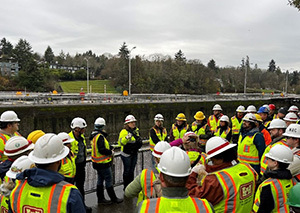
In mid-December, WRIA 8 convened a tour of the dewatered Ballard Locks for partners, which was hosted by the Army Corps of Engineers. Over 55 individuals attended, spending two hours exploring the depths of the vast concrete large lock chamber, which was emptied of water for annual maintenance and construction of the replacement large lock gates. The tour offered participants an opportunity to see a side of the locks most people don’t get to see, and to understand the maintenance necessary to keep the facility operational as a key navigation pathway for boats and salmon between saltwater in Puget Sound and freshwater in the Lake Washington Ship Canal. The Locks and Ship Canal are a critical migratory pathway for salmon in the WRIA 8 watershed, and improving water quality conditions, reducing predation impacts, and improving fish passage are all high priorities for salmon recovery.
New Technical Resources for WRIA 8
A recently finalized Synthesis Report describes predation impacts on juvenile Chinook salmon in WRIA 8. Predation on juvenile Chinook by native and non-native fish is a primary constraint to the productivity and recovery of Chinook in the Lake Washington Basin. The report synthesizes available information on predatory fish populations and their impacts on juvenile Chinook in the watershed and highlights critical findings and management needs relevant to predation.
King County scientists published an article in the North American Journal of Fisheries Management on the drivers of off-channel habitat use by juvenile Chinook and Coho salmon in the Cedar River. Off-channel habitats are important for juvenile salmon but can vary widely in their capacity to support salmon. The authors found that both microhabitat conditions and habitat arrangement influenced salmon densities within off-channel features, with implications for restoration.
Riverbend Project Wins Construction Award
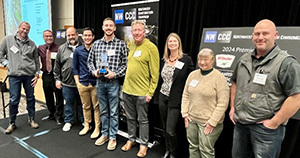
The Riverbend Floodplain Restoration Project on the Cedar River was recently the recipient of the Northwest Construction Consumer Council's Best Public Project (under $10M) award. Led by a construction engineering team from Seattle Public Utilities along with critical technical experts and design engineers from King County Water and Land Resources Division, the completion of the two-phase floodplain reconnection project on Cedar River near Renton constructed by the contractor Rodarte, has been a terrific success for stream restoration in WRIA 8. Removing a historically flooded mobile home park, restoring the area of a relic gravel mining pond, and improving protection for State Route 169 that parallels the project area, were all components of the multi-benefit salmon recovery project constructed jointly by King County and the City of Seattle from 2020-2023. Congratulations all!
Lake Sammamish Aquatic Weed Technical Workshop Hosted by Trout Unlimited
Trout Unlimited hosted its first Lake Sammamish Aquatic Weed Technical Workshop on December 6th. Trout Unlimited has been pursuing aquatic weed control in Lake Sammamish since 2020 to complement the fisheries co-managers’ effort to reduce predation mortality of juvenile salmonids in the basin. One of the main contributors of this mortality is non-native warmwater gamefish which depend on the habitat provided by non-native aquatic weeds for at least one portion of their lifecycle.
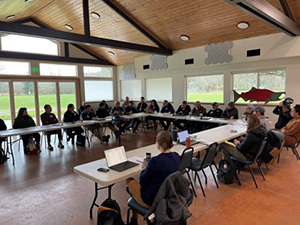 |
The workshop was funded through WRIA 8’s Cooperative Watershed Management (CWM) grant program, with funding provided by the King County Flood Control District. The agenda included reviewing Trout Unlimited’s work to date and the results from treatment effectiveness monitoring, review of a newly completed aquatic weed map of Lake Sammamish, and more. Attendance for the workshop included: King County, Snoqualmie Tribe, WRIA 8, WA Ecology, WA Department of Natural Resources, WDFW, SePRO, AquaTechniX, Woodland Resource Services, Herrera, and Trout Unlimited. If you are interested in participating in future meetings of this group, please contact Dave Kyle, DKYLE@TU.ORG.
Mid Sound Fisheries Enhancement Group Thanks 2024 Volunteers!
In 2024, 800 volunteers at Mid Sound’s West Sammamish River Trail site in Woodinville volunteered for a collective 2,536 hours! They cleared Himalayan blackberry and planted native plants in the riparian area, learned about salmon and native plants, and connected with other stewards from their community. Volunteers are instrumental in helping achieve restoration goals. We are so grateful for them!
 |
Salmon Friendly Lakes Program
Do you live along the shores of Lake Washington or Lake Sammamish? Are you interested in learning about opportunities to make your shoreline better for salmon? King Conservation District and Mid Sound Fisheries Enhancement Group are partnering to provide free site assessments for technical assistance eligibility. Technical assistance could include: shoreline redesign, permitting assistance, salmon-safe lighting plans, and funding opportunities. The deadline to sign-up for technical assistance is January 31, 2025. Visit the webpage for more information.
December Updates from the Hatchery!
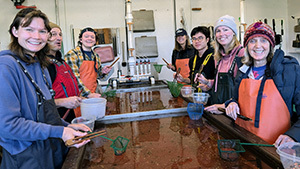
Friends of Issaquah Salmon Hatchery (FISH) welcomed over 100,000 visitors and over 6,000 students to the hatchery to learn about salmon recovery and watershed stewardship this year. In addition to these experiences, FISH provided salmon education programs at schools and community events, supported fish operations, and helped with habitat stewardship at the hatchery. Over 300 volunteers donated more than 4,400 hours to make it all happen. The photo featured is of volunteers picking eggs (to reduce mortality, eggs are checked to be viable at the eyed stage - about 30 days, depending on temperature units - and volunteers support with quality control after a machine has automatically sorted out most of the dead ones).
2024 Hatchery Spawning Numbers:
Chinook:
- Trapped: 5,534
- Spawned: 1,795
Coho:
- Trapped: 5,500
- Spawned: 983
The Mountains to Sound Greenway Trust is Hiring Several Seasonal Positions
Learn more about the organization, positions, and benefits at mtsgreenway.org/careers.
- Restoration Crew Members
- Restoration Crew Assistant Lead
- Restoration Crew Lead
- Volunteer Specialist
- Educators
- Trail Specialists (coming soon)
Priority will be given to applications received by January 5th (Restoration Crew positions) or January 15th (Volunteer and Education positions).
Grant Opportunities
WRIA 8 2025 Salmon Recovery Grants
The WRIA 8 Salmon Recovery Council is pleased to announce its annual request for proposals for salmon recovery grant funding through the Salmon Recovery Funding Board (SRFB) and King County Flood Control District Cooperative Watershed Management (CWM) programs. Eligible activities (depending on the funding source) include habitat acquisition and restoration projects, outreach and education programs, and monitoring and assessment activities. For a full description of the application process, links to application materials, and other important information, visit the WRIA 8 Funding for Salmon Conservation webpage.
King County Conservation Futures Land Acquisitions Grant
King County is seeking applications for 2026 King County Conservation Futures land acquisition grants. Applications are due on Monday, February 10, 2025. Conservation Futures grants can be used to acquire land for open spaces and parks used for passive recreation. These grants can help purchase land to be used as urban greenspaces, natural areas, restoration sites, forests, community gardens, farms, and trails – including stormwater parks or parks near affordable housing. Acquisitions serving historically underserved communities may qualify for a match waiver to cover the full purchase price. Acquisitions must be located within King County. Along with acquisition, we can fund initial site stabilization costs of demolition, signage, and fencing.
Reach out to, Ingrid Lundin with any questions.For more information, view the Conservation Futures application webpage.
The Climate Smart Communities Initiative (CSCI) is Now Accepting Grant Applications
This funding will help communities accelerate their climate resilience plans and projects. The grants offer funding (up to $100,000 per award) along with training and technical support. These funds can be used over 12 months for activities such as risk assessments, community engagement, project prioritization, and initial implementation. The initiative will accept grant applications into March of 2025 and expects to announce multiple awards in the summer of 2025. For more details on the grant program, visit the Climate Smart Communities webpage
|