Please welcome our newest plan reviewer, Kelly Kennedy!
|
I'm a journey-level plumber and BIM detailer, and have worked on major construction projects across Washington and Oregon since 2014. I'm passionate about the role of plumbing in protecting the public health of our community. Before entering the construction industry, I earned my B.A. in Statistics at the University of Chicago, where I also studied math, computer science, and biomechanics.
I live in South Seattle with my goofy cat, Koji. In my free time, I love scuba diving, practicing martial arts, and open water swimming in Puget Sound. As I start this new chapter of public service, I'm looking forward to providing consistent, clear, and helpful plans review services to clients around King County.
Best,
Kelly
|
|
 |
Updated procedure and documentation for re-pipe projects
Re-pipe projects have a unique ratio of inspections to fixtures, so we’ve developed a unique procedure to accurately capture the cost of inspecting these types of projects aside from the standard fixture count. Since April 2024, any re-pipe project required to be submitted for plan review includes a new document (referred to as R-20) that captures the anticipated number of inspections agreed upon between the applicant and a Public Health representative.
The total permit fee assessed includes the total anticipated inspection number multiplied by the program’s hourly operating rate in addition to the standard base permit fee with only a representative fixture or fixtures listed (‘re-pipe hot’, ‘re-pipe cold’, or ‘re-pipe drainage’ as applicable). The anticipated inspection number and representative ‘re-pipe’ fixtures takes the place of a typical fixture count on the permit with the exception of tub/shower valve replacements or other in-wall plumbing fixture revisions that would be included separately.
We want your input on future featured articles!
Do you have ideas for plumbing and gas piping topics that could use a deep-dive explanation? Each installment of our newsletter includes a featured article. In these sections, our Assistant Chief Plumbing Inspector, Dave Price, demystifies a plumbing and gas piping topic. Previous featured articles have covered design considerations for tankless water heaters, code updates, and more.
We’d like to hear what you think should be topics for future featured articles! If you have an idea, please reach out to us at planreviewinfo@kingcounty.gov with “Featured article” in the title.
Tips for installing an indirect receptor in a base cabinet
There may be times during a retrofit or remodel when an indirect receptor is needed to accept the discharge from backflow devices, icemakers, drip pans, AC units, and similar items. Often, the most logical place to install such a receptor is within a base cabinet.
UPC/SPC 804.1 specifically prohibits the installation of an indirect drain within a cupboard and requires such receptors to be provided with ‘ready access’. Strictly enforced, this would mean an indirect receptor could only be installed in a base cabinet if the cabinet had no doors.
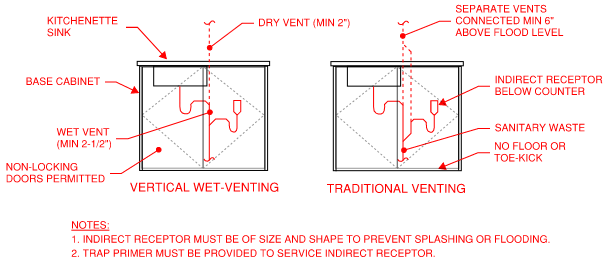
Knowing this limitation is problematic from a practical and aesthetic standpoint, we have developed some guidance for these situations. An indirect receptor (hub drain) may be installed with a separate trap and trap primer within the cabinet as long as the cabinet floor is removed in the section of cabinetry where the drain is located. Non-locking doors may remain in place.
The removal of the floor will make any drainage backups more apparent and will prevent any backup from being hidden within the cabinetry or migrating into wall framing or floor/ceiling assemblies. This same allowance would apply to floor sinks and funnel type floor drains used as indirect receptors within a base cabinet.
See the below figure for additional detail.
By Dave Price, Assistant Chief Plumbing Inspector, Public Health - Seattle & King County
After more than a year of development, we have assembled a group of six initial Example Plans for reference on our website. This first round of drawings includes:
- A cover sheet
- Calculations & notes
- Schedules
- A plumbing plan
- Two riser diagrams (natural gas and rainwater)
We intend to include at least two additional riser diagram sheets (sanitary DWV and domestic water) and a construction detail sheet soon. All current Example Plans are linked to on our updated ‘Schedule A’ guidance document.
To create a place for posting Example Plans, we thoroughly reformatted our ‘Schedule A’ document. It now more clearly categorizes the various guidance documents that were previously linked and provides a brief description of each. Along with adding Example Plan links, we have also included a link to the ‘Plumbing requirements for food service establishments’ document.
Note: ‘Schedule A’ now includes more than one page and will continue to expand in the future.
So, what are Example Plans?
Example Plans are a fictional set of design documents created to help designers and engineers visualize the type of information requested by our program when submitting a project for plan review. Most firms accustomed to doing business within our jurisdiction are already familiar with the standard requirements, however these documents illustrate some very specific requirements and should help guide designers and engineers that may not be as familiar with our submittal expectations.
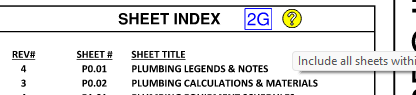
You will notice on each plan there are a number of alpha-numeric symbols shown. These correlate with line items on our Plumbing Design Guidance document. For example, including a Sheet Index on the plan cover sheet is noted in item 2G of our design guidance. On the cover sheet Example Plan, you can search for and find item 2G and then hover over the question mark symbol for expanded information:
Please note, the design information used to create this initial round of Example Plans was gathered using donated information from a volunteer group of industry partners. As such, the plans created are not a cohesive ‘plan set’. The Sheet Index does not match the actual plan sheet numbers or titles, the riser diagrams do not match the plan information, etc.
Each Example Plan should be taken as a standalone sheet and be used as a reference only. We do not require anything submitted for plan review to exactly match what is shown on these plans. The information shown is intended only as an example of the type of information we are looking for. You or your firm are welcome to use any in-house created schedule, calculation, or other method of conveying information as long as the end result provides the information being requested.
We want to extend a big thank you to the industry partners that donated the base information used to develop these Example Plans. This includes MacDonald Miller, HVE, IMEG (formerly Rushing), and Holaday-Parks. It would have been far more difficult to develop these plans on our own without this support.
Although these plans have been reviewed both internally and by our Policy Advisory Committee, there is still a chance that something slipped through the cracks. If you notice any glaring errors on any of the Example Plans, please send a note to planreviewinfo@kingcounty.gov and we will address it as soon as possible.
|