|
2021 Seattle Codes to take effect no sooner than September 30, 2024
For updates and additional information, please visit the City of Seattle 2021 Code Adoption-Timeline page. Meanwhile, the 2021 Codes are in effect for unincorporated King County.
Temporarily postponed - development of new State rules for On-site nonpotable water systems (ONWS)
In April 2024, the Washington State Department of Health (DOH) withdrew the CR-101 Pre-proposal Statement of Inquiry. This had been intended to kick off the development of a state-wide set of rules governing ONWS systems. The reason for the postponement was that DOH realized the scope of the original CR-101 was too narrow and would not allow them to enact the robust and comprehensive proposals originally intended. While the original CR-101 was withdrawn, a new CR-101 was filed in its place. For more information, please follow these links to review the new CR-101 and the Withdrawal Memo.
Revised process for reviewing out-of-portal plumbing plans
When an over-the-counter (OTC) permit is pulled for work that requires plan review, the assigned field inspector will place the project on hold at the first inspection. It will remain on hold until plans are submitted, reviewed, and approved. With the understanding that mistakes can be made, and giving Contractors the benefit of the doubt, we have traditionally tried to process these out-of-portal reviews as quickly as possible to avoid construction delays. However, with the increasing frequency of OTC permits being pulled for work requiring plan review and the need to streamline review processes, the Plumbing and Gas Piping Program will begin reviewing plans for review-required projects in the order received effective 6/10/2024. In other words, if the project is placed on hold pending plan review because of a lack of initial plan review, those plans will go into our queue when received and will be reviewed according to the current plan review timeline. This does not apply to plan resubmittals to capture field revisions or design changes after initial plan review and approval. Those resubmittals will still be reviewed as soon as possible (generally within 3 business days).
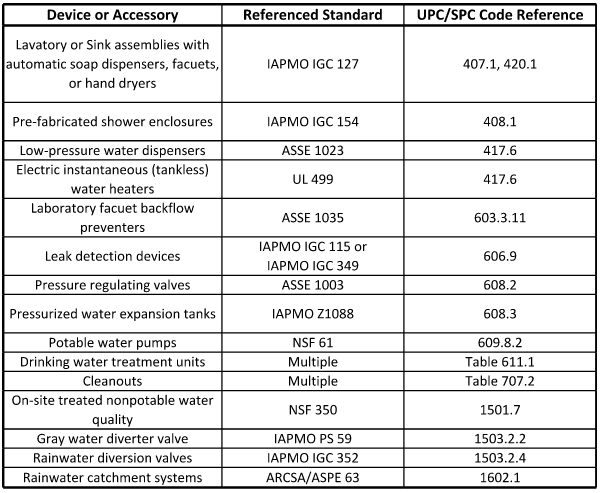
The 2021 Uniform Plumbing Code (UPC) and Seattle Plumbing Code (SPC) include a number of new Listing requirements for certain types of equipment and accessories. To prevent unnecessary delays when submitting for plan review under the 2021 Codes, please ensure your drawings include a reference indicating the proposed products meet the new Referenced Standards in the table below.
By Dave Price, Assistant Chief Plumbing Inspector, Public Health - Seattle & King County
Depending on the application, tankless water heaters can be a great option. They are smaller than a storage-type water heater and can often be placed close to the fixtures served. This saves energy when a recirculating system is not in place. However, there are some design parameters that need to be considered when sizing a tankless water heater. This article provides a high-level overview of some of the basics of tankless water heater sizing.
The two primary sizing factors are Temperature Rise and Flow Rate. Temperature Rise is the difference between the incoming water temperature and the outgoing water temperature. In our area, a groundwater temperature of 50°F is commonly used for design calculations. Be aware that some manufacturers publish sizing charts based on a much higher groundwater temperature. Using these charts can result in an undersized water heater. According to the Uniform Plumbing Code (UPC) WA State amendments and the Seattle Plumbing Code (SPC), ‘Hot Water’ is defined as being water at a temperature exceeding or equal to 100°F. This means in order to supply ‘Hot Water’, the tankless water heater typically needs to have a minimum Temperature Rise of 50°F at the design flow rate.
Design Flow Rate can be calculated in a number of ways depending on how many fixtures are being served or the specific process the water heater is being used for (in a recirc system for example). It could be as low as 0.35 Gallons per Minute (GPM) for a public lavatory, or hundreds of GPM for a large building. In the 2021 UPC/SPC, Table 501.1 will require non-storage water heaters to meet the first hour rating based on maximum system design flow. For a typical house, this could range from 7 GPM to 20 GPM or more depending on the calculation method used. Under the 2018 UPC/SPC, a tankless water heater should be sized to deliver not less than 100°F water to the fixture with the highest flow rate. This is typically a bathtub filler at approximately 5.5 GPM.
Selecting the water heater size is simply a matter of figuring out how much water (Flow Rate) needs to be heated a certain number of degrees (Temperature Rise). For gas-fired units, the thermal efficiency of the water heater can be a factor because they are not 100% efficient. For electric units it is more straightforward. The electrical element or burner sizing is based on a mathematical calculation converting Temperature Rise and Flow Rate to BTUH or KW. A couple of examples:
Heating water at a Temperature Rise of 50° and a Flow Rate of 1.8 GPM (maximum allowable kitchen faucet flow rate) would require a 14KW (14,000 Watt) electric tankless water heater (or 54,000 BTUH gas-fired tankless water heater at 90% efficiency).
Heating water at a Temperature Rise of 50° and a Flow Rate of 5.5 GPM (typical bathtub flow rate) would require a 41KW (41,000 Watt) electric tankless water heater. In a 240V residential electrical circuit, this would equate to 170 Amps!
A third factor to consider is the Pressure Drop through a tankless water heater. To heat water from the inlet temperature to the outlet temperature instantaneously, the water must travel through a heat exchanger or heating element with a relatively small cross-sectional area. This could be equivalent to hundreds of feet of pipe. If the incoming water pressure is low, you could find that the residual water pressure leaving a tankless water heater is lower than what is required by Code. In one example, the Pressure Loss chart from a manufacturer indicated a 21 Pounds per Square Inch (PSI) loss at 5.5 GPM.
In summary, tankless or instantaneous water heaters certainly have a place in the world of plumbing design. However, the designer should be aware of the factors that play into the selection of a particular make/model, and the requirements that need to be met to ensure Code compliance.
|