|
New training opportunity for aspiring plumbing designers
There is a two day Basic Plumbing Design course being held on May 16th and 17th at McKinstry (5005 3rd Ave S, Seattle, WA 98134). Visit seattleaspe.net to register. Registration is $400 for ASPE members, and $500 for non-members.
Reminder - we want your input on plumbing & gas application fixture lists!
Thanks to everyone who has signed up so far to review a proposed list of fixtures and appurtenances to be added to plumbing and gas permit applications (when these documents are updated later this year). We are still accepting people who are interested - there is no limit to how many people per company may participate.
You can learn more about what this will involve, as well as sign up, by using our online form. If you have already signed up, you do not need to sign up again. This is your chance to be involved in the development of new permit applications that will likely impact your work for years to come. Feedback surveys will begin going out at the end of this month.
Links to commonly used reference documents
Our website was recently redesigned and some of our customers have been having trouble finding the documents they normally reference. Please bookmark the links below for future use:
2018 UPC/SPC Section 710.1 requires “fixtures” installed on a floor level lower then the next upstream manhole cover of the public or private sewer to be protected from backflow of sewage by an approved backwater valve. Unfortunately there is no official definition of “fixture” in the UPC, so grease interceptors (and other interceptors) are often overlooked when making the determination of where backwater valves are required.
Referencing the last sentence of 2018 UPC/SPC Section 1014.1, it is evident that the intent of the Code is to prevent sewage from entering a grease interceptor. From a public health standpoint, it doesn’t matter if the introduction of sewage is from a direct connection or a result of a sewer overflow. For that reason, our jurisdiction considers an interceptor of any type to be a “fixture” for the purposes of enforcing the provisions of UPC/SPC Section 710.1.
Floor drains and trap primers
King County's Plumbing & Gas Piping Program generally considers all floor drains and most hub drains, floor sinks, and other indirect receptors to be infrequently used. This means they need to be served by a trap primer in accordance with 2018 UPC/SPC Section 1007.1. These trap priming devices must be listed to ASSE 1018 or ASSE 1044. Trap seal devices (listed to ASSE 1072) are not a suitable substitute for the required trap primer. If you intend to not serve a particular indirect drain or floor drain with a trap primer, please note that on any plans submitted for plan review so that the discussion can be had prior to installation and costly construction delays can be avoided.
Shower compartment design
When installing a shower enclosure, take note of the requirements outlined in 2018 UPC/SPC 408.9 for valve and head locations. We have seen a number of installations lately with very nice glass shower enclosures and tile finished interiors that failed a final inspection because they did not comply with this code section. Our inspectors do attempt to spot potential issues early on, however they often do not know how the finished enclosure will be configured. For example, a particular shower enclosure might have a showerhead and valve placed in a way that would be compliant when using a shower curtain, but is not compliant when using a solid hinged glass door. If an average size person cannot adjust the shower temperature without getting wet, chances are the installation is not compliant.
By Dave Price, Assistant Chief Plumbing Inspector, Public Health - Seattle & King County
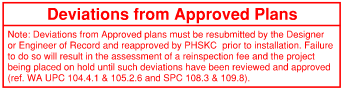
When plans are sent in for plan review, our teams review them based on the information provided on the plans. The sizing and system configurations are checked for Code compliance before plans are stamped as ‘Approved’ and the permit is issued. If the installing contractor makes changes to the Approved design in the field, then the Approval is no longer valid. Our field inspectors do not have the resources to conduct plan review in the field to account for design revisions.
Because of that, if there is a field-driven design change (regardless of the cause), the designer or engineer of record must revise the drawings and resubmit them to our plan review group for re-approval. While not popular, this is the only way we can verify Code compliance and stand by our ‘Approved’ stamp and our inspector’s inspection sign-offs.
This is not an attempt to ‘as-built’ the plumbing system or even to have accurate historical records. It is simply to ensure Code compliance of the design the same way we do when plans are initially submitted for review. Minor re-routes to avoid structural conflicts and similar minor configuration changes do not require a drawing resubmittal. This only applies to field changes that fundamentally alter part of a previously approved design.
To be clear, this is not a new requirement. The final two paragraphs of our Design Guidance (first posted in September 2023) clearly spell this out. Prior to that, 2018 SPC 108.3 and 108.4 (in effect since March 2021) essentially codified the same general principal.
When the original design is changed, the installing contractor will likely have to pay a reinspection fee. This is in addition to the designer or engineer of record having to resubmit drawings and potentially incurring a substantial redesign fee and/or construction delay. The reinspection fee will need to be paid prior to calling for another inspection. Reinspection fees and the reasons for them are covered in 2018 SPC Sections 109.8 and 109.8.1. A reinspection fee may be assessed for a number of reasons including:
- Installation not conforming to Approved drawings.
- Approved plans not being available on site.
- Contractor not ready for inspection.
- No access to inspection area.
- Nobody on site to meet inspector.
- Previous corrections not corrected.
- Permit not posted.
Our plan review group has begun to apply an additional stamp to the cover sheet of each reviewed plan set (see image below). We're doing this to spread the word about the impacts of Approved plan deviations and to help our customers avoid these fees and other associated costs. Hopefully this will better inform installing contractors as well as designers and engineers of the potential implications of making field-derived changes to an Approved design. Please help spread the word!
|