|
The NW Chapter of IAPMO and the Seattle Chapter of ASPE are co-hosting a free training event at Green River College in Auburn, Feb. 17, 2024, from 8 a.m. to 12 p.m. The presentation will be given by three well-respected IAPMO members who were instrumental in developing this alternate sizing method (also known as the Water Demand Calculator). Seating is limited to 96 people. For more information or to RSVP, please email VPLegislative@seattleaspe.net.
Our field inspectors have been informing plumbing installers of the need to provide water hammer arrestors on supply lines serving all domestic dishwashing machines in accordance with UPC/SPC 609.10. The vast majority of domestic dishwashing machines on the market today are electronically controlled with internal quick-acting valves that tend to induce water hammer in unprotected piping systems. The water hammer arrestors themselves are fairly inexpensive, compared to the potential cost a project might incur due to a failed field inspection (which could be much higher). Please make sure water hammer arrestors are installed before calling for final inspection.
By Dave Price, Assistant Chief Plumbing Inspector, Public Health - Seattle & King County
As defined by the Uniform Plumbing Code, a Backwater Valve is “A device installed in a drainage system to prevent reverse flow.” This sounds relatively simple, but in practice there are a lot of questions about backwater valves and how and where they should be used. There are also different types of backwater valves (normally open and normally closed). This article will attempt to address some of these questions.
Generally speaking, a backwater valve is required when a fixture discharges to the public sewer by gravity, and the fixture is below the next upstream manhole rim elevation. The intent of this requirement is to prevent sewage from backing up into a building if there is a blockage in the public sewer downstream of the Building Sewer connection to the utility main. If a backup occurs, the backwater valve will close. Sewage will then continue to back up in the public sewer until it reaches the elevation of the upper manhole and is relieved into the street. While not a pleasant thought, it is much less of a public health risk than backing up into an occupied building.
The type of backwater valve to use depends on the installation:
‘Normally Open’ - As the name suggests, this type of backwater valve is normally open to allow airflow through the system. When waste begins to back up in the system, the valve closes. If all of the building drainage is being routed through a backwater valve, the ‘Normally Open’ type is most often used to relieve backpressure from the public sewer.
‘Normally Closed’ – A normally closed backwater valve will not relieve backpressure from the public sewer. A relief vent may be needed downstream of the backwater valve to relieve sewer backpressure depending on the system configuration when these types of backwater valves are installed (ref UPC/SPC 904.1). A normally closed backwater valve may be preferable when only a small branch is being routed through the backwater valve, or if there is a desire to prevent positive air pressure from reaching the upstream piping. This might be the case for example when area drains from a courtyard plaza are being routed through a backwater valve to a combined storm/sewer. The selection of a normally closed backwater valve in that application would help to prevent any objectionable sewer odors from coming out through the area drains and into the courtyard.
Another common question has to do with which fixtures are required to go through a backwater valve, which are prohibited, and which are optional. The text of 2018 UPC/SPC 710.1 requires fixtures located below the next upstream manhole elevation to be routed through a backwater valve. This same section prohibits fixtures on upper floor levels from discharging through a backwater valve, but does not prohibit fixtures on the same floor level from discharging through a backwater valve. In practice, this means the designer or engineer may route all of the fixtures of a bathroom group through a backwater valve even if the floor drain(s) are the only fixture technically required to be discharged through a backwater valve (see illustration below):
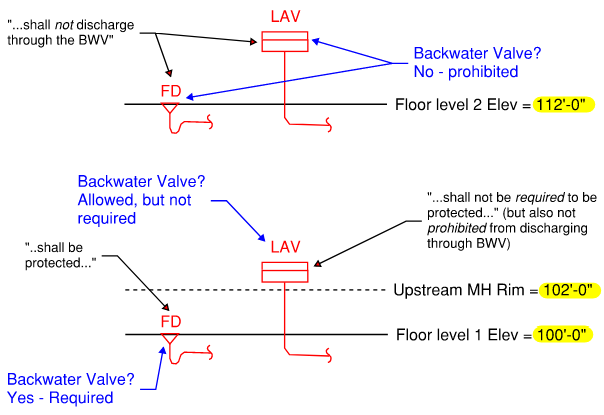 2018 UPC/SPC 710.1 Backflow Protection. Fixtures installed on a floor level that is lower than the next upstream manhole cover of the public, or private sewer shall be protected from backflow of sewage by installing an approved type of backwater valve. Fixtures on such floor level that are not below the next upstream manhole cover shall not be required to be protected by a backwater valve. Fixtures on floor levels above such elevation shall not discharge through the backwater valve. Cleanouts for drains that pass through a backwater valve shall be clearly identified with a permanent label stating "backwater valve downstream."
Lastly, don’t forget about the requirement in the last sentence of Section 710.1 to label all cleanouts upstream of backwater valves to alert maintenance staff to a backwater valve being present in the system. As always, if you have any technical questions about backwater valves that have not been addressed here, or if you have questions about what might be required for a specific project, please send an inquiry to: planreviewinfo@kingcounty.gov.
|