Georgetown Wet Weather Treatment Station construction update
King County, Washington sent this bulletin at 11/16/2018 11:52 AM PST
November 2018 Project Update
King County Wastewater Treatment Division (WTD) is building a new Wet Weather Treatment Station (WWTS) in Georgetown at the corner of Fourth Avenue South and South Michigan Street. As part of the WWTS project, WTD is also building a new outfall structure under the First Avenue South Bridge and connecting pipes from the station to the outfall. Read below for updates about all three project areas, highlights from the past month, and upcoming work.
Treatment Station
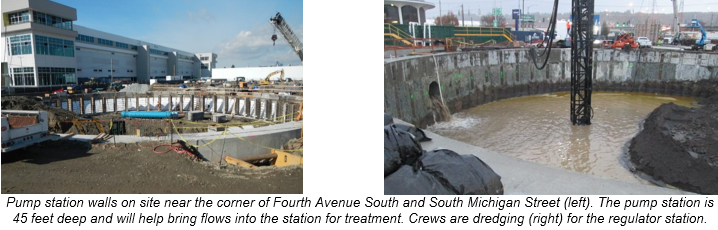
Progress continues at the station site with crews excavating, setting rebar, and pouring concrete to form the walls of the regulator structure, pump station, and areas that will hold underground pipes. Crews are also dredging, which means using water to excavate soil, in the area that will be the regulator structure's underground tank. Dredging is the first step to prepare for a "tremie pour." See our project highlight below to learn more about the tremie pour. The pour will require 24-hour work scheduled over three days in December.
Outfall Pipe
Crews are preparing to install the 54-inch outfall pipe that will transport treated water from the facility, through the outfall structure, and into the Duwamish River. Crews will be fusing pipe sections offsite for installation in the Duwamish River.
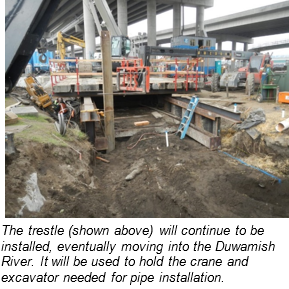
To bring pipe sections to the site for installation, crews will use two smaller flat boats, called work skiffs, to tow segments along the Duwamish River. Once the pipe arrives on-site, a crane and excavator sitting on a trestle, or wooden platform, in the Duwamish (see photo below) will be used to safely sink the pipe. Pipe installation will take place in multiple segments and is expected to begin as early as the end of November.
Conveyance Pipes
Crews are beginning construction activities to install new pipes to connect the station to the outfall. This first phase of work continues near Evergreen Tractor by South Michigan Street, in the yard area just outside the property. There is no work planned in the road for this first phase. Crews began preparing the site in early November, which included bringing in large settling tanks that will be part of the dewatering systems. Dewatering is important because it removes water from areas that need to be excavated. Sediment and erosion control Best Management Practices will be used throughout construction to control dust, keep dirt contained to the site, and help protect the environment.
As part of the site preparation work, existing structures in the area were removed in early November. In December, sheet piles will be installed. Steel sheet piles will be installed using a large piece of equipment called a vibratory hammer. Piles are used to hold back water and soil while crews dig and excavate to install pipes and other supporting structures.
What to expect during construction
- Excavation activities and pipe installation continue at treatment station, conveyance, and outfall sites through the end of the year
- Increased truck traffic going in and out of all construction sites
- Increased noise and vibration levels as sheet piles are installed
-
Work completed weekdays during the following hours:
- Station and outfall: 7 a.m. to 6 p.m.
- Conveyance pipes: 6 a.m. to 2:30 p.m.
- Drills, pumps, excavators, cranes and trucks working on project sites
- Hotline staffed 24/7
Project Highlight
Pump Station construction: Using a buoyancy slab and tremie pour to build in an area with a high water table
What is Pump Station and why does it need a buoyancy slab?
Our new Pump Station will help bring in flows to the station for treatment. The structure needs a solid concrete base to offset the upward force (buoyancy) from underground water when it reaches a high level. We all know that around here rainy days are frequent, and the concrete base provides more stability for the underground structure. The slab will sit below the underground tank and anchor it by exerting a downward force, which will offset the structure's buoyancy. Isn't physics cool?!
How does the concrete slab get put in?
We're glad you asked! This is where the "tremie pour" comes in. A tremie pour is a way to pour and place concrete. It uses vertical pipes to carry concrete below a pool of water to where the slab will be placed. The water from the dredging will stay in place for this work.
What can neighbors expect?
This work will be completed over the weekend from December 21 - 23, 2018. Work will start Friday at 7 p.m. and continue 24 hours/day through Sunday until 12 p.m. Near neighbors may experience higher noise levels and nighttime lighting during the tremie pour.
 |

|
|
Update your preferences or unsubscribe. If you have questions about this service, you may contact us directly or search FAQs here. View King County's privacy policy. |
|
Having trouble viewing this email? View it as a Web page. |