|
|
|
|
Himalayan Blackberry June 2018 Weed of the Month
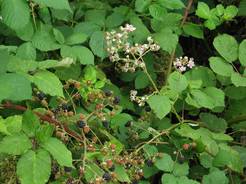 If Washington ever decided on a state weed, Himalayan blackberry (Rubus armeniacus) would be a strong contender. Some people hate its thorns, some love its berries, but almost everyone has a strong opinion about it. Yet, for all its fame, this plant has only grown in Washington for a little over one hundred years—a striking example of just how quickly a noxious weed can take over.
Even the origins of Himalayan blackberry are almost mythic: In the late 1800s, botanist/entrepreneur Luther Burbank brought the plant to his California farm in the hope of selling it far and wide. His newfound blackberry was both vigorous and delicious, and grew especially well in temperate climates. It seemed to Burbank like the perfect fit. (Thinking the plant was from India, Burbank named it “Himalayan Giant,” although it actually originated in Armenia.)
A century later, those same traits have created an ecological disaster throughout much of the western United States. Himalayan blackberry stems (often called canes) are large, thick, arching, star-shaped in cross-section, and have big thorns. They can quickly grow up to 15 feet tall and 40 feet long, outcompeting many other plants and forming dense monocultures.
|
|
|
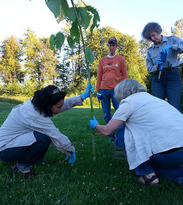 Knotweed control classes offered June 20 and June 26.
In June, our riparian team will be teaching two sessions of our popular free workshop on invasive knotweed control. In the class you’ll learn all about invasive knotweeds, how (and when) to control them (including how to borrow and use a stem injector), replanting ideas, and an update on the battle against knotweed on King County’s rivers.
The sessions are June 20 at Mercer Island Community and Event Center, 8236 SE 24th Street, Mercer Island, WA 98040 and June 26 at Fall City Library, 33415 SE 42nd Place, Fall City WA 98024. Both sessions will be from 6:30pm to 8:30pm. The class is free but please sign up online so we know to expect you.
|
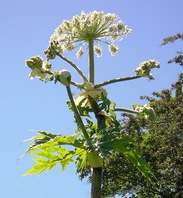 Noxious weeds to watch for in June.
If you’ve made it outside on a recent sunny day, you’ve probably noticed the abundance of flowers blooming in gardens, parks, forests, and throughout King County right now. Unfortunately, the noxious weeds are out there, too—many of them bolting, flowering, and even going to seed already. Click the link below to learn about some of the top regulated noxious weeds to keep an eye out for this month. Please let us know if you see one of these high-priority invasive plants, so we can make sure they’re controlled or eradicated in time! Report locations and share photos with us easily on our new and improved Report a Weed online form.
|
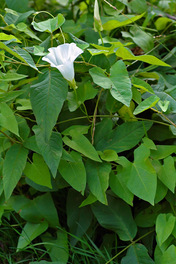 Invasive weeds that are ripe for action this time of year.
All over King County invasive weeds are on the move, growing in parks, gardens, roadsides, and many other places. Now is a perfect time to get outside, enjoy the sun, and eradicate them! Click the link below to learn about some important invasive and noxious weeds that are conspicuous this month. These species are generally non-regulated noxious weeds so there isn’t a requirement to control them in King County. However, they are all highly invasive and can cause big problems if left unchecked. With a little sweat, you can help make our neighborhoods healthier, safer, and more vibrant.
|
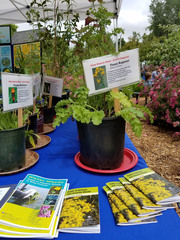 Find out about noxious weeds at a Farmers Market or summer event near you.
We have many dates scheduled at farmers markets around King County this summer, as well as a few big festivals. Our noxious weed information booth will have free weed guides and fact sheets and live weeds on display. Where else can you find noxious weeds labeled for your convenience and get your questions answered at the same time? If you have a community event that could use some noxious weed education, please let us know so we can get you on our schedule. Click below to go to our 2018 Events Calendar. Hope to see you soon!
|
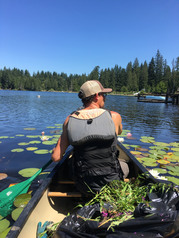 Does your lake have weeds?
There’s still time to sign up for our lake weed watcher class on June 25. Find out how to search for and identify weeds in the water at our Lake Weed Watcher training. All you need is curiosity about plants growing in the water, a small boat and a willingness to get out on the lake a few times during the summer. Our aquatic weed specialist Ben Peterson will teach what plants to look for, how to survey for them and what details to record to help us figure out which species you have. Who doesn’t like to scoop up a bunch of dripping wet plants out of the water and take a closer look? The class will be on June 25, 6:30-8:30 pm at Beaver Lake Lodge in Sammamish. Find out more and register online through the link below.
|
|
|
Sasha Shaw, King County Noxious Weed Control Program
Special thanks to contributing writer Nate Dolton-Thornton for much of the content of this issue. Please feel free to distribute this information freely and to contact me if you have any questions.
Thank you.
Sasha Shaw
King County Noxious Weed Control Program
sasha.shaw@kingcounty.gov
|
|


