|
|
|
|
Milk Thistle May 2018 Weed of the Month
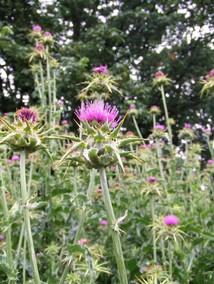 If you’ve ever walked barefoot in a field, chances are you’ve felt a thistle: those spiny-leaved plants that prick your feet and make you jump. Left unchecked, they produce purple or pink flowers at stem ends and plenty of seeds. Milk thistle (Silybum marianum) is no exception. Originally from parts of Europe and Asia, this Class A noxious weed is now invasive in North America, South Africa, Australia, and New Zealand, among other places. Luckily, it’s still pretty rare in King County (and all of Washington), growing mostly in pastures in the Enumclaw area and Pierce County, where it was likely introduced through contaminated out-of-state hay.
But once milk thistle shows up, it’s persistent. Seeds survive in soil an average of 16 years. One King County landowner eradicated a few plants from his pasture more than a decade ago. Last summer, he cleared a blackberry patch on the land. Earlier this spring, Weed Specialist Dan Sorensen found over 50 new plants growing in the cleared area!
|
|
|
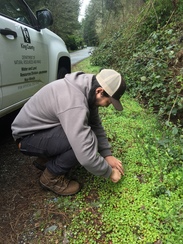 Noxious weed shiny geranium spreading on Vashon Island and other places in King County.
When noxious weed specialists Maria Winkler and Minwook Park drove down a quiet street on Vashon Island earlier this spring, they were alarmed to find a large, dense carpet of shiny geranium lining the road. It wasn’t the first time this Class B Noxious Weed had been found on Vashon, but in the past it had appeared to be limited to just a few properties. Unfortunately, this was only the first of several new large populations that Maria has found this spring, and these are possibly only the tip of the iceberg given the size of the island and how easily the plant spreads. Vashon residents (and everyone in King County) should watch for this noxious weed, report it, control it and, especially, make sure not to spread it.
|
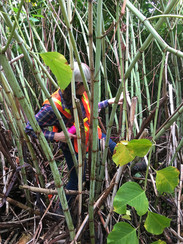 Got knotweed? Take a free class to learn how to control it!
Knotweed is one of the most invasive and difficult to control plants in King County. It can cause very direct impacts to your property such as taking over your backyard or damaging septic systems or foundations. It can also take over riparian areas, crowd out native vegetation and impact salmon habitat. And on top of all that, knotweed is seriously hard to control once it gets established. Our classes will teach you all about knotweed biology and the methods we have found that work to control it. We will also teach you how to use a knotweed stem injector that you can borrow from us for free. Learn more about the classes and sign up by clicking the link below.
|
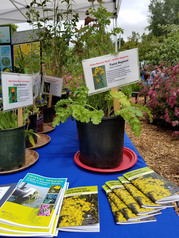 Find out about noxious weeds at a Farmers Market or summer event near you.
We have many dates scheduled at farmers markets around King County this summer, as well as a few big festivals. Our noxious weed information booth will have free weed guides and fact sheets and live weeds on display. Where else can you find noxious weeds labeled for your convenience and get your questions answered at the same time? If you have a community event that could use some noxious weed education, please let us know so we can get you on our schedule. Click below to go to our 2018 Events Calendar. Hope to see you soon!
|
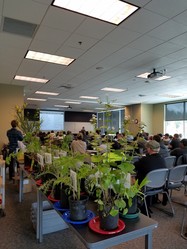 Evening workshop on noxious weed identification and control.
Our final spring workshop on noxious weeds will be on June 4 at the Renton Library, 6:30-8:30 pm. We will cover noxious weed and invasive plant identification and control. The class is helpful for people who are interested in controlling weeds for professional or personal reasons. For people with WSDA applicator licenses, the class has 2 WSDA pesticide recertification credits available. The class is free and open to everyone! Find out more and register online by clicking the link below.
|
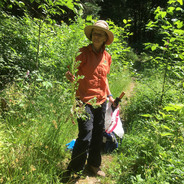 Learn how to save the wilderness from the scourge of invasive plants!
If hiking is your hobby and fighting invasive plants is your passion, you should consider Weed Watching! If you find yourself unable to look away from stinky bob along the hiking trail, or you can’t avoid noticing English ivy in the forest or knotweed on the river, then this is the perfect activity for you. King County is teaming up with Pacific Northwest Invasive Plant Council to offer two training classes for Weed Watchers (or the formal name – Citizen Science EDRR Volunteers). We will teach how to gather data – you can choose low-tech or high-tech – and how to identify the key invaders that public lands managers are working to control. Did you know that there are still forests in western Washington that are untouched by English ivy? Wouldn’t it be wonderful to keep it that way? Join us on June 3, 12:30-4:30 pm, in North Bend at the Snoqualmie District Ranger Station. Sign up and get more information by clicking on the link below.
|
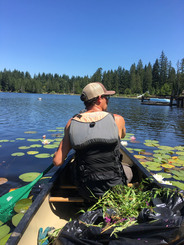 Does your lake have weeds?
Find out how to search for and identify weeds in the water at our Lake Weed Watcher training. All you need is curiosity about plants growing in the water, a small boat and a willingness to get out on the lake a few times during the summer. Our aquatic weed specialist Ben Peterson will teach what plants to look for, how to survey for them and what details to record to help us figure out which species you have. It is super important to find new water weeds early before they get established. Once a plant is widespread in a lake, it is almost impossible to get rid of it. When we find it early, we have a much better chance of stopping it. You can help keep community lakes free of new noxious weeds and have fun at the same time. Who doesn’t like to scoop up a bunch of dripping wet plants out of the water and take a closer look? The class will be on June 25, 6:30-8:30 pm at Beaver Lake Lodge in Sammamish. Find out more and register online through the link below.
|
|
|
Sasha Shaw, King County Noxious Weed Control Program
Please feel free to distribute this information freely and to contact me if you have any questions.
Thank you.
Sasha Shaw
King County Noxious Weed Control Program
sasha.shaw@kingcounty.gov
|
|


